
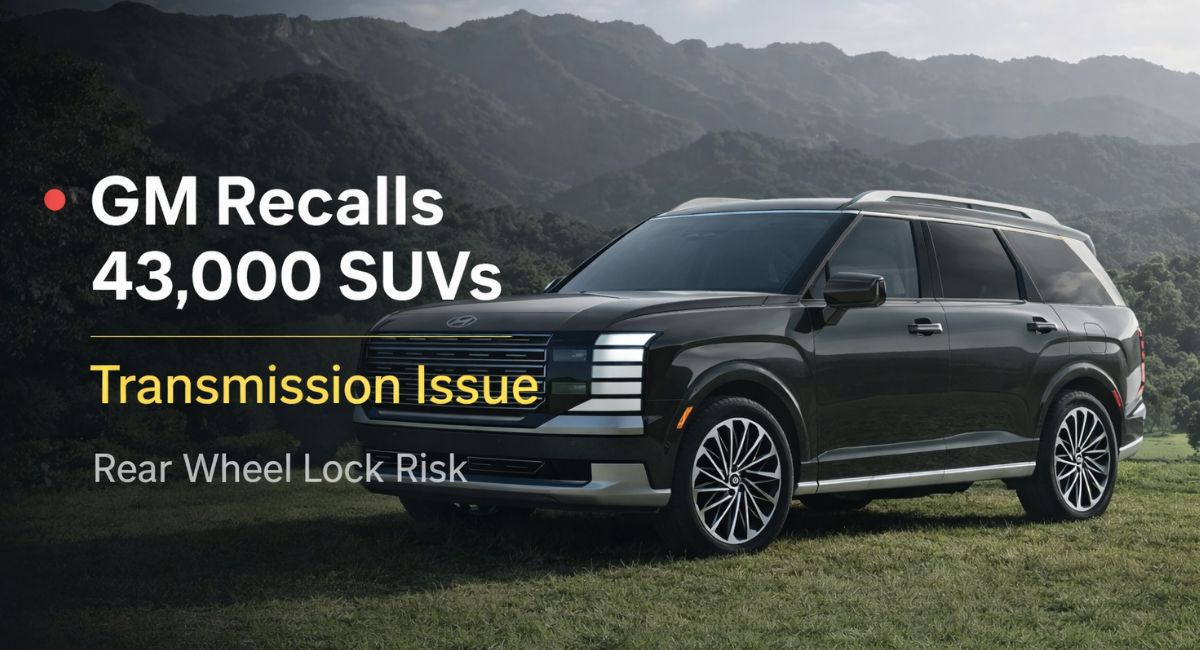
When a major automaker initiates a recall involving tens of thousands of vehicles, it immediately commands attention. The latest development sees GM Recalls 43,000 SUVs due to a transmission-related defect that can potentially lock the rear wheels — a serious safety risk that drivers cannot afford to ignore.
While recalls are not uncommon in the automotive industry, issues involving drivetrain components demand closer scrutiny. Transmissions play a critical role in vehicle stability, performance, and safety. When something goes wrong at that level, the implications extend far beyond routine inconvenience.
In this in-depth report, we examine what happened, which models are affected, the technical nature of the defect, potential safety implications, repair procedures, vehicle specifications, and what current owners should do next.
Understanding the Recall: What Triggered the Investigation?
The recall centers on a transmission defect that may cause the rear wheels to lock unexpectedly while driving. According to official recall documentation, the issue stems from an internal transmission component failure that can lead to a sudden loss of wheel rotation.
In practical terms, if the transmission experiences certain internal damage or malfunction, it could cause abrupt drivetrain behavior. In rear-wheel-drive and certain all-wheel-drive systems, this may result in the rear wheels locking while the vehicle is in motion.
Even a brief wheel lock at highway speeds can compromise stability, particularly during lane changes, acceleration, or wet-road conditions.
Which Vehicles Are Affected?
The recall involves approximately 43,000 SUVs manufactured within a specific production window. These vehicles share similar transmission architecture and drivetrain components.
Affected models include select variants from GM’s SUV portfolio equipped with specific automatic transmission units.
While exact trim levels vary, impacted vehicles typically feature:
- Rear-wheel drive (RWD) or all-wheel drive (AWD)
- Multi-speed automatic transmissions
- Mid-size to full-size SUV platforms
- Advanced electronic stability and traction systems
Owners can verify eligibility using their Vehicle Identification Number (VIN) through official dealer channels.?
Transmission System Overview: Why It Matters?
To understand the severity of the issue, it helps to briefly explain how modern automatic transmissions function.
Modern GM SUVs typically utilize electronically controlled automatic transmissions with:
- Multiple planetary gearsets
- Hydraulic torque converters
- Electronic shift solenoids
- Transmission control modules (TCM)
- Adaptive shift programming
These systems coordinate gear changes smoothly and efficiently. When functioning properly, the transmission distributes torque to the drivetrain in a controlled manner.
However, if an internal mechanical failure occurs — such as a damaged component affecting gear engagement — it can disrupt torque flow abruptly. In severe cases, this may cause a wheel lock condition.
Read more:- ATTACK SHARK X8 Gaming Mouse Review: The Large-Hand Powerhouse That Quietly Outperforms Premium Rivals
How a Transmission Issue Can Lock Rear Wheels?
A wheel lock scenario may occur if:
- Internal components fracture or seize
- Debris interferes with gear operation
- Torque transfer becomes abruptly restricted
- Gear engagement fails under load
When torque suddenly stops transferring to rotating wheels, especially at speed, it can create a brief locking sensation. The driver may experience:
- Sudden deceleration
- Skidding sensation
- Traction control activation
- Warning lights on the dashboard
Even if the lock is momentary, it poses a significant safety hazard.
Safety Implications: Assessing the Real-World Risk
Rear wheel lock can compromise:
- Steering stability
- Vehicle balance during acceleration
- Control on wet or slippery roads
- Highway maneuvering safety
Electronic stability control systems can mitigate some risks, but mechanical lock events can outpace electronic correction systems.
Importantly, the recall was issued proactively — before widespread incidents were reported. That indicates GM identified a potential risk pattern and acted to reduce future safety concerns.
Repair Process: What Dealers Will Do?
Owners affected by the recall will be notified by mail. The repair process typically includes:
- Transmission inspection
- Software diagnostics
- Replacement of defective components if necessary
- Possible full transmission replacement in severe cases
- Transmission fluid flush and refill
All recall repairs are performed free of charge.
Dealers may require:
- Vehicle inspection appointment
- Temporary vehicle drop-off
- Possible loaner vehicle depending on repair duration
Vehicle Specifications of Affected SUVs
While models vary slightly by trim and drivetrain configuration, typical specifications include:
Engine Options:
- 2.7L Turbocharged Inline-4
- 3.6L V6
- 5.3L V8 (select trims)
Transmission:
- 8-speed automatic transmission
- 10-speed automatic transmission (select configurations)
Drivetrain:
- Rear-Wheel Drive
- All-Wheel Drive
Horsepower Range:
- 310 hp to 420 hp (depending on engine)
Torque Output:
- 348 lb-ft to 460 lb-ft
Towing Capacity:
- Up to 8,400 lbs (when properly equipped)
These are powerful, high-torque vehicles — making transmission integrity especially critical.
Why This Recall Is Significant?
Large recalls often raise questions about manufacturing quality. However, context matters.
Automakers conduct extensive testing before vehicles reach market. Despite that, rare manufacturing variances or component defects can emerge over time.
The fact that GM Recalls 43,000 SUVs demonstrates:
- Active monitoring of field data
- Willingness to address safety risks proactively
- Regulatory compliance
- Commitment to customer safety
In the automotive industry, transparency and corrective action are critical indicators of manufacturer responsibility.
How GM Is Handling the Situation?
General Motors has established recall service protocols across its dealer network. The company:
- Issued formal recall documentation
- Notified regulatory agencies
- Provided technical repair bulletins to dealers
- Committed to covering repair costs
Such steps align with federal motor vehicle safety requirements.
Should Owners Stop Driving Their Vehicles?
In most recall cases, manufacturers provide guidance on continued vehicle operation.
Unless specifically instructed otherwise, owners may continue driving cautiously until repairs are performed. However, drivers should remain alert for:
- Unusual transmission noises
- Sudden deceleration
- Dashboard warning lights
- Harsh shifting
If any abnormal behavior occurs, the vehicle should be inspected immediately.
What This Means for Resale Value?
Recalls can temporarily influence resale perception. However:
- Recall repairs restore vehicle compliance
- Documentation improves buyer confidence
- Major manufacturers often maintain strong resale values
Once repaired, the long-term value impact is generally minimal.
Broader Industry Context
Transmission-related recalls are not unique to GM. Over the past decade, several major automakers have issued drivetrain-related recalls.
As vehicles become more complex — integrating advanced electronics, adaptive transmissions, and torque management systems — the margin for mechanical precision narrows.
This incident reflects industry-wide challenges in managing modern high-output drivetrain systems.
Owner Checklist: What To Do Now?
If you own one of the affected SUVs:
- Verify recall status using your VIN
- Schedule a dealer appointment promptly
- Avoid aggressive acceleration until repair
- Monitor for unusual drivetrain behavior
- Keep recall documentation for records
Being proactive ensures safety and protects long-term ownership value.
When GM Recalls 43,000 SUVs, it highlights the complex engineering challenges behind modern high-performance vehicles. Transmission systems are among the most intricate mechanical assemblies in any SUV.
The positive takeaway is that the issue was identified, documented, and addressed before widespread safety incidents occurred. For owners, the next step is simple: verify your vehicle and schedule the repair.
In today’s automotive landscape, proactive recalls demonstrate accountability — and ultimately reinforce long-term consumer trust.
FAQs
Why did GM recall 43,000 SUVs?
The recall addresses a transmission defect that could cause the rear wheels to lock unexpectedly, creating a potential safety risk.
Which GM SUVs are affected?
Select models equipped with specific automatic transmissions and produced within a certain manufacturing window are included. VIN verification is recommended.
Is it safe to drive an affected SUV?
In most cases, yes — but drivers should schedule repairs promptly and remain alert for unusual transmission behavior.
Will GM replace the entire transmission?
If inspection determines severe internal damage, a full transmission replacement may occur. Otherwise, component repair or updates may suffice.