
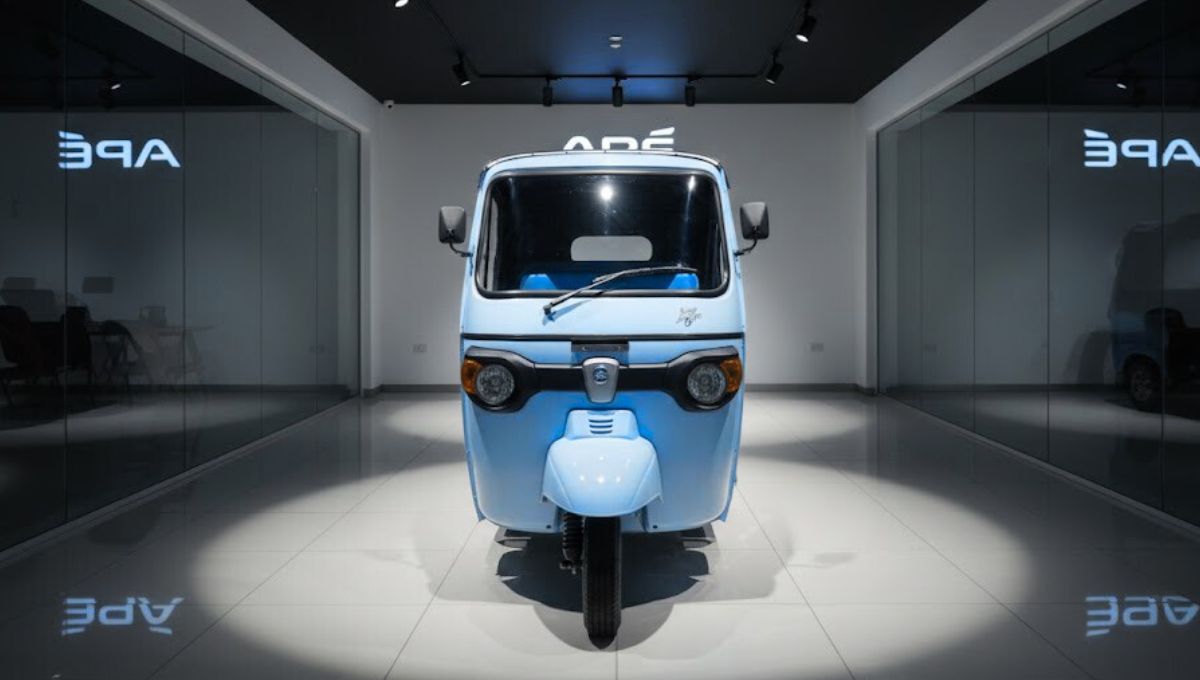
What is the Apé Electric Auto?
The Apé Electric Auto refers to the electric three-wheeler range from Piaggio — designed for passenger transport — that uses a swappable lithium-ion battery rather than a fixed fuel tank or fixed battery alone. Instead of refuelling with petrol or waiting for long charging cycles, drivers can replace depleted batteries with fresh, fully charged ones. This approach offers a more flexible, low-maintenance, and eco-friendly alternative to traditional autorickshaws.
Among the models, the one commonly referred to under this umbrella is Piaggio Ape E-City FX Max — a passenger-carrying electric auto rickshaw with battery swap capability and features tuned for urban mobility.
Key Features and Technical Specifications
Here are the main technical specs and characteristics of the Apé Electric Auto (particularly the Ape E-City FX Max)
- Battery & Motor: Uses a lithium-ion battery (48 V or 51.2 V, depending on variant) with a capacity of up to 8 kWh in certain versions. The electric motor produces a peak power of about 5.44 kW and a peak torque of around 29 Nm.
- Seating Capacity: Driver plus up to 3 passengers (D + 3 seater) — making it suitable for typical small-group transport or shared rides.
- Performance: The top speed is around 50 km/h. The typical driving range per full battery or swap can be up to 145 km (on certain 8 kWh battery versions under favorable conditions).
- Charging / Battery Swap: Battery swap reduces downtime compared to conventional charging — rather than waiting for long charging cycles, a driver can quickly get a fresh battery and resume work. For home charging (when needed), a 48 V / 3000 W off-board charger takes about 3 hours 45 minutes for a full charge (depending on battery state).
- Build & Design: Built as a “fully built” passenger vehicle with standard three-wheeler dimensions (length ~2700 mm, width ~1370 mm, height ~1725 mm), making it compact and easy to navigate through narrow lanes and congested city traffic.
- Environment & Drive Quality: As an electric vehicle, the Apé Electric Auto produces zero tailpipe emissions and operates quietly, providing pollution-free and low-noise transport — a big advantage in urban areas.
Beyond just the basic specs, the swappable battery design adds important practical benefits for drivers and fleet operators — which we explore next.
Why Swappable Battery Matters, Benefits of the Apé Electric Auto
1. Less Downtime, More Productivity
With a swappable battery, the downtime that comes with charging is significantly reduced. Instead of waiting hours for charging, the driver can swap in a fully charged battery and get back on the road — maximizing daily operating hours. This is especially useful for commercial use where time is money.
2. Flexibility and Convenience
Drivers don’t need to rely solely on charging stations; they can rotate batteries, possibly using off-peak hours (like at night) for charging, and keep working during the day. For fleet owners, this can simplify operations and scheduling.
3. Eco-Friendly and Quiet Operation
Being fully electric, the Apé Electric Auto emits no tailpipe pollution and creates minimal noise — benefiting both passengers and city environments. This supports cleaner air in congested urban areas and contributes to sustainable transport goals.
Read more:- Apé Auto DX: The Smart and Powerful Passenger Auto for Modern India
4. Cost Efficiency and Lower Maintenance
Electric motors generally require less maintenance than internal combustion engines (no oil changes, fewer moving parts, etc.). Coupled with the swappable battery system, this can reduce overall running costs, making it attractive for small business owners or shared-ride operators.
5. Economic Passenger Transport Option
With seating for up to 3 passengers (plus driver), the Apé Electric Auto is well-suited for intra-city passenger transport or shared-ride services. Its compact build and decent range make it practical for daily urban commuting or short-distance transport needs.
Practical Use Cases — Who Can Benefit from Apé Electric Auto?
- Urban autorickshaw operators & fleet owners: Those who run passenger-car autos in cities can reduce running costs and avoid fuel price fluctuations.
- Shared-ride or ride-hailing services: For services operating in cities, this can be a greener and more economical alternative to petrol/diesel autos.
- Small business owners or transport-service providers: For transporting small groups of people (e.g., school commute, staff transport, short-distance rides), the Apé Electric Auto offers a compact and efficient solution.
- Eco-conscious individuals/communities: Anyone looking to reduce their carbon footprint and support electric mobility, especially in dense urban areas with air pollution issues, may consider this vehicle as a sustainable alternative.
Challenges or Considerations
While Apé Electric Auto brings many advantages, there are a few practical factors to consider:
- Battery Infrastructure: For swappable battery systems to be effective, there must be a reliable infrastructure — enough charged batteries and swap stations in accessible locations. Without this, drivers might still face downtime or limited range.
- Load & Passenger Limits: As a small three-wheeler with limited passenger capacity, it may not be suitable for heavy cargo or large-group transport.
- Peak Load / Terrain Impact: Performance (range and power) may vary depending on load, number of passengers, road conditions or terrain — especially in hilly areas or heavy traffic, which could reduce effective range.
- Initial Costs & Battery Management: Though maintenance is lower, the initial purchase cost (or subscription for battery swapping, if implemented) needs to be weighed. Also, proper battery care and charging habits are required to maximize battery life.
Final Thoughts
The Apé Electric Auto represents a smart shift in urban mobility — combining compact dimensions, electric efficiency, and the practicality of swappable batteries. For city-based transport, shared rides, small fleets, or eco-conscious drivers, it offers a compelling blend of cost savings, convenience, and environmental benefit. While the success of such a vehicle depends on supportive infrastructure (battery swap stations, proper maintenance, and charging facilities), it is one of the promising ways forward for cleaner, quieter, and more efficient urban commuting — especially in crowded cities where conventional autorickshaws contribute to pollution and congestion.