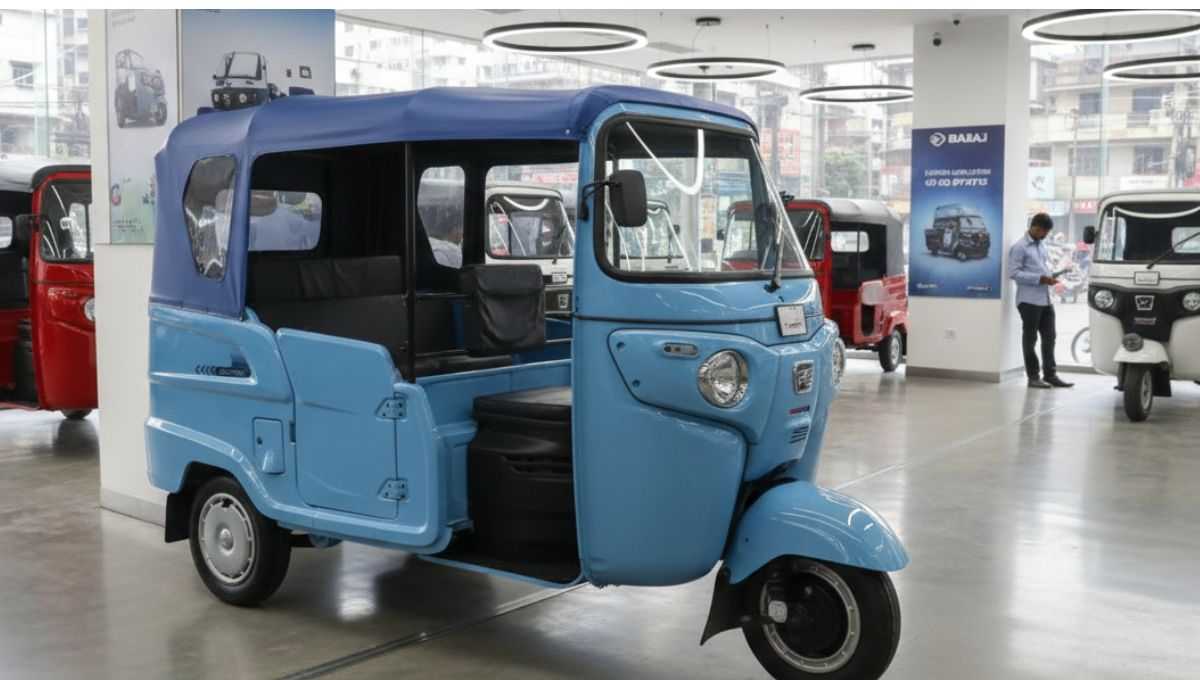
Bajaj GoGo is the all-new electric three-wheeler brand launched by Bajaj Auto in February 2025. GoGo is designed to cater to both passenger and cargo needs — although at launch the company introduced only passenger variants, with cargo versions planned for later.
As of now, the GoGo line-up consists of three variants: P5009, P5012, and P7012. In the naming scheme:
- “P” denotes passenger category.
- “50” or “70” indicates the size class (compact vs larger).
- “09” or “12” reflect battery capacity: ~9 kWh or ~12 kWh.
Technical Specs & Features
Here’s a breakdown of the key specs and features of the GoGo variants:
| Variant | Battery / Capacity | Range (single charge) | Key Features |
|---|---|---|---|
| P5009 | ~9.2 kWh | ~176 km | 36 Nm torque; two-speed automated transmission; basic safety & lighting |
| P5012 | ~12.1 kWh | ~248 km | 36 Nm torque; better range; same transmission & safety/lighting features |
| P7012 | ~12.1 kWh (larger body) | Up to ~251 km (best-in-class in segment) | 36 Nm torque; two-speed automated transmission; full-metal body; improved passenger space; LED lights; advanced safety features |
Standout Features — What Makes GoGo Special
- Two-speed automated transmission: Helps with better efficiency and climbing ability on inclines — a first in this segment.
- Safety & convenience features: GoGo offers first-in-class features such as auto-hazard warning, anti-roll detection, LED lighting, and hill-hold assist.
- Full-metal durable body: Designed for Indian road conditions, likely to be more robust than many conventional auto-rickshaws.
- 5-year battery warranty: Bajaj promises a five-year battery warranty — providing peace of mind for operators who rely on regular incomes.
- Optional Premium “TecPac” pack: Offers extra features like remote immobilization, reverse assist — useful for fleet operators.
With these features, GoGo aims to deliver a reliable, cost-effective, and modern alternative to traditional fuel-based auto-rickshaws.
Pricing & Market Launch
At launch, GoGo’s passenger variants were priced (ex-showroom, Delhi) as follows:
- P5009 — ₹ 3,26,797
- P7012 — ₹ 3,83,004 Bookings opened across all Bajaj Auto dealerships pan-India soon after launch.
Bajaj Auto has indicated that cargo variants (for goods/ freight) will be launched later — expanding GoGo’s usability beyond passenger transport.
Early Market Response & Impact
The launch of GoGo has had an immediate and strong impact on the Indian electric three-wheeler (3W) market:
- Within months of launch, GoGo helped Bajaj Auto secure a 36% share of India’s electric three-wheeler market (L5 segment) as of April 2025.
- In the passenger e-3W segment, Bajaj claims even 39% share — signaling strong acceptance among buyers and operators.
- Sales numbers back this — in April 2025 alone, the company sold 5,506 units of electric three-wheelers under GoGo.
Such rapid adoption suggests that GoGo met a real need for affordable, efficient, and reliable electric autos suitable for Indian conditions.
Why GoGo Matters: Implications for Mobility in India
For Drivers / Auto-Operators
- Lower running cost: Electric autos mean significant savings compared to petrol or CNG fuel — electricity cost is lower, and maintenance tends to be simpler.
- Higher earning potential: Low operating costs + decent range = more rides per charge, and less downtime.
- Less maintenance & longer life: Full-metal body, robust build and 5-year battery warranty reduce long-term costs and hassles.
For Environment & Cities
- Zero tailpipe emissions: Helps reduce pollution in dense urban areas — cleaner air for cities.
- Support for sustainable transport push: As India pushes EV adoption, vehicles like GoGo support last-mile connectivity without sacrificing convenience.
For the EV Market & Industry
- Benchmark for e-3W segment: GoGo sets a new standard (longest range, better build, modern features) — pushing other manufacturers to upgrade offerings.
- Encouraging shift from ICE to EV Autos: Demonstrates that EV autos aren’t just experimental — they can be practical, profitable, and scalable.
Considerations & What to Watch Out For
While GoGo offers many advantages, there are a few practical considerations:
- Charging infrastructure: Operators need access to reliable charging — especially important for long-range claims to translate into real-world daily usage.
- Initial cost vs ICE autos / used autos: Though cheaper over time, upfront cost is still significant vs used ICE autos or second-hand rickshaws.
- Cargo variants not yet launched: For businesses needing cargo transport, they’ll have to wait until cargo versions become available under GoGo.
GoGo vs Competitors — Quick Comparison
Mahindra Treo (and variants)
- Price (approx.): ₹ 2.92–3.02 lakh ex-showroom.
- Battery / Motor / Range: Lithium-ion battery ~7.37 kWh; certified/claimed range ~130–141 km per charge.
- Top Speed: ~55 km/h.
- Other Features: Direct-drive transmission (less vibration, simpler maintenance), decent suspension setup (helical springs + hydraulic shock absorbers), compact size — good for narrow streets and dense urban areas.
Pros
- Lower entry cost compared to premium 3-wheelers.
- Lower operating/maintenance cost (smaller battery, simpler setup).
- Good for short or moderate urban trips; manoeuvrable and suitable for tight, crowded areas.
Cons
- Much shorter range compared to high-range EV 3Ws — may need frequent recharging on busy operation days.
- Smaller battery/motor — may struggle with heavy loads or repeated full-day usage compared to bigger 3Ws.
Piaggio Ape E‑City FX Max / Piaggio Ape E‑City Ultra
- Price (approx.): FX Max ~₹ 3.30 lakh, Ultra ~₹ 3.88 lakh (ex-showroom).
- Battery / Motor / Range:
- FX Max: ~8.0 kWh battery, 7.4 kW motor, range ~174 km.
- Ultra: ~10.2 kWh LFP battery, 9.55 kW motor, certified range up to ~236 km.
- Performance / Features: Top speed ~50–55 km/h; good gradeability/climb-assist (useful in slopes/flyovers); full-metal body; 4G telematics, remote immobilization, digital instrumentation.
Pros
- Very good range — FX Max and particularly Ultra can cover long city routes or heavy usage days without frequent recharging.
- Strong motor and torque — better for fully loaded trips or frequent start-stop city driving.
- Modern features: telematics, remote monitoring, build quality — useful for fleet owners or commercial operators.
Cons
- Higher upfront cost compared to budget e-rickshaws like Treo.
- Slightly bulkier than small e-rickshaws — might be less nimble in narrow lanes or congested roads.
Montra Electric Super Auto (2025 model)
- Price (approx.): ₹ 3.79 lakh ex-showroom (post-subsidy) for base variant.
- Battery / Range / Performance: Claimed range up to ~160 km per charge. — Some variants reportedly achieve ~203 km (with larger battery pack).
- Features: LED headlamps, tubeless radial tyres, re-engineered suspension for a smoother ride, updated cabin, connected platform (“One Montra Electric”) for real-time data and charging-station info.
Pros
- Balanced offering: decent range and performance for daily operations without going to premium price bracket.
- Modern comforts and safety/upgrades — good for drivers and passengers alike.
- Good candidate for medium-distance city runs or for users needing more range than basic e-rickshaws.
Cons
- Price is moderate-high; upfront cost may be a factor for small-scale operators.
- Real-world range will likely depend heavily on load, traffic and driving patterns — may be less than claimed 160–200 km.
Bajaj GoGo (GoGo P50 / P70 series)
- Range & Performance: As per manufacturer claims, GoGo offers up to ~248–251 km per charge (in higher battery/size variants) — among the highest in passenger EV-3W segment in India.
- Market Response: According to recent data, GoGo helped Bajaj Auto secure ~36% share in India’s electric 3-wheeler market soon after launch.
- Use Case: With high range, relatively modern EV tech, and brand backing, GoGo seems suited for heavy usage — full-day city commuting, last-mile passenger transport, fleet operations.
Pros
- Among the best range per charge in its class — reduces dependency on frequent charging, good for long shift operations.
- Backed by brand and wide dealer/service network (assuming from Bajaj’s reach) — useful for long-term reliability.
- Likely well-suited for daily high-usage patterns (multiple trips, long hours).
Cons / What to watch out for
- Being a newer entrant, real-world performance (ride quality, after-sales service in small towns) is yet to be fully established.
- Higher-range/battery vehicles may cost more upfront compared to basic e-rickshaws; electricity costs & charging infrastructure matter.
Summary Comparison (When to Choose What)
| Your Requirement / Use | Best Option(s) |
|---|---|
| Low upfront investment / short intra-city trips / narrow lanes | Mahindra Treo |
| Balanced price + range + reliability (fleet use, moderate city routes) | Montra Super Auto; Piaggio Ape FX Maxx |
| Long daily usage, many trips, need high range / heavy usage / potentially full-day shifts | Bajaj GoGo; Piaggio Ape E-City Ultra |
| Need stronger motor / power / better build and optionally better gradeability (for hills / heavier loads) | Piaggio Ape E-City models; GoGo (higher variants) |
My View — How GoGo Stands Out (and Tradeoffs)
- GoGo’s long range is a major advantage over many basic & mid-range e-rickshaws — this reduces “range anxiety,” especially for operators doing many trips or long hours.
- Compared with budget options (like Treo), GoGo likely offers better total value in the long term if you cover high daily kilometers.
- However, if your use is limited to short daily runs, narrow roads (like many parts of West Bengal), or you want the lowest investment/maintenance, simpler e-rickshaws may still make sense.
- Also, charging infrastructure and electricity price where you operate matter a lot: with high-capacity batteries, you need reliable access to charging to realize the benefits fully.
Bajaj GoGo represents a bold and timely push by a legacy automaker into India’s electric mobility future. With competitive pricing, modern features, and a focus on reliability and practicality, GoGo has already disrupted the electric three-wheeler segment within months of launch.
For passengers, operators, and urban mobility alike, GoGo offers a glimpse into what EV-driven last-mile transport could — and perhaps should — look like: efficient, clean, and built for Indian roads.