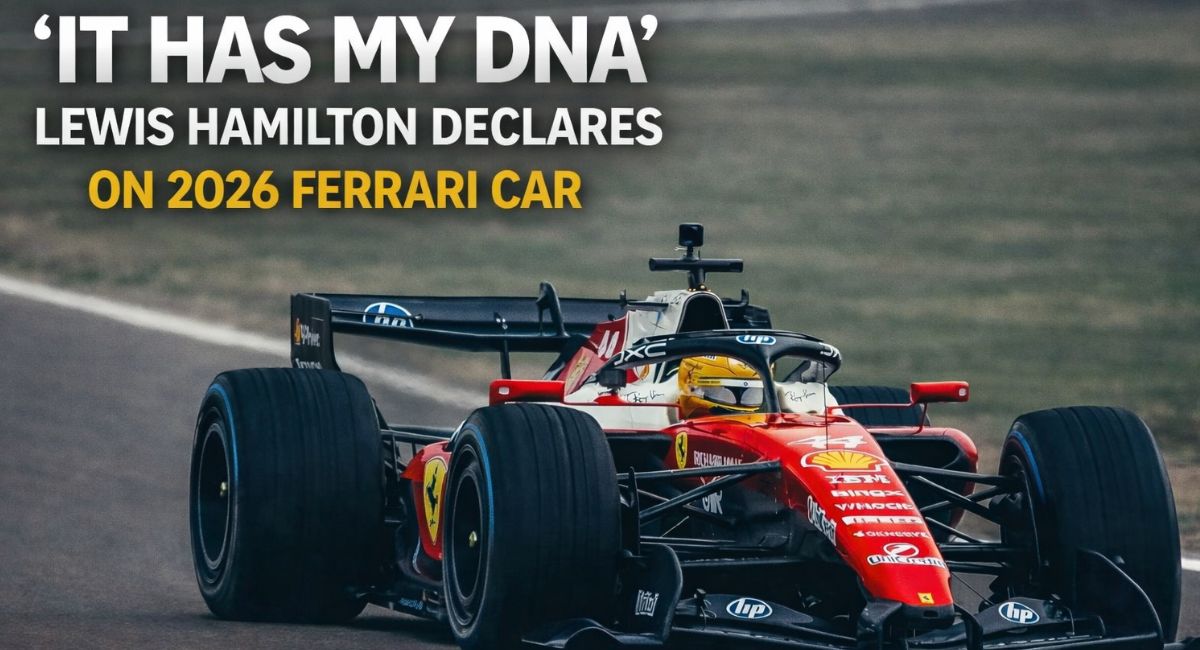
When Lewis Hamilton declared that the 2026 Ferrari car has his ‘DNA,’ it was more than a confident soundbite. It was a statement layered with intent, symbolism, and technical implication. In Formula 1, drivers influence machinery in countless subtle ways. But for a seven-time world champion to suggest that Ferrari’s next-generation car carries his imprint signals something far more strategic.
The 2026 season represents a seismic shift in Formula 1 regulations. New power unit rules, revised aerodynamics, and evolving sustainability requirements will reset the competitive order. Against that backdrop, Hamilton’s assertion positions him not merely as a driver switching teams—but as a co-architect of Ferrari’s future.
In this in-depth analysis, we explore what it truly means when Hamilton says the Ferrari car has his ‘DNA,’ how driver feedback shapes F1 engineering, what the 2026 technical regulations demand, and why this partnership could redefine the competitive landscape.
The Significance of 2026 in Formula 1
The 2026 regulations are not incremental tweaks—they are structural changes. The sport is introducing:
- Revised aerodynamic philosophies
- Lighter chassis targets
- Greater electrical power contribution
- Fully sustainable fuel integration
- Simplified hybrid systems
Power units will shift toward a 50/50 split between internal combustion and electric output. Energy recovery systems will become more influential. Aerodynamic drag reduction systems will evolve.
For teams like Ferrari, this represents a rare opportunity: a reset button.
When Hamilton says the Ferrari car has his ‘DNA,’ it suggests his feedback has influenced how Ferrari interprets these sweeping changes.
What Does “DNA” Mean in Formula 1 Terms?
In motorsport language, DNA is not about branding—it is about driving characteristics.
A car that carries a driver’s “DNA” typically reflects:
- Preferred steering feel
- Brake balance characteristics
- Rear-end stability under acceleration
- Front-end responsiveness on turn-in
- Suspension setup philosophy
- Energy deployment preferences
Lewis Hamilton is known for:
- Exceptional sensitivity to brake modulation
- Preference for a stable rear platform
- Smooth corner entry technique
- Ability to adapt but strong preference for predictable balance
If the 2026 Ferrari car has his ‘DNA,’ engineers likely tailored development priorities around those traits.
Hamilton’s Development Legacy
Throughout his career, Hamilton has shaped championship-winning machines.
His strengths include:
- Detailed simulator feedback
- Tire management insight
- Sensitivity to aerodynamic balance shifts
- Deep understanding of hybrid energy deployment
Championship cars are rarely built in isolation. Drivers contribute to:
- Setup direction
- Mid-season upgrades
- Long-term architecture decisions
At Ferrari, his involvement reportedly extends into early-stage development cycles—a crucial factor given the magnitude of the 2026 regulation overhaul.
Ferrari’s Strategic Rebuild
Ferrari’s ambitions in the hybrid era have fluctuated. Moments of promise have been offset by inconsistency.
The 2026 project is understood to involve:
- A fully redesigned power unit
- Reworked chassis concept
- Revised aerodynamic package
- Integration of sustainable fuels
- Enhanced energy deployment systems
Hamilton’s arrival aligns perfectly with this rebuild.
When he says the Ferrari car has his ‘DNA,’ it suggests he has influenced not only setup preferences but potentially broader design philosophy decisions.
Read more:- 2026 Nissan Gravite Vs Renault Triber: Same Roots, Different Personalities? A Deep Dive Comparison
Technical Specifications: What We Know About the 2026 Ferrari Concept?
While official specifications remain confidential, based on regulatory frameworks and industry insight, the 2026 Ferrari car is expected to feature:
Power Unit Architecture:
- 1.6L turbocharged V6 internal combustion engine
- Increased electric motor contribution
- Removal of the MGU-H
- Expanded MGU-K power output
Fuel System:
- 100% sustainable fuel
Chassis Changes:
- Lighter overall car weight target
- Revised floor aerodynamics
- Reduced drag philosophy
- Active aero components under consideration
Energy Deployment Strategy:
- Enhanced battery storage
- Aggressive energy harvesting
- Optimized power distribution mapping
Driver input influences how these components interact dynamically.
Why Driver Feedback Matters More in 2026?
With greater electrical reliance, throttle response characteristics will change. Energy harvesting and deployment patterns become more complex.
A driver like Hamilton—who excels at managing hybrid systems—can shape:
- Deployment mapping during corner exits
- Brake-by-wire calibration
- Energy regeneration balance
- Power delivery smoothness
If Ferrari’s engineers built systems around his strengths, that’s the “DNA” he refers to.
Psychological Impact of the Statement
Beyond technical meaning, the statement carries psychological weight.
In Formula 1:
- Confidence influences performance
- Team belief impacts morale
- Leadership shapes culture
By asserting ownership of the project, Hamilton signals commitment. That can galvanize engineers, mechanics, and management.
Ferrari thrives on belief. The narrative of a champion embedding himself into the team’s future strengthens internal unity.
Adapting Ferrari to Hamilton’s Driving Style
Ferrari cars historically exhibit:
- Aggressive front-end turn-in
- Sensitive rear balance
- Strong mid-corner rotation
Hamilton typically favors:
- Predictable rear grip
- Stable braking platform
- Smooth torque delivery
If the Ferrari car has his ‘DNA,’ it likely balances Ferrari’s natural sharpness with increased rear stability and braking confidence.
This blend could produce a uniquely competitive package.
The Maranello Factor
Ferrari’s facilities in Maranello represent decades of racing heritage. However, modern Formula 1 success requires more than tradition.
The 2026 project reportedly involves:
- Wind tunnel refinements
- Simulator upgrades
- Data modeling expansion
- Hybrid system innovation
Hamilton’s experience with cutting-edge development processes adds external insight.
When he says the Ferrari car has his ‘DNA,’ it may reflect collaborative alignment between driver and technical department.
Championship Implications
A regulation reset often disrupts dominance hierarchies.
In 2009, 2014, and 2022, new rules reshaped the grid.
2026 could do the same.
If Ferrari successfully integrates:
- Competitive power output
- Efficient energy recovery
- Stable aerodynamic balance
- Driver-optimized setup characteristics
They may position themselves as immediate title contenders.
Hamilton’s involvement increases that possibility.
Risk Factors
No matter how promising development appears, risks remain:
- Power unit reliability challenges
- Cooling integration difficulties
- Battery management complexity
- Weight distribution constraints
Even a car with a driver’s ‘DNA’ must overcome engineering realities.
Formula 1 margins are razor-thin.
Commercial and Brand Value
Hamilton joining Ferrari was already commercially seismic. His statement enhances that narrative.
Brand advantages include:
- Global media amplification
- Increased sponsor engagement
- Cultural crossover appeal
- Youth audience expansion
But ultimately, results determine legacy.
The phrase Ferrari car has his ‘DNA’ raises expectations accordingly.
Can Driver DNA Guarantee Success?
No driver influence guarantees championships.
However, successful F1 projects require:
- Alignment between driver and engineering
- Early development clarity
- Unified technical direction
- Confidence in car philosophy
If Ferrari truly built the 2026 car around Hamilton’s preferences, it reduces adaptation time.
And in a new regulation era, time matters.
Long-Term Legacy Considerations
For Hamilton, this chapter carries historical weight.
Success at Ferrari would:
- Cement multi-team championship legacy
- Enhance historical comparisons
- Reinforce adaptability credentials
For Ferrari, pairing its iconic heritage with Hamilton’s global stature could redefine modern identity.
When Lewis Hamilton says the Ferrari car has his ‘DNA,’ he signals involvement, belief, and ownership.
In Formula 1, championships are rarely accidental. They are engineered through alignment—between driver, engineers, management, and regulation interpretation.
The 2026 season will test that alignment.
If Ferrari’s technical direction truly reflects Hamilton’s strengths, the partnership could usher in a transformative era. If not, expectations may turn into pressure.
Either way, one thing is clear: the project is personal.
And in Formula 1, personal investment often fuels extraordinary performance.
FAQs
What does Lewis Hamilton mean when he says the Ferrari car has his ‘DNA’?
It means the car’s development reflects his driving preferences, feedback, and technical input, influencing balance, energy deployment, and handling characteristics.
What changes are coming to Formula 1 in 2026?
The 2026 regulations introduce revised aerodynamics, increased electric power contribution, sustainable fuels, and simplified hybrid systems.
Will the 2026 Ferrari be competitive?
While performance remains unproven, regulation resets create opportunities for teams that interpret rules effectively.
How much influence does a driver have on car design?
Top drivers contribute significant feedback during simulator sessions, testing phases, and development meetings, shaping setup philosophy and refinement.