
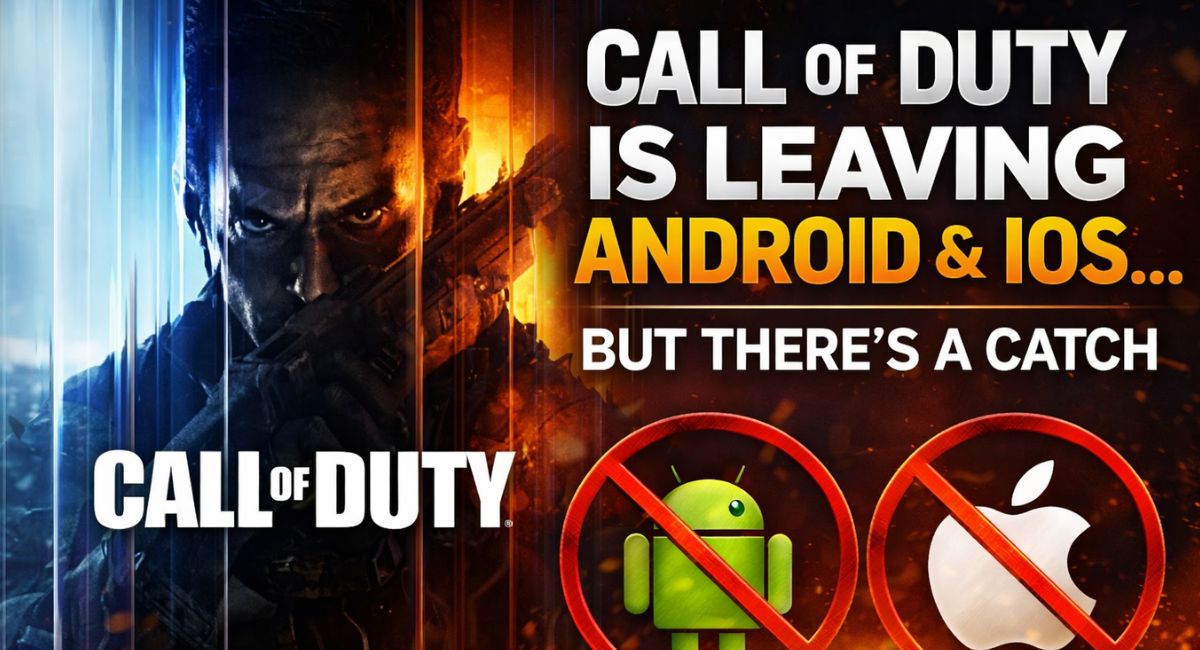
Few gaming franchises command global attention like Call of Duty. For over two decades, the series has defined competitive shooters across consoles and PC. When it expanded to mobile devices, it reshaped expectations for what smartphone gaming could achieve.
Now, reports that Call of Duty is leaving Android and iOS have triggered confusion, concern, and intense speculation. But the reality is more nuanced. This is not a sudden disappearance. It is a strategic transition — and there is indeed a catch.
In this in-depth analysis, we break down what’s happening, why it’s happening, how it affects players, and what it reveals about the future of mobile gaming within the Call of Duty ecosystem.
Understanding the Headlines: Is Call of Duty Really Leaving Mobile?
The statement that Call of Duty is “leaving” Android and iOS requires context.
The franchise itself is not disappearing from mobile entirely. Instead, the change centers around restructuring, platform realignment, and long-term strategic direction.
For years, Call of Duty: Mobile delivered console-quality gameplay on smartphones. It offered multiplayer modes, battle royale, ranked seasons, weapon progression, and cosmetic customization — all optimized for touchscreen controls.
However, the mobile gaming landscape has evolved rapidly:
- Hardware capabilities have increased
- Cross-platform ecosystems have expanded
- Cloud gaming infrastructure has matured
- Player expectations for parity with console versions have grown
The reported departure reflects a pivot rather than a shutdown.
The Rise of Call of Duty on Mobile
When Call of Duty: Mobile launched, it achieved something rare. It successfully translated the franchise’s fast-paced gunplay into a mobile format without sacrificing competitive depth.
The game featured:
- Iconic maps like Nuketown and Crash
- Ranked multiplayer modes
- 100-player battle royale
- Seasonal battle passes
- Controller support
- Regular content updates
It quickly amassed millions of downloads and became one of the most successful shooter titles on mobile platforms.
So why step away from Android and iOS?
The Catch: It’s About Consolidation, Not Abandonment
The critical nuance is this: Call of Duty is not exiting the mobile market entirely. Instead, the franchise appears to be consolidating its ecosystem around newer infrastructure and possibly more unified platforms.
There are three likely factors behind the move:
1. Strategic Ecosystem Alignment
The Call of Duty franchise now operates across:
- Console
- PC
- Cloud services
- Subscription ecosystems
Maintaining separate development pipelines for standalone mobile builds may no longer align with long-term goals.
2. Focus on New Mobile Initiatives
With next-generation mobile hardware, developers may be shifting toward a more integrated or cloud-powered version of Call of Duty that connects directly with console ecosystems.
Rather than maintaining a legacy mobile framework, resources could be redirected to a more scalable future solution.
3. Infrastructure Evolution
Mobile gaming increasingly overlaps with:
- Cloud gaming platforms
- Cross-progression systems
- Unified accounts
- Shared seasonal content
Leaving Android and iOS in their traditional standalone form could signal a move toward deeper integration with broader franchise architecture.
Read more:- DJI Neo Review: Is This the Beginner Drone That Finally Gets Everything Right?
What Happens to Existing Players?
Naturally, the biggest concern for players is progression and purchased content.
If a mobile version transitions or sunsets, players typically want clarity on:
- Account preservation
- Purchased skins and battle passes
- Rank progression
- In-game currency balances
Historically, major franchises offer migration options, especially when transitioning platforms.
It is reasonable to expect that Call of Duty’s developers will prioritize user trust by:
- Communicating transition timelines clearly
- Offering account migration tools
- Preserving cross-progression where possible
Player retention depends heavily on continuity.
Technical Specifications: What Mobile Call of Duty Required?
To understand the shift, it helps to revisit what the mobile version required from devices.
Call of Duty: Mobile Technical Specs (Typical Requirements)
Operating System:
Android 5.1+ / iOS 9.0+
RAM:
Minimum 2GB (recommended 3GB or higher)
Storage Space:
Approximately 2GB to 3GB, depending on updates
Graphics:
Mid-range to high-end mobile GPU for optimal performance
Internet Connection:
Stable broadband or 4G/5G connection
Over time, as graphical fidelity improved, the performance demands increased. Maintaining optimization across thousands of device models can become increasingly complex and costly.
A platform consolidation strategy may reduce fragmentation.
The Bigger Picture: Mobile Gaming Is Changing
Mobile gaming today is not what it was five years ago.
The lines between platforms are blurring.
Players expect:
- Shared progression across devices
- Unified seasonal events
- Cross-play compatibility
- Graphical parity with consoles
If Call of Duty is repositioning itself within this environment, the move may actually strengthen its long-term mobile presence — even if it temporarily disrupts the current model.
Cloud Gaming as the Future Gateway?
One potential direction is deeper reliance on cloud streaming.
With faster internet speeds and improved compression technology, high-end console experiences can now be streamed to mobile devices.
Advantages include:
- No heavy local storage requirements
- Reduced hardware fragmentation
- Easier content updates
- Visual consistency across devices
Instead of optimizing for thousands of smartphone configurations, developers can deliver a standardized experience via cloud infrastructure.
This could be the strategic “catch” behind the headline.
Competitive Landscape Pressures
The mobile shooter market is intensely competitive.
Rivals constantly innovate in:
- Graphics engines
- Live-service models
- Monetization strategies
- Social integration
Sustaining dominance requires continuous reinvestment.
If Call of Duty is reallocating resources toward larger ecosystem integration, it may be aiming to protect long-term brand strength rather than maintain short-term mobile independence.
Player Trust and Brand Longevity
Call of Duty is not a short-term brand. It is a multi-generational franchise.
Decisions affecting Android and iOS users must be handled carefully to avoid:
- Community backlash
- Reputation damage
- Revenue decline
Transparent communication will be key.
Historically, the franchise has demonstrated adaptability — evolving from traditional single-player campaigns to online multiplayer dominance, then to battle royale integration.
This may simply be the next evolution.
Economic Considerations Behind the Move
Maintaining a live-service mobile game involves:
- Ongoing server costs
- Device compatibility testing
- Security updates
- Anti-cheat systems
- Content development
As development priorities shift, companies often consolidate to improve efficiency.
If a new integrated model promises:
- Broader monetization potential
- Cross-platform synergy
- Lower operational fragmentation
Then restructuring makes financial sense.
Is This the End of Mobile Call of Duty?
It is highly unlikely that Call of Duty will permanently abandon mobile audiences.
The mobile market represents:
- Billions of potential players
- Massive in-app revenue streams
- Rapid global expansion opportunities
More realistically, this is a pivot toward a new mobile strategy rather than a withdrawal.
What Players Should Watch For Next?
Players should monitor announcements related to:
- Account migration tools
- Cloud gaming support
- Cross-platform unification
- New mobile entry points
- Release timelines for updated experiences
Transitions often come with beta testing phases and phased rollouts.
Industry Implications
This development highlights a broader industry truth:
Gaming ecosystems are consolidating.
Instead of isolated platform versions, companies are increasingly building unified ecosystems that span:
- Console
- PC
- Mobile
- Cloud
- Subscription services
Call of Duty may be aligning with this trend.
A Strategic Pivot, Not a Goodbye
The headline that Call of Duty is leaving Android and iOS sounds dramatic. But the deeper story reveals a calculated move toward ecosystem integration and long-term scalability.
For players, the key takeaway is this:
The franchise is evolving, not disappearing.
As gaming infrastructure modernizes and platform boundaries fade, Call of Duty appears determined to stay ahead of the curve — even if that means reshaping how and where it’s played on mobile devices.
Transitions can be disruptive. But if handled transparently, this move could ultimately deliver a stronger, more unified Call of Duty experience across every screen.
FAQs
Is Call of Duty shutting down on Android and iOS?
Reports suggest a strategic transition rather than an immediate shutdown. The franchise is expected to shift toward a new mobile strategy rather than disappear entirely.
What happens to my Call of Duty: Mobile account?
While official migration details may vary, major franchises typically offer account preservation or transition options to maintain player trust.
Will there be a new mobile version of Call of Duty?
It is highly likely that a new or integrated mobile experience will replace the current structure, potentially with cloud-based or cross-platform capabilities.
Why would Call of Duty leave Android and iOS?
The shift may be driven by ecosystem consolidation, infrastructure upgrades, and long-term platform integration strategies.