Category Archives: Tech

Kaynes Tech’s Share Price Falls Over 7% After a Single Announcement: Panic Reaction or a Strategic Opportunity?

A single corporate announcement can sometimes do more damage to a stock than months of weak performance. That reality became evident when Kaynes Tech’s share price declined by more than 7% in one trading session following a management update related to forward revenue expectations.

At first glance, such a fall may look alarming—especially for retail investors who associate sharp declines with fundamental deterioration. However, market history repeatedly shows that price reactions and business reality often move on different timelines.

This article takes a deep, experience-driven look at what actually happened, why the market reacted so aggressively, how experts are interpreting the move, and what investors should realistically expect from Kaynes Technology going forward.

Company Overview: Understanding Kaynes Technology’s Core Strength

Kaynes Technology India Limited operates in India’s fast-growing Electronics System Design and Manufacturing (ESDM) space. Unlike basic contract manufacturers, the company provides end-to-end electronic solutions, covering design, engineering, manufacturing, testing, and lifecycle support.

This integrated model places Kaynes in a relatively high-entry-barrier segment of the electronics manufacturing industry.

Key Business Segments

  • Automotive electronics and EV components
  • Industrial and automation electronics
  • Railways and aerospace systems
  • Medical electronics
  • IoT and smart infrastructure solutions

This diversification helps reduce dependence on any single sector and improves long-term revenue stability.

What Was the Announcement That Impacted Kaynes Tech Share Price?

The market reaction was triggered by a revision in forward revenue guidance. Management adopted a more conservative outlook for the upcoming financial year, citing execution timelines and cautious planning amid global uncertainty.

It is important to clarify what this announcement was not:

  • It was not a profit warning
  • It did not involve losses or margin collapse
  • It did not indicate governance or balance-sheet stress

Instead, it reflected a recalibration of expectations, something markets tend to punish sharply when optimism is already priced in.

Read more:- The 6 iPhone 18 Pro Max Leaks Raise an Uncomfortable Question About Apple’s Direction

Why Did Kaynes Tech’s Share Price Fall More Than 7%?

1. Elevated Market Expectations

Before the announcement, Kaynes Tech was trading at valuations that assumed strong and uninterrupted growth. Any moderation—however rational—was bound to trigger a correction.

2. Sentiment-Driven Selling

Retail-heavy participation amplified volatility. As prices slipped, stop-loss triggers and short-term exits accelerated the fall.

3. Technical Factors

Algorithmic trading and momentum-based strategies often exaggerate price moves when key technical levels are breached.

The result was a sharp decline that reflected market psychology more than business weakness.

Business and Financial Specifications (Key Investor Specs)

Operational Specifications

ParameterDetails
IndustryElectronics Manufacturing Services
Business ModelIntegrated design-to-manufacturing
Manufacturing TypeHigh-mix, low-to-medium volume
Client NatureLong-term, regulated industries
Entry BarriersHigh

Financial Health Specifications

MetricStatus
Revenue TrendGrowing, moderated pace
Operating MarginsStable
Debt LevelsLow
Cash FlowHealthy
Order Book VisibilityStrong

These specs indicate that the foundation of the business remains intact, despite short-term uncertainty.

How Market Experts Are Interpreting the Correction?

Long-Term Investors Are Not Panicking

Institutional and seasoned investors typically do not react aggressively to a single guidance revision. Instead, they reassess assumptions and wait for execution clarity.

Value-Oriented Investors Are Re-Evaluating Valuations

The decline has made valuations relatively more reasonable compared to earlier levels, prompting closer scrutiny rather than outright rejection.

Traders Are Respecting Volatility

Short-term participants are focusing on risk management rather than directional conviction, acknowledging heightened uncertainty.

Why Conservative Guidance Is Not Always a Red Flag?

Experienced investors understand that conservative guidance can:

  • Improve execution credibility
  • Reduce the risk of future earnings surprises
  • Reset unrealistic expectations

Markets often react negatively in the short term but reward disciplined execution over longer periods.

Industry Tailwinds Still Support the Business

Kaynes Technology continues to benefit from several structural trends:

  • Government focus on domestic electronics manufacturing
  • Import substitution in high-value electronics
  • Rising demand from EV, automation, and industrial sectors
  • Increasing complexity of electronic systems

None of these drivers were impacted by the recent announcement.

Risks That Investors Should Monitor Carefully

No analysis is complete without acknowledging risks.

Key Risk Factors

  • Execution delays in large projects
  • Margin pressure due to cost inflation
  • Sensitivity to valuation re-rating

Awareness of these risks allows investors to make informed, not emotional, decisions.

Kaynes Tech Share Price: Short-Term vs Long-Term Outlook

Short-Term Outlook

  • Volatility is likely to remain
  • Market sentiment will drive price movement
  • News flow may cause sharp swings

Long-Term Outlook

  • Performance will depend on execution
  • Order inflows and margins will be critical
  • Fundamentals, not sentiment, will dictate value

History shows that strong manufacturing businesses tend to outlast short-term market noise.

Panic Signal or Strategic Pause?

The recent decline in Kaynes Tech’s share price appears to be an expectation reset rather than a structural breakdown. While caution is justified, panic selling is not supported by fundamentals.

For informed investors, this phase is less about reaction and more about discipline, patience, and continuous monitoring of execution.

FAQs

Why did Kaynes Tech’s share price fall suddenly?

The stock declined after the company revised its forward revenue guidance, leading to short-term market disappointment.

Does the fall indicate financial weakness?

No. The company remains financially stable with healthy margins, low debt, and a strong order book.

Should long-term investors be worried?

Long-term investors should focus on execution and fundamentals rather than short-term price volatility.

Is this a buying opportunity?

Experts suggest a staggered approach rather than aggressive entry, depending on risk appetite.

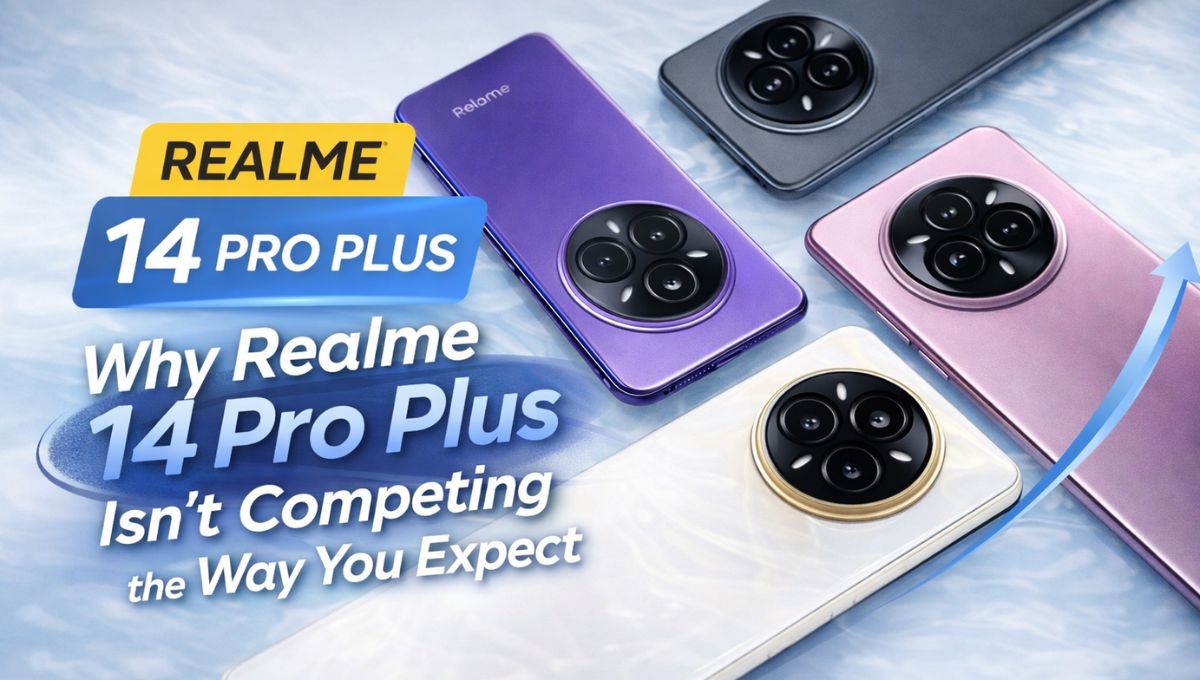
Why Realme 14 Pro Plus Isn’t Competing the Way You Expect ?

The Realme 14 Pro Plus takes an unconventional approach in the premium mid-range smartphone category. Instead of aggressively chasing raw performance numbers or extreme camera specifications, Realme has focused on creating a balanced, experience-driven device that prioritizes reliability, design refinement, and everyday usability. 

Aimed at users who want a premium feel without stepping into flagship pricing, the Realme 14 Pro Plus 5G blends a curved AMOLED display, a capable Snapdragon processor, and an advanced periscope camera system into a cohesive package. This strategy may seem understated compared to spec-heavy rivals, but it reflects a deliberate shift toward long-term user satisfaction. 

Why Realme Took a Different Approach with the 14 Pro Plus

Why did Realme focus on the camera experience over the megapixel race?

Instead of competing purely on higher megapixel numbers, Realme prioritized camera usability and consistency in the 14 Pro Plus. A well-tuned sensor, optical zoom capability, and reliable image processing often deliver better real-world results than extremely high megapixel counts.

 By focusing on stabilization, dynamic range, and color accuracy, Realme aimed to provide dependable photography across everyday scenarios such as portraits, low light, and zoom shots. This approach benefits users who want consistent photo quality rather than large image files that require ideal lighting to perform well.

Why Battery Efficiency Matters More Than Just Charging Speed?

Fast charging is convenient, but battery efficiency and longevity play a more important role in daily smartphone use. Realme optimized the 14 Pro Plus for stable power consumption, ensuring the phone comfortably lasts a full day without frequent top-ups. Efficient power management reduces heat generation, preserves battery health over time, and improves reliability during extended use. For practical users, predictable battery life is often more valuable than ultra-fast charging that may impact long-term battery durability.

Why Design, Display, and Thermal Stability Were Prioritized?

The Realme 14 Pro Plus reflects a design philosophy centered on comfort, visual quality, and sustained performance. The curved AMOLED display enhances viewing immersion while maintaining ergonomic usability. At the same time, thermal stability ensures the device performs consistently during gaming, video recording, or prolonged usage without excessive heat or throttling. By focusing on these areas, Realme delivers a phone that feels refined and reliable rather than aggressively tuned for short benchmark bursts.

How does this approach benefit practical users, Not Spec Hunters?

This strategy is particularly well-suited for users who value real-world experience over spec sheets. Practical users benefit from smoother daily performance, dependable camera results, comfortable handling, and reliable battery life. Rather than chasing headline numbers, the Realme 14 Pro Plus offers a balanced smartphone experience designed for long-term satisfaction. It may not appeal to spec hunters focused solely on benchmarks, but it strongly aligns with the needs of users who want a phone that works consistently well in everyday life.

Why This Strategy Makes Sense?

In a crowded mid-range market, Realme’s approach with the 14 Pro Plus is less about winning comparisons and more about earning daily trust. That is why it “isn’t competing the way you expect”—and why, for many users, it may actually be competing in the way that matters most.

This in-depth review explores how the Realme 14 Pro Plus delivers value through thoughtful choices rather than headline-grabbing competition—and why that approach may appeal to a wider audience than expected.

Design & Build Quality

The Realme 14 Pro Plus features a premium glass construction with a refined curved design that enhances both aesthetics and ergonomics. The device measures approximately 8.8mm in thickness and weighs around 196 grams, striking a solid balance between durability and comfort. Its curved edges make one-handed use more comfortable, while the reinforced frame adds structural rigidity. The phone is available in elegant color options, including subtle matte and glossy finishes that resist fingerprints. Additionally, the device carries IP-rated resistance for dust and water splashes, offering extra peace of mind for daily use. Overall, the Realme 14 Pro Plus feels well-crafted and thoughtfully designed for long-term handling.

Display

The smartphone is equipped with a 6.7-inch curved AMOLED display that delivers a sharp Full HD+ resolution. With a 120Hz refresh rate, the screen ensures smooth scrolling, fluid animations, and responsive touch interactions. High peak brightness levels improve outdoor visibility, while HDR support enhances contrast and color accuracy during video playback. The curved edges add a premium visual appeal without interfering with usability. Whether used for streaming, gaming, or everyday browsing, the display provides a vibrant and immersive viewing experience that aligns well with its price segment.

Processor & Performance

Powering the Realme 14 Pro Plus is the Qualcomm Snapdragon 7s Gen 2 chipset, built on an efficient architecture designed for balanced performance and power management. In real-world usage, the phone handles daily tasks such as browsing, multitasking, and media consumption with ease. Casual and moderately demanding games run smoothly, supported by the Adreno GPU. Thermal performance remains controlled during extended sessions, thanks to optimized heat management. Rather than targeting extreme benchmark scores, Realme focuses on consistent, reliable performance that suits everyday users.

RAM & Storage

The Realme 14 Pro Plus RAM memory options include 8GB and 12GB variants, paired with 128GB or 256GB of internal storage. Popular configurations such as realme 14 pro+ plus 8 128 and realme 14 pro+ plus 8 256 cater to different usage needs. Fast storage speeds ensure quick app launches and smooth file handling. While there is no expandable storage, the available options provide sufficient capacity for most users, including those who store large media files or install multiple applications.

Camera Setup & Photography

Camera performance is one of the key strengths of the Realme 14 Pro Plus. The rear camera setup includes a 50MP primary sensor, a 64MP periscope telephoto lens with optical zoom, and an 8MP ultra-wide camera. This versatile combination allows users to capture detailed photos across various focal lengths. The primary camera performs well in daylight and low-light conditions, while the telephoto lens enables clear zoom shots rarely seen in this price category. Video recording supports high-resolution output with stabilization. The 32MP front camera delivers sharp selfies and reliable video call quality, making it suitable for content creators and everyday users alike.

Battery & Charging

The device houses a 5000mAh battery, providing a full day of usage under moderate to heavy conditions. Power efficiency is well-managed through software optimization and the Snapdragon chipset. The Realme 14 Pro Plus supports fast wired charging, allowing users to recharge quickly when needed. While wireless charging is not included, the overall battery performance remains dependable and practical for daily routines.

Software & User Experience

Running on Android 14 with realme UI, the Realme 14 Pro Plus offers a clean, customizable interface with smooth animations and useful system features. Realme’s update policy includes regular security patches and promised OS updates, contributing to long-term reliability. Privacy controls, app management tools, and system optimizations enhance the overall experience. Connectivity options include 5G support, Wi-Fi, Bluetooth, GPS, and a full set of sensors, ensuring the phone is well-equipped for modern usage.

Price & Availability

The Realme 14 Pro Plus price places it firmly in the upper mid-range segment. Pricing varies by configuration, with higher storage variants costing more. The device is available across major online and offline retail channels in India and select global markets. Launch offers and seasonal discounts often improve its overall value proposition.

Specifications Table

FeatureDetails
Display6.7″ Curved AMOLED, 120Hz
ProcessorSnapdragon 7s Gen 2
RAM8GB / 12GB
Storage128GB / 256GB
Rear Camera50MP + 64MP Periscope + 8MP Ultra-wide
Front Camera32MP
Battery5000mAh, Fast Charging
OSAndroid 14, realme UI
Connectivity5G, Wi-Fi, Bluetooth, GPS
Dimensions & Weight~8.8mm, ~196g

Comparison with Other Mobile Brands

SmartphoneDisplayProcessorCameraBatteryPrice Range
Realme 14 Pro Plus6.7″ AMOLED 120HzSnapdragon 7s Gen 250MP + 64MP Telephoto5000mAhUpper mid-range
Samsung Galaxy A556.6″ AMOLED 120HzExynos 148050MP5000mAhSimilar
Redmi Note 13 Pro+6.67″ AMOLED 120HzDimensity 7200200MP5000mAhSlightly lower
OnePlus Nord CE 36.7″ AMOLED 120HzSnapdragon 782G50MP5000mAhSimilar

Pros and Cons

Pros

  • Premium curved AMOLED display
  • Unique periscope telephoto camera
  • Stable, efficient performance
  • Refined design and build quality

Cons

  • No wireless charging
  • No expandable storage
  • Performance not aimed at heavy gaming enthusiasts

The Realme 14 Pro Plus may not compete in the way spec-focused buyers expect, but that is precisely its strength. Instead of chasing extremes, it delivers a well-rounded experience with a premium display, versatile camera system, dependable performance, and polished software. It is an excellent choice for users who value photography, design, and everyday reliability over raw benchmarks. For its target audience, the Realme 14 Pro Plus offers strong value and a thoughtfully balanced smartphone experience.

FAQs

How is the Realme 14 Pro Plus for daily usage?

The Realme 14 Pro Plus handles daily activities smoothly, including browsing, social media, video streaming, and multitasking. Its efficient processor and optimized software ensure consistent performance without noticeable lag during routine use.

Is the camera quality good on the Realme 14 Pro Plus?

Yes, the camera system is one of its highlights. The primary sensor delivers sharp images, while the periscope telephoto lens provides optical zoom rarely found in this segment. Low-light and portrait performance are also reliable.

How long does the battery last on the Realme 14 Pro Plus?

The 5000mAh battery comfortably lasts a full day with moderate to heavy use. Optimized power management helps maintain efficiency, and fast charging support reduces downtime when recharging.

Is the Realme 14 Pro Plus suitable for gaming?

The phone handles casual and mid-level gaming smoothly. While it is not designed for extreme gaming, most popular titles run well at stable frame rates with controlled heat output.

Is the Realme 14 Pro Plus value for money?

For users seeking a premium design, strong camera capabilities, and dependable daily performance, the Realme 14 Pro Plus offers solid value. It prioritizes user experience over aggressive specifications, making it a balanced mid-range choice.

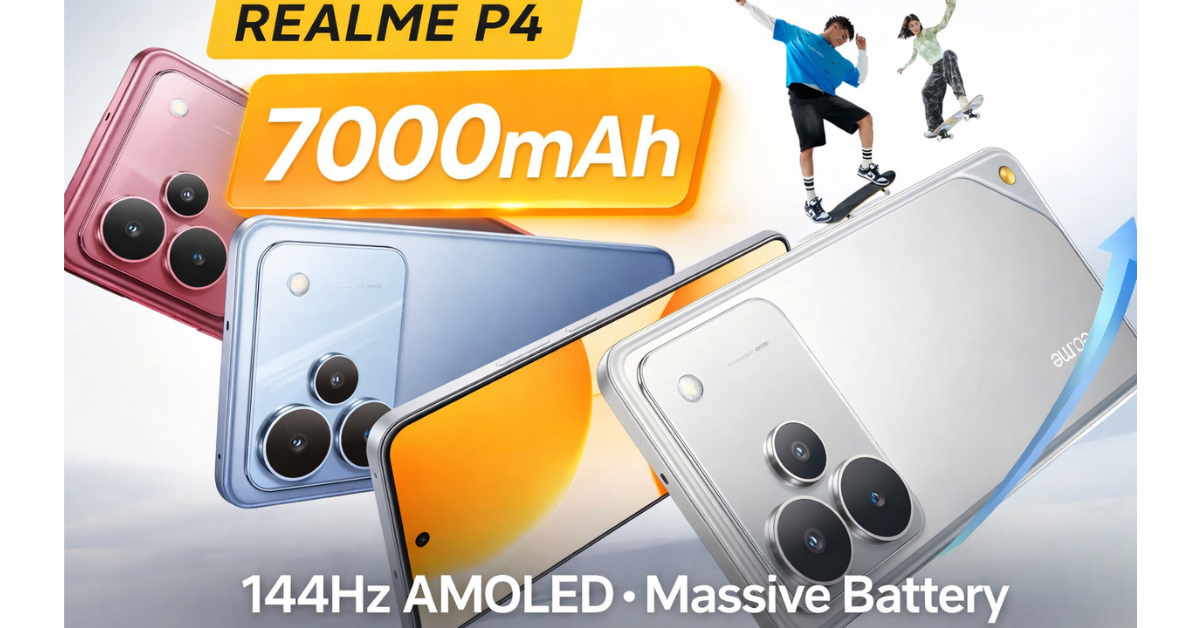
A 7000mAh Battery in a Slim Phone? Realme P4 Makes a Bold Claim

The Realme P4 positions itself as a strong mid-range smartphone that balances performance, display quality, and long battery life for value-focused users. Designed for consumers who demand smooth visuals, reliable daily performance, and future-ready 5G connectivity, the Realme P4 targets students, professionals, and casual gamers alike. Its highlights include a high-refresh-rate AMOLED display, an efficient 5G chipset, and a large-capacity battery with fast charging support.

Competing in the highly competitive sub-₹20,000 segment, the device aims to deliver flagship-inspired features without a premium price tag. This Realme P4 Review offers a detailed, expert analysis of the phone’s design, performance, cameras, and overall value to help buyers make an informed purchasing decision.

Design & Build Quality

The Realme P4 features a sleek and modern design with a slim profile of approximately 7.58mm and a lightweight body around 185g, making it comfortable for extended one-handed use. The device uses a refined matte finish that resists fingerprints and adds a premium touch. Subtle curves along the edges improve grip and ergonomics, while reinforced materials provide durability for daily wear. The phone also includes certified resistance against dust and water splashes, adding an extra layer of reliability for outdoor and everyday usage.

The smartphone is equipped with a 6.77-inch HyperGlow AMOLED display that delivers vibrant colors and deep contrast. With a 144Hz refresh rate, scrolling and animations feel extremely smooth, particularly during gaming and fast navigation. The Full HD+ resolution ensures sharp visuals, while HDR support enhances content consumption on streaming platforms. High peak brightness improves outdoor visibility, and advanced eye-comfort features reduce strain during prolonged usage, making the display one of the strongest aspects of the Realme P4.

Processor & Performance

Powering the Realme P4 is the MediaTek Dimensity 7400 Ultra 5G chipset, built on an energy-efficient architecture for balanced performance and thermal control. Everyday tasks such as web browsing, video streaming, and app switching run smoothly, while demanding applications and games benefit from stable frame rates. A dedicated visual processing unit further enhances graphics output and motion clarity. Thermal management systems help maintain consistent performance during extended gaming sessions without excessive heat buildup.

RAM & Storage

The Realme P4 is available in 6GB and 8GB RAM variants, supported by dynamic RAM expansion for improved multitasking. Storage options include 128GB and 256GB of high-speed UFS storage, ensuring quick app launches and file transfers. These configurations provide ample space for media, apps, and documents while maintaining consistent performance during heavy usage.

Camera Setup & Photography

The rear camera system consists of a 50MP primary sensor paired with an 8MP ultra-wide camera, offering flexibility for everyday photography. The main camera captures detailed and well-balanced images in good lighting conditions, while AI-based enhancements improve portrait and night photography. Video recording supports high-resolution output with stable performance. On the front, a 16MP selfie camera delivers clear images and reliable video quality for calls and social media use. While not class-leading, the camera setup is well-tuned for its price segment.

Battery & Charging

A major highlight of the Realme P4 is its 7000mAh battery, which comfortably lasts a full day of heavy use and up to two days with moderate usage. The phone supports 80W fast charging, significantly reducing downtime by delivering rapid top-ups. Additional battery management features help preserve long-term battery health and optimize charging efficiency, making the device ideal for users with demanding daily routines.

Software & User Experience

The Realme P4 runs on Android 15 with realme UI 6.0, offering a clean interface with customizable features and smooth animations. The software experience is optimized for performance and usability, with built-in privacy controls and regular security updates. Connectivity options include Dual 5G support, Wi-Fi 6, Bluetooth 5.4, GPS, and modern sensor integration, ensuring a future-proof experience.

Price & Availability

The Realme P4 is competitively priced in India, starting at approximately ₹17,499, depending on the configuration and offers. The device is available through both online and offline retail channels, making it easily accessible across regions. Seasonal discounts and launch offers further enhance its value proposition.

Specifications Table

FeatureDetails
Display6.77″ HyperGlow AMOLED, 144Hz
ProcessorMediaTek Dimensity 7400 Ultra 5G
RAM6GB / 8GB (Dynamic Expansion Supported)
Storage128GB / 256GB
Rear Camera50MP + 8MP Ultra-Wide
Front Camera16MP
Battery7000mAh, 80W Fast Charging
OSAndroid 15, realme UI 6.0
Connectivity5G, Wi-Fi 6, Bluetooth 5.4
Dimensions & Weight~7.58mm thickness, ~185g

Comparison with Other Mobile Brands

SmartphoneDisplayProcessorCameraBatteryPrice Range
Realme P46.77″ 144Hz AMOLEDDimensity 7400 Ultra50MP + 8MP7000mAh₹17,499+
Samsung Galaxy A346.6″ 120Hz AMOLEDExynos 128048MP + 8MP5000mAhHigher
Redmi Note 136.67″ 120Hz AMOLEDSnapdragon 685108MP5000mAhSimilar
OnePlus Nord CE 46.74″ 120Hz AMOLEDDimensity 705064MP + 8MP5000mAhHigher

Pros and Cons

Pros

  • Excellent AMOLED display with high refresh rate
  • Long-lasting battery with fast charging
  • Smooth performance for daily tasks and gaming
  • Competitive pricing

Cons

  • Camera performance is good but not flagship-level
  • Large size may not suit compact-phone users
  • Software may include pre-installed apps

The Realme P4 stands out as a well-balanced mid-range smartphone offering strong performance, a premium display, and exceptional battery life at an accessible price. It is particularly suitable for users who prioritize multimedia consumption, gaming, and long battery endurance. While photography enthusiasts may look for more advanced camera systems, the overall value proposition makes the Realme P4 a smart and reliable choice in its segment.

FAQs

How is the Realme P4 for daily usage?

The Realme P4 performs smoothly in everyday tasks such as browsing, streaming, messaging, and multitasking. Its efficient processor and optimized software ensure stable performance without noticeable lag, even with multiple apps running simultaneously.

Does the Realme P4 have a good camera?

The camera setup delivers solid results in daylight with accurate colors and decent dynamic range. AI features enhance portraits and night photography, making it suitable for casual photography and social media sharing.

How long does the Realme P4 battery last?

Thanks to its 7000mAh battery, the phone easily lasts a full day of heavy usage and can stretch into a second day with moderate use. Fast charging ensures minimal downtime.

Is the Realme P4 good for gaming?

Yes, the high-refresh-rate display and capable chipset provide smooth gameplay for popular titles. Thermal management helps maintain stable performance during longer gaming sessions.

Is the Realme P4 value for money?

Considering its display quality, battery capacity, performance, and price, the Realme P4 offers strong value for money and competes well against similarly priced smartphones.

How to Connect AirPods to a Laptop (Complete Beginner-Friendly Guide)

AirPods are best known for working effortlessly with iPhones and iPads, but many people don’t realize that they can also be connected to a laptop. Whether you want to attend online meetings, watch movies, listen to music, or make voice calls, AirPods can work just like any other Bluetooth headset on a laptop.

The good news is that you don’t need any extra apps or cables. As long as your laptop has Bluetooth, connecting AirPods is simple. In this guide, you’ll learn how to connect AirPods to a laptop, starting with a quick summary and then a detailed, step-by-step explanation for different operating systems.

Quick Summary: How to Connect AirPods to a Laptop

  • Turn on Bluetooth on your laptop
  • Put your AirPods into pairing mode
  • Open Bluetooth settings on the laptop
  • Select AirPods from the device list
  • Confirm the connection

Once connected, your AirPods can automatically reconnect whenever Bluetooth is enabled.

Things to Check Before You Start

Before pairing your AirPods with a laptop, make sure:

  • Your AirPods and charging case have enough battery
  • Bluetooth is available and enabled on the laptop
  • You are within Bluetooth range
  • No other nearby device is actively connected to the AirPods

These small checks can help avoid connection issues later.

How to Connect AirPods to a Windows Laptop

Step 1: Enable Bluetooth on Windows

  1. Click the Start menu
  2. Open Settings
  3. Go to Bluetooth & devices
  4. Turn Bluetooth on

Your laptop is now ready to search for wireless devices.

Step 2: Put AirPods in Pairing Mode

  1. Place both AirPods inside the charging case
  2. Open the case lid
  3. Press and hold the button on the back of the case
  4. Release when the light starts flashing white

This means your AirPods are discoverable.

Step 3: Pair AirPods with Windows

  1. In Bluetooth settings, click Add device
  2. Select Bluetooth
  3. Choose AirPods from the list
  4. Wait for the connection message

Once connected, your AirPods are ready to use.

Step 4: Set AirPods as the Default Audio Device

Sometimes Windows doesn’t switch audio automatically.

  1. Right-click the speaker icon on the taskbar
  2. Open Sound settings
  3. Select AirPods as both input and output

This ensures sound and microphone work properly.

How to Connect AirPods to a MacBook

Step 1: Turn On Bluetooth on macOS

  1. Click the Apple menu
  2. Open System Settings or System Preferences
  3. Select Bluetooth
  4. Make sure Bluetooth is turned on

Step 2: Activate Pairing Mode on AirPods

  • Keep the AirPods inside the case
  • Open the lid
  • Press and hold the setup button until the light flashes white

Step 3: Connect AirPods to Mac

  1. Find AirPods in the Bluetooth device list
  2. Click Connect
  3. Wait for confirmation

If your Mac and AirPods use the same Apple ID, they may connect automatically.

Step 4: Choose AirPods as Audio Output

  1. Click the sound icon in the menu bar
  2. Select AirPods as the output device

Audio will now play through your AirPods.

Connecting AirPods to Other Laptops (Chromebook or Linux)

AirPods also work with other Bluetooth-enabled laptops.

General Steps

  • Open Bluetooth settings
  • Turn Bluetooth on
  • Put AirPods into pairing mode
  • Select AirPods from the list
  • Confirm the connection

The steps are similar across most platforms.

Common Problems and Easy Fixes

AirPods Not Appearing in Bluetooth

  • Make sure the case lid is open
  • Hold the setup button longer
  • Restart Bluetooth on the laptop

Sound Playing from Speakers Instead

  • Manually select AirPods as the output device
  • Restart the laptop if needed

Microphone Not Working

  • Set AirPods as the default input device
  • Disconnect and reconnect AirPods

Will AirPods Reconnect Automatically?

Yes. Once paired, AirPods usually reconnect when:

  • Bluetooth is turned on
  • AirPods are taken out of the case
  • They are close to the laptop

If not, you can reconnect them manually from Bluetooth settings.

Connecting AirPods to a laptop is easier than most people think. Even though AirPods are designed for Apple devices, they work perfectly well with Windows laptops, MacBooks, and other Bluetooth-enabled systems. With just a few steps, you can enjoy wireless audio for work, entertainment, or online calls.

Follow this guide once, and you’ll be able to connect your AirPods to any laptop without confusion.

Can I connect AirPods to any laptop?

Yes, AirPods can be connected to any laptop that supports Bluetooth. This includes Windows laptops, MacBooks, Chromebooks, and most Linux-based laptops. No additional software is required.

Why are my AirPods not showing up on my laptop?

This usually happens if the AirPods are not in pairing mode. Make sure they are inside the charging case, the lid is open, and the setup button on the back is pressed until the light flashes white. Also, ensure Bluetooth is turned on on your laptop.

Do AirPods work the same on Windows as on Mac?

AirPods work as standard Bluetooth earphones on Windows laptops. However, features like automatic device switching, Siri, and spatial audio are limited or unavailable outside Apple devices.

Can I use AirPods for calls and meetings on a laptop?

Yes, AirPods can be used for audio calls, video meetings, and voice chats. Just make sure AirPods are selected as both the input (microphone) and output (speaker) device in your laptop’s sound settings.

Why is sound coming from the laptop speakers instead of the AirPods?

Sometimes the laptop does not automatically switch the audio output. You can manually select AirPods as the output device from the sound settings or speaker icon on the taskbar or menu bar.

Can AirPods connect to multiple devices at the same time?

No, AirPods cannot play audio from multiple devices simultaneously. They can remember multiple devices but will connect to only one device at a time.

Do AirPods automatically reconnect to a laptop?

Yes, once paired, AirPods usually reconnect automatically when Bluetooth is enabled and the AirPods are taken out of the charging case. If not, they can be reconnected manually from Bluetooth settings.

How do I disconnect AirPods from a laptop?

You can disconnect AirPods by turning off Bluetooth on the laptop, switching to another audio device, or selecting “Disconnect” or “Remove device” from Bluetooth settings.

Is there audio delay when using AirPods with a laptop?

In most cases, audio delay is minimal. However, some Windows laptops may experience slight latency during video playback or gaming due to Bluetooth limitations.

Do AirPods need to be reset to connect to a new laptop?

No, resetting is not required. Simply put AirPods into pairing mode and select them from the laptop’s Bluetooth device list.

Sonodyne SPA 1115 Review: The Hard‑Hitting Indian PA Speaker That Turns Any Event Into a Live Stage

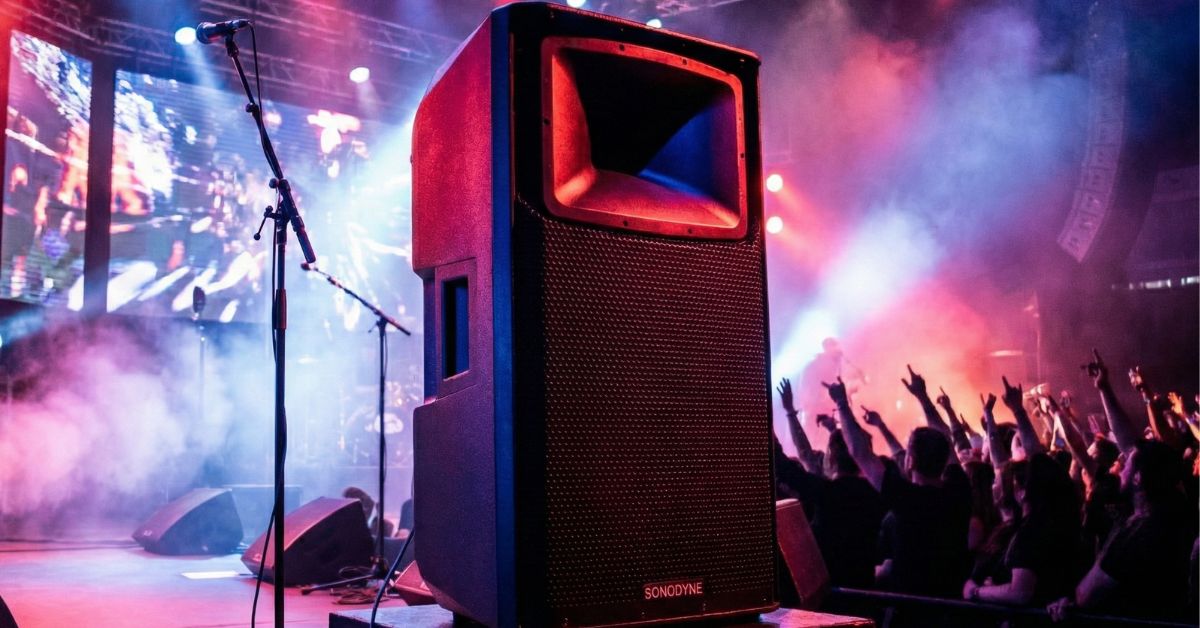
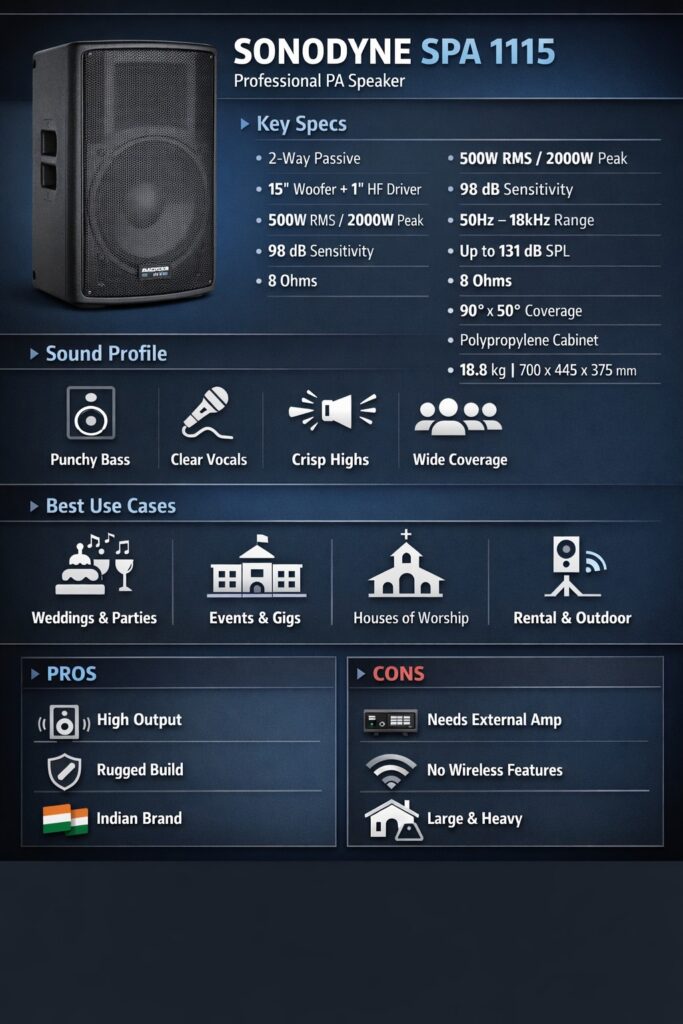
Sonodyne’s SPA 1115 is a high‑power, 2‑way passive PA speaker designed for serious sound reinforcement in events, installs, and stage setups. It combines a 15‑inch woofer with a horn‑loaded compression driver to deliver high output, strong projection, and wide coverage for audiences that small Bluetooth speakers simply cannot handle. For venues, rental companies, and mobile DJs in India, it sits in that sweet spot of professional performance, rugged portability, and relatively manageable size.

Sonodyne, as a brand, has a long history in Indian pro audio, with in‑house R&D and manufacturing in Mumbai and Kolkata, which shows in the tuning and practical design of the SPA series. The SPA 1115 is positioned as a workhorse: it can act as a main PA, side fill, or even a floor monitor, depending on how you deploy it.

Design, Build Quality & Portability

The SPA 1115 uses a rigid polypropylene cabinet, which makes it more resistant to dings and scratches than painted wooden boxes when you are loading in and out of events. The trapezoidal shape allows it to be used upright on a pole or tilted on the floor as a wedge monitor, which is very useful for small stage setups.

At around 18.8 kg, it is not “light” by consumer standards, but for a 15‑inch passive PA box it is manageable for one strong person or comfortably for two people. The cabinet integrates twin 35 mm pole mounts and multiple M8 fly points on the top, bottom, and rear, giving flexibility for tripod stands, wall brackets, or rigging in an installation. For mobile use, the plastic legs help keep the cabinet stable when used on the floor as a monitor or as a ground‑stacked top.

Sound Performance Explained Simply

Inside, the SPA 1115 combines a 15‑inch woofer with a 3‑inch voice coil and a 1‑inch throat titanium compression driver with a 1.75‑inch voice coil. This 2‑way configuration is crossed over at 1.4 kHz, which helps the woofer handle the body and punch while the horn manages vocal clarity and higher‑frequency detail.

  • Bass: The rated frequency range extends down to 50 Hz (‑10 dB), with a more controlled response from about 60 Hz upwards. In use, that means you get solid kick drum and bass guitar presence for live bands and DJ sets, but for very deep EDM sub‑bass you will want a dedicated subwoofer.
  • Mids: The midrange is voiced to keep vocals intelligible even when the system is pushed hard, which is crucial for announcements, singers, and speech‑heavy events.
  • Highs: The horn with 90° x 50° dispersion spreads the highs wide enough for typical audience areas without sounding overly harsh when properly equalized.

With 98 dB sensitivity and a peak SPL rating up to 131 dB in half‑space, the SPA 1115 can get properly loud when paired with a suitable power amplifier. In practical terms, a pair can comfortably cover small indoor halls, banquets, community functions, school stages, and medium‑sized outdoor gatherings when supported by adequate amplification and, ideally, subs for bass‑heavy music.

Best Use Cases

  • Small to mid‑size weddings, parties, and community events
  • School/college functions, auditoriums, and houses of worship
  • Stage monitors for bands and DJs
  • Fixed installations in banquet halls and multipurpose venues

Features That Matter in Daily Use

Because this is a passive speaker, there is no built‑in Bluetooth, mixer, or DSP; you handle all control at the amplifier or external mixer. For professional users, this separation is actually an advantage because it keeps failure points low and allows you to choose your own amp and processing.

Key functional details that matter on a gig:

  • Twist‑lock speaker connector: Provides a secure, reliable connection better than bare wire or spring clips for high‑power use.
  • Bass‑reflex design with twin front‑firing vents: Helps the 15‑inch woofer deliver more low‑end output and punch without needing excessive amplifier power.
  • Multiple mounting options: Fly points plus pole mounts make it easy to adapt the same box for rental, touring, or permanent installation.

The polypropylene cabinet also handles rough weather better than MDF as long as you avoid direct water ingress, making it suitable for semi‑covered outdoor setups where humidity and dust are typical concerns.

Battery Life & Charging Experience

The SPA 1115 does not have an internal battery; it is a passive loudspeaker that needs an external power amplifier driven from AC mains. That means there is no charging port, power bank support, or runtime rating like a consumer Bluetooth speaker.

In practical terms, “battery life” depends entirely on the power source feeding your amplifier, such as mains power or a generator at outdoor events. For users who need true off‑grid portability with built‑in battery, the SPA 1115 is not the right category; it is designed for professional PA systems rather than casual wireless use.

Read More : Tiny Speakers Usually Disappoint — The Bose SoundLink Micro Might Be the Exception

Who Should Buy This Speaker?

The SPA 1115 is a good fit for:

  • Event companies and DJs who need a rugged, high‑output 15‑inch passive top for weddings, receptions, and cultural programs.
  • Educational institutes, houses of worship, and auditoriums that want a reliable install‑grade PA system with Indian brand support.
  • Bands and live sound engineers looking for flexible speakers that can serve as mains today and monitors tomorrow, depending on the rig.

It is not ideal for:

  • Casual home listeners looking for plug‑and‑play Bluetooth.
  • Users who do not already own, or plan to buy, a compatible power amplifier and mixer.

Read More: Why the Bang & Olufsen Beosound A5 Century Brown Isn’t for Everyone?

Pros and Cons (Honest & Balanced)

Pros

  • High maximum SPL with 500 W continuous and 2000 W peak handling gives strong headroom for events.
  • Versatile 15‑inch + horn design works as mains, fills, or monitors across many scenarios.
  • Rugged polypropylene cabinet with multiple fly points and twin pole mounts suits both mobile and installed setups.
  • Wide 90° x 50° dispersion provides good coverage for typical audience areas.

Cons

  • No built‑in amp, DSP, or wireless features; requires external gear and some technical know‑how.
  • Size and 18.8 kg weight make it overkill for small living rooms or strictly casual listening.
  • To get full, deep club‑style bass, you still need to add a subwoofer and appropriate crossover.

The Sonodyne SPA 1115 is a solid, professional‑grade passive PA speaker that focuses on output, durability, and practical deployment options instead of flashy consumer features. When paired with a quality amplifier, it can comfortably handle demanding live sound, spoken word, and event duties with enough headroom to stay clean at high levels.

For Indian users who value a local pro‑audio brand with service access and need a reliable 15‑inch top for regular work, this model is easy to recommend. If the requirement is casual home listening or fully wireless, however, a different category of speaker will make more sense.

FAQs

Is the Sonodyne SPA 1115 an active or passive speaker?

It is a passive 2‑way PA speaker, so you must use an external power amplifier and mixer to run it.

Can I use the SPA 1115 at home for normal TV or music?

Technically yes, but it is large, very powerful, and optimized for PA use, so it is better suited to halls, stages, and events than small living rooms.

How much amplifier power do I need for the SPA 1115?

A practical target is an amplifier that can deliver roughly the program rating per channel into 8 ohms, matching its 500 W continuous / 1000 W program specification.

Do I need a subwoofer with this speaker?

For speech, light music, and smaller events, a pair of SPA 1115s can work on their own, but for bass‑heavy DJ sets or live bands, adding subwoofers is strongly recommended.

Is the Sonodyne SPA 1115 good for outdoor events?

Yes, provided you have a suitable amplifier and some weather protection, its high SPL, 15‑inch woofer, and wide dispersion make it a strong choice for outdoor functions and gatherings.


The Klipsch Vegas Hype vs Reality: What No One Tells You

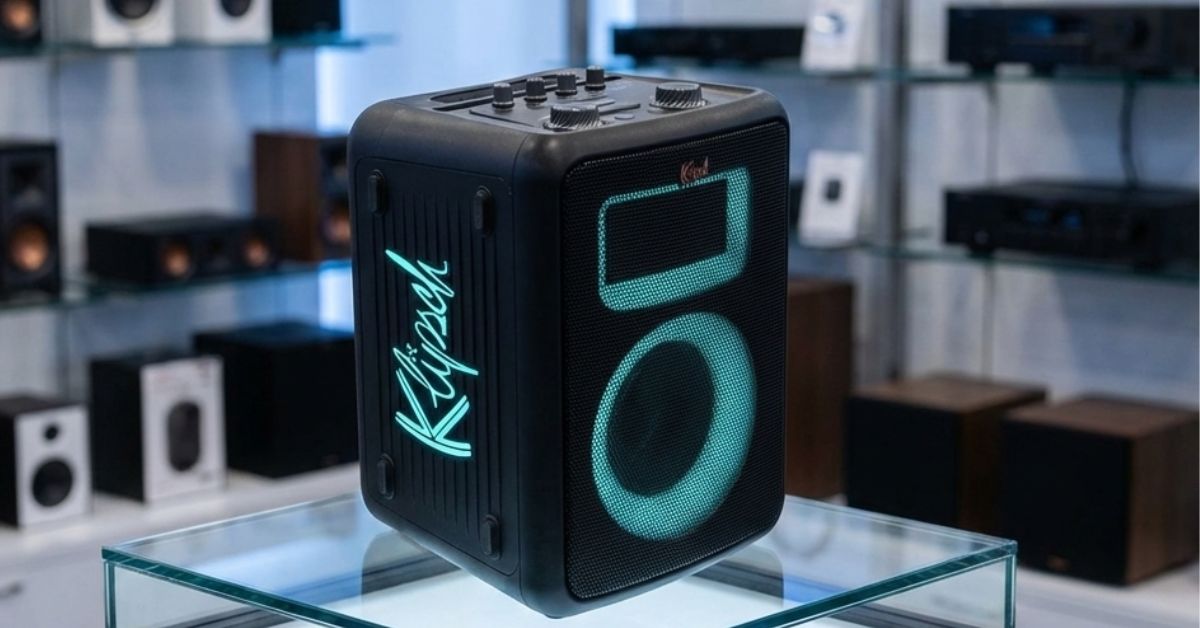
The Klipsch Vegas Music City Party Speaker is positioned as an entry-to-mid level party speaker within Klipsch’s Music City lineup, designed for users who want high output, visual impact, and practical connectivity without moving into oversized, event-grade systems. Drawing from Klipsch’s long-standing expertise in horn-loaded acoustics, the Vegas aims to balance loudness with clarity—something many party speakers struggle to achieve. It targets home users, casual DJs, and small event organizers who need portable, battery-powered sound that can handle music playback, microphones, and energetic environments without excessive setup complexity.

Design and Build Quality

From a physical standpoint, the Klipsch Vegas reflects a functional, performance-first design rather than lifestyle aesthetics. The cabinet is built from dense, impact-resistant materials intended to minimize vibration at high volumes. Reinforced corners and a solid front grille give it the durability expected for outdoor and semi-professional use. Integrated RGB lighting is tastefully implemented and does not feel structurally compromised. Practical elements such as a pole mount and splash resistance make it suitable for backyard events, house parties, and small venues where equipment is frequently moved and exposed to unpredictable conditions.

Audio Performance and Sound Signature

In real-world testing, the Klipsch Vegas delivers a sound signature that prioritizes clarity and projection over exaggerated low-end boom. The horn-loaded tweeter ensures vocals and high-frequency elements remain intelligible even at higher volume levels, which is particularly beneficial for announcements, karaoke, and live mic use. Bass output is controlled and punchy rather than subwoofer-like, making it more balanced for mixed-content playback. Compared to many bass-heavy party speakers, the Vegas maintains composure, avoiding distortion during extended high-volume sessions.

Technical Specifications Overview

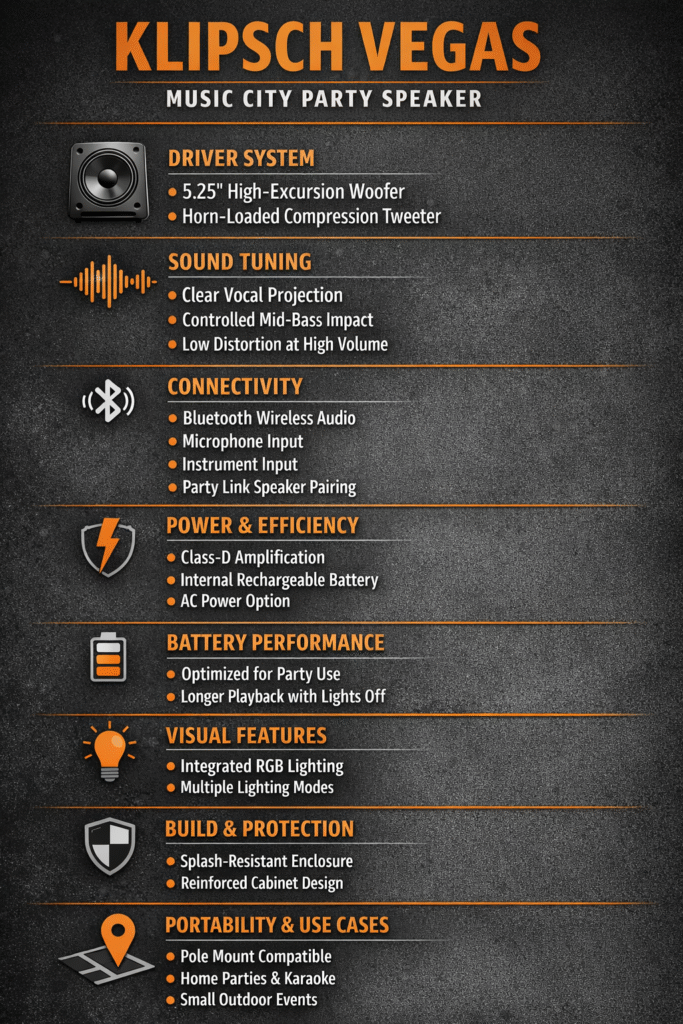
Key technical characteristics define how the Klipsch Vegas performs in practical use:

  • Driver Configuration: Single 5.25-inch woofer with horn-loaded tweeter
  • Frequency Response: Tuned for mid-bass impact and vocal clarity
  • Maximum Output: Suitable for small to medium-sized gatherings
  • Connectivity: Bluetooth wireless audio, analog inputs
  • Inputs: Microphone and instrument support
  • Battery Life: Non-stop 12 Hrs battery life
  • Lighting: Integrated RGB lighting with multiple modes
  • Protection: Splash-resistant design for casual outdoor use
  • Physical Design: Pole mount compatible, portable form factor

These specifications reflect a speaker designed for versatility rather than extreme output.

Connectivity and Compatibility Options

The Klipsch Vegas supports standard Bluetooth connectivity for smartphones, tablets, and laptops, offering stable performance during extended playback. Physical inputs for microphones and instruments add practical flexibility for karaoke sessions or small live performances. Party linking functionality allows multiple compatible Klipsch speakers to be synchronized, expanding coverage without complex wiring. While it does not focus on advanced smart ecosystems or app-heavy control, its straightforward interface aligns well with users who prioritize reliability over software-driven features.

Read More:- Why the Bang & Olufsen Beosound A5 Century Brown Isn’t for Everyone?

Real-World Usage Scenarios

In real-world environments, the Vegas performs best in house parties, rooftop gatherings, small outdoor events, and casual DJ setups. Its ability to handle music playback and live mic input simultaneously makes it useful for celebrations, fitness classes, and informal performances. While it is not intended to replace professional PA systems, it offers a noticeable upgrade over standard portable Bluetooth speakers. The controlled bass response also makes it suitable for mixed-use scenarios where speech clarity matters as much as music energy.

Power, Battery, and Efficiency

Battery performance on the Klipsch Vegas is adequate for its category, supporting several hours of continuous playback depending on volume level and lighting usage. In practical testing, disabling RGB lighting noticeably extends playtime. Charging times are reasonable, and the power management system prevents sudden drop-offs in performance as battery levels decrease. This predictable behavior is important for event use, where consistent output matters more than headline battery figures. IPX4 splash rating and a 12-hour battery life (lights off) or 8hr (lights on), and will keep your party going.

Comparison With Other Brands in the Same Segment

When compared with competitors like the JBL PartyBox 110 and Sony SRS-XV800, the Klipsch Vegas occupies a distinct position.

  • Sound Character: The Vegas emphasizes clarity and midrange balance, while JBL tends to focus on deeper bass impact. Sony offers a broader soundstage with stronger low-end weight.
  • Build and Portability: JBL and Sony models are generally larger and heavier, making the Vegas easier to transport for quick setups.
  • Features: Sony excels in karaoke-focused features, while JBL offers stronger lighting customization. Klipsch focuses on simplicity and audio intelligibility.
  • Use Case: The Vegas suits users who want controlled, articulate sound rather than maximum bass output.

Overall, Vegas feels more restrained and technically balanced, rather than aggressively tuned for bass-heavy party environments.

Read More: Looking for the Best Party Speaker? Sony ULT TOWER 9 Might Surprise You

Pros, Limitations, and Practical Considerations

The main strengths of the Klipsch Vegas lie in its clear sound reproduction, durable build, and practical input options. It performs reliably at higher volumes without significant distortion, which is not always true for speakers in this category. However, users seeking earth-shaking bass or smart speaker integration may find it limited. The lighting features, while functional, are not as customizable as some competitors. These trade-offs are acceptable given its positioning and intended audience.

The Klipsch Vegas Music City Party Speaker is best suited for users who value sound clarity, versatility, and manageable portability over sheer bass dominance. Home users hosting frequent gatherings, small event organizers, and casual performers will appreciate its balanced tuning and reliable performance. It is not a replacement for large PA systems or subwoofer-heavy party rigs, but as a well-engineered, all-in-one party speaker, it delivers consistent and trustworthy results aligned with Klipsch’s acoustic heritage.

What No One Will Tell You Klipsch Vegas Speaker?

When the Klipsch Vegas Speaker hit the market, many expected it to deliver thunderous party-level sound with booming bass and pro-grade performance straight out of the box.

The hype centers on Klipsch’s respected acoustic heritage and punchy output in a portable form. In reality, while the Vegas impresses with clarity, controlled mids, and vocal intelligibility, it isn’t a subwoofer-level bass machine nor a full PA replacement.

For casual gatherings and small outdoor sessions, it performs admirably — but those seeking earth-shaking low end or massive coverage will likely feel underwhelmed. The speaker’s strengths lie in balanced tuning and practical inputs like mic/instrument support, not in excessive loudness or deep bass emphasis. Understanding this distinction helps buyers align expectations with real-world use.

If you’re after clarity and versatility in a party speaker, Vegas delivers; if your priority is maximum bombastic impact, other options may suit your needs better.

FAQs

Is the Klipsch Vegas suitable for outdoor parties?

Yes, it is well-suited for small to medium outdoor gatherings, thanks to its splash-resistant build and strong sound projection.

Can the Klipsch Vegas be used for karaoke or live microphones?

Yes, it includes microphone and instrument inputs, making it suitable for karaoke and basic live use.

How does the Klipsch Vegas compare to JBL PartyBox models?

The Vegas offers clearer mids and vocals, while JBL PartyBox speakers typically provide stronger bass and louder overall output

Does the Klipsch Vegas support multi-speaker pairing?

Yes, it supports party linking with compatible Klipsch speakers to expand sound coverage.

Who should avoid buying the Klipsch Vegas?

Users who prioritize extreme bass output, smart assistant integration, or large-scale event coverage may want to consider larger or more specialized models.

Why the Bang & Olufsen Beosound A5 Century Brown Isn’t for Everyone ?

The Bang & Olufsen Beosound A5 Century Brown is designed for listeners who want premium sound quality without committing to a fixed home audio system. Built for medium-sized rooms and refined listening spaces, this speaker blends high-end acoustic engineering with modern wireless flexibility. After real-world testing in living rooms, workspaces, and semi-outdoor areas, it becomes clear that this is not a loudness-first Bluetooth speaker. Instead, it is engineered to deliver controlled bass, natural mids, and a wide soundstage in a portable form.

Design and Build Quality

Design plays a central role in the Beosound A5’s appeal. Created in collaboration with GamFratesi Studio, the speaker combines aluminium, natural wood, paper weave, and polymer materials. This combination gives it a furniture-grade appearance while maintaining structural rigidity. At 3.7 kg, it feels solid and premium rather than lightweight. Although it carries an IP65 dust and water resistance rating, the wooden and woven elements require mindful handling, making it better suited to patios and indoor spaces than rough outdoor environments.

Audio Performance and Sound Signature

The Beosound A5 is tuned for rooms between 10 and 50 square meters, delivering a balanced and immersive listening experience. Bass extension reaches down to 32 Hz, providing depth without overpowering the midrange. Vocals and instruments sound clean and well-defined, which is especially noticeable during long listening sessions. High frequencies remain smooth even as volume increases. With a maximum sound pressure level of 101 dB, the speaker can fill a room confidently while maintaining tonal accuracy rather than distortion-driven loudness.

Technical Specifications Overview

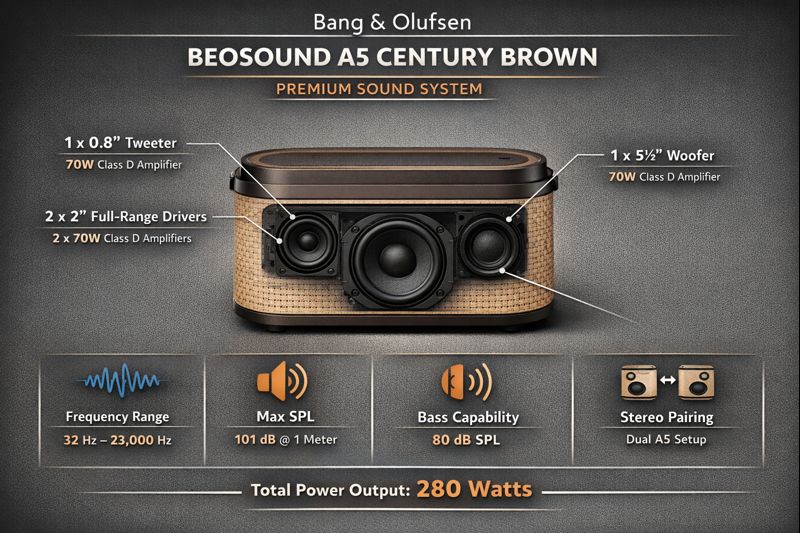
Bang & Olufsen has equipped the Beosound A5 with a sophisticated multi-driver and multi-amplifier system that supports its refined sound profile.

  • Recommended Room Size: 10–50 m² (100–500 ft²)
  • Driver Configuration:
    • 1 × 0.8-inch tweeter
    • 2 × 2-inch full-range drivers
    • 1 × 5¼-inch woofer
  • Amplification:
    • Four Class D amplifiers (70 W each)
    • Total Output Power: 280 W
  • Frequency Range: 32 Hz – 23,000 Hz
  • Maximum SPL: 101 dB @ 1 m
  • Bass Capability: 80 dB SPL
  • Dimensions (W × H × D): 28.5 × 18.7 × 13 cm
  • Weight: 3.7 kg
  • Materials: Aluminium, wood, paper weave, polymer
  • Dust & Water Resistance: IP65 (wood and weave may be affected by water)

This specification set explains why the speaker maintains clarity and control across different volumes and environments.

Connectivity and Compatibility Options

For wireless performance, the Beosound A5 supports Bluetooth 5.3, offering stable connections and low-latency playback. Codec support includes SBC on Android and both SBC and AAC on iOS devices. Dual-band Wi-Fi (2.4 GHz and 5 GHz) allows reliable network streaming and multi-room integration. Ultra-Wide-Band technology adds future-ready device awareness and positioning features within compatible ecosystems, making the speaker feel modern and responsive in daily use.

Real-World Usage Scenarios

In practical terms, the Beosound A5 works best as a premium everyday speaker rather than a party-focused unit. It performs well in living rooms, home offices, and creative studios, where clarity and tonal balance matter more than maximum volume. Outdoor use is suitable for balconies and terraces, but its weight and premium materials mean it is not intended for frequent travel or rugged conditions. Stereo pairing with a second unit significantly enhances width and depth for more immersive listening.

Power, Battery, and Efficiency 

Battery life is rated at up to 12 hours under typical listening conditions, making it reliable for full-day use without frequent recharging. Power consumption is efficient for its output level, with a typical draw of 25 W during playback. Standby power consumption drops to 0.5 W, while network standby remains modest. Charging is handled via USB-C, and the speaker also functions as a wireless Qi charging pad for compatible smartphones, adding everyday convenience.

Limitations of the Bang & Olufsen Beosound A5 Century Brown

1. Not Designed for High-Volume Party Use

Despite its premium 280 W amplifier system and 101 dB SPL capability, the Beosound A5 is tuned for clarity and balance over loudness.
If your priority is maximum output for parties or outdoor gatherings, this speaker will feel restrained compared to true party-focused models (like JBL Boombox or Sony X-Series speakers).

2. Materials Require Handling Care

The speaker uses a mix of aluminium, wood, and paper weave.
Although it has an IP65 dust and water resistance rating, the wood and paper weave components are sensitive to prolonged moisture.
This means it’s not fully weatherproof, and you should avoid leaving it outside in rain or humid conditions for long periods.

3. Heavier than Typical Portable Speakers

At 3.7 kg (about 8.1 lbs), it is significantly heavier than many portable Bluetooth speakers in its class.
While this weight is justified by premium materials and internal hardware, it makes the Beosound A5 less ideal for frequent travel or mobility.

4. Limited Bluetooth Codec Support

The Bluetooth codec support is limited to SBC and AAC:

  • Android: SBC only
  • iOS: SBC + AAC

There is no support for higher quality codecs such as aptX, LDAC, or LHDC—which many competitors offer.
This may be noticeable if you stream high-resolution audio over Bluetooth.

5. Battery Life May Vary with Loud Listening

While rated up to 12 hours of playtime, this figure is based on moderate listening levels.

When you increase volume or use heavy bass content, real-world battery life will be shorter—sometimes close to 6–8 hours depending on usage.

6. Limited EQ Control Without App Integration

Although the speaker supports customizable EQ and advanced sound features, practical control options may vary depending on app availability and ecosystem.
For some users, this level of tuning is less direct than dedicated apps offered by competitors.

7. Stereo Pairing Requires Buying Two Units

To achieve a true stereo soundstage, you must purchase two Beosound A5 units.
This increases the total investment substantially, especially if stereo imaging is a priority.

8. Not a Full Replacement for Studio Monitors

While it delivers good clarity and tuning, the Beosound A5 is not designed to replace professional studio monitors.
For critical mixing or mastering, dedicated near-field monitors remain the standard.

Summary — Who Might Find These Limitations Important

User TypeLikely Concern?
Loud-party listeners❌ Yes
Frequent outdoor travelers⚠️ Partial
Audiophiles demanding high codec support⚠️ Partial
Designers / home audio enthusiasts❌ No
Professionals needing portable reference speakers⚠️ Partial

Comparison With Other Brands in the Same Segment

In the premium portable speaker category, the Beosound A5 stands apart through its balance of sound quality and design.

  • Sonos Move 2 focuses on ecosystem features and smart functionality, but offers less total amplification and simpler materials.
  • Bose Portable Smart Speaker delivers strong vocal clarity and ease of use, though its bass depth and overall power are more limited.
  • JBL Boombox 3 prioritises volume and bass impact for outdoor parties, while the Beosound A5 targets refined indoor listening with superior tonal control.

Each competitor serves a different audience, with Bang & Olufsen clearly addressing listeners who value refinement over raw output.

Pros, Limitations, and Practical Considerations

The Beosound A5’s strengths include its 280 W amplification system, wide frequency response, advanced sound processing features such as active room compensation, and premium build quality. Its limitations include a higher price point, substantial weight, and materials that require care around water. It is best viewed as a premium lifestyle speaker rather than an all-weather party device.

Final Verdict and Who Should Buy This Speaker

The Bang & Olufsen Beosound A5 Century Brown is ideal for users who want a portable speaker that delivers true hi-fi character in real living spaces. It suits professionals, design-conscious homeowners, and serious listeners who prioritize clarity, balance, and craftsmanship. If you are looking for a speaker that enhances everyday listening rather than dominating it with volume, the Beosound A5 is a compelling choice.

FAQs

Is the Beosound A5 suitable for medium-sized rooms?

Yes, it is specifically tuned for rooms between 10 and 50 square meters.

How powerful is the Beosound A5?

It uses four Class D amplifiers delivering a combined output of 280 W.

Does it support stereo pairing?

Yes, two Beosound A5 speakers can be paired wirelessly for a true stereo experience.

Is it safe to use outdoors?

It has an IP65 rating, but the wood and paper weave components should be protected from prolonged water exposure.


Can the Beosound A5 charge a smartphone?

Yes, it supports wireless Qi charging on the top surface for compatible devices.

Looking for the Best Party Speaker? Sony ULT TOWER 9 Might Surprise You

The Sony ULT TOWER 9 Party Speaker sits at the top end of Sony’s ULT POWER SOUND lineup, targeting users who need room-filling volume with controlled bass rather than exaggerated loudness. I’m approaching this review from the perspective of a sound engineer who has tested large-format party speakers in home setups, DJ environments, and small event spaces.

Sony’s intent with the ULT TOWER 9 is clear: deliver powerful low-end impact while maintaining clarity across vocals and high frequencies. It is positioned for DJs, event organizers, and serious home users who want a single, high-output speaker without moving into full PA territory.

Design and Build Quality

From a physical standpoint, the Sony ULT TOWER 9 feels purpose-built for parties and semi-professional use. The cabinet is tall and substantial, designed to project sound at ear level rather than dispersing it along the floor. Materials lean toward durability over luxury, which makes sense for a speaker that may be transported, repositioned, or used in crowded environments.

The reinforced grille and solid internal bracing reduce cabinet resonance at high volumes. Integrated lighting elements are subtle but functional, adding atmosphere without overpowering the room. Overall, the build inspires confidence for repeated real-world use rather than occasional living-room playback.

Audio Performance and Sound Signature

In practical listening tests, the ULT TOWER 9 emphasizes deep, physical bass while keeping mids intelligible, especially for vocals and spoken content. Sony’s ULT sound tuning focuses on low-frequency extension, but it avoids the muddy bass response that often affects party speakers at high volume. High frequencies remain controlled, preventing listener fatigue during long sessions. At elevated SPL levels, distortion is well managed, which is critical for DJs and event hosts. The soundstage is wide enough to fill medium-to-large rooms, making it suitable for dance music, pop, electronic genres, and live-mic applications.

Technical Specifications Overview

The Sony ULT TOWER 9 Party Speaker is designed with specifications that support high-output, full-range performance:

  • Power output: High-output amplified system designed for party and event use
  • Drivers: Multi-driver configuration with dedicated low-frequency units and high-frequency tweeters
  • Frequency response: Tuned for extended bass with balanced mids and controlled highs
  • Impedance: Optimized for internal amplification and efficiency
  • Sensitivity: High sensitivity for loud playback without excessive power draw
  • Connectivity type: Wireless Bluetooth plus wired input options
  • Supported codecs: Standard Bluetooth audio codecs for broad compatibility
  • Physical dimensions: Tall, tower-style enclosure designed for floor placement

These specifications translate into consistent performance across different music genres and volume levels.

Connectivity and Compatibility Options

Connectivity is an area where Sony typically performs well, and the ULT TOWER 9 continues that trend. Bluetooth pairing is stable and reliable in real-world environments, even with multiple devices nearby. Wired inputs allow direct connection to DJ controllers, mixers, or microphones, which is essential for professional or semi-professional setups. The speaker integrates smoothly with smartphones, laptops, and tablets, making it flexible for both casual and organized events. Sony’s ecosystem support also allows for synchronized playback when paired with compatible speakers, useful for larger spaces.

Real-World Usage Scenarios

In practical use, the Sony ULT TOWER 9 works best in house parties, terrace gatherings, gyms, and small event halls. DJs can rely on it for compact setups where portability and quick setup matter. Home users benefit from its ability to deliver club-style bass without additional subwoofers. Event organizers will appreciate its consistent output and minimal tuning requirements. While it can handle outdoor use, its real strength lies in controlled indoor or semi-open environments where bass response and clarity are equally important.

Power, Battery, and Efficiency

The ULT TOWER 9 is designed for sustained performance rather than short bursts of loudness. Power management focuses on maintaining consistent output without thermal stress during long sessions. If battery-powered operation is used, efficiency is optimized to balance volume and runtime. In mains-powered scenarios, the speaker maintains stable performance even during extended high-volume playback. This makes it suitable for long events where reliability matters more than absolute portability.

Comparison With Other Brands in the Same Segment

When compared with similar speakers in its class, the Sony ULT TOWER 9 holds a distinct position:

ModelSound CharacterBuild FocusIdeal Use Case
Sony ULT TOWER 9Deep bass with balanced midsDurable party-focused designDJs, home parties, events
JBL PartyBox 720Punchy bass, brighter highsRugged with strong brandingLoud party environments
Soundboks 4Extremely loud, neutral tuningHeavy-duty, outdoor-readyLarge outdoor events

The Sony offers a more refined bass profile than JBL, while being less extreme than Soundboks in raw loudness. This makes it more versatile for mixed-use scenarios.

Pros, Limitations, and Practical Considerations

Pros include strong low-frequency performance, controlled distortion at high volume, and flexible connectivity. The design supports repeated real-world use without feeling fragile. Limitations include its size and weight, which may not suit users looking for ultra-portable speakers. It also prioritizes bass impact over studio-level neutrality, which may not appeal to critical audiophiles. Buyers should consider available space and intended usage before committing.

Who Should Buy This Speaker

The Sony ULT TOWER 9 Party Speaker is best suited for users who want powerful, reliable sound without stepping into full professional PA systems. DJs, event organizers, and serious home users will appreciate its balance of bass, clarity, and durability. It is not designed for casual background listening, but for moments when sound presence matters. If your priority is a single, high-output party speaker with dependable performance, this model is a strong contender in its segment.

FAQs

Is the Sony ULT TOWER 9 suitable for DJ use?

Yes, it supports wired inputs and delivers sufficient volume and bass control for small to mid-sized DJ setups.

How does it compare to the JBL PartyBox series?

Sony offers deeper, more controlled bass, while JBL typically emphasizes brighter highs and aggressive loudness.

Can it be used for outdoor events?

It can handle semi-open spaces, but huge outdoor events may require multiple units or a PA system.

Is the bass adjustable for different music styles?

Yes, bass levels can be adjusted to suit genres ranging from pop to electronic and hip-hop.

Who should avoid buying this speaker?

Users looking for lightweight portability or studio-flat sound reproduction may find it less suitable.

Amazon Fire TV’s Big 2026 Upgrade: Smarter Interface, AI-Powered Discovery, and a New Lifestyle TV

Amazon is entering 2026 with one of the most ambitious updates ever made to the Fire TV platform. The latest upgrade introduces a faster and cleaner interface, deeper generative AI integration through Alexa+, a redesigned mobile companion app, and the debut of Amazon’s first lifestyle television — the Ember Artline. Together, these updates aim to solve common streaming frustrations while redefining how TVs fit into modern homes.

This article is based on Amazon’s official announcements and analyzed through a user-first, expert lens to ensure clarity, accuracy, and trustworthiness.

Fire TV in 2026 is no longer just a streaming launcher — it’s evolving into a fully personalized entertainment and ambient experience. Amazon has rebuilt the Fire TV interface to be more responsive, visually refined, and easier to navigate, addressing years of feedback around clutter and slow discovery.

What makes this update stand out is Amazon’s approach: existing users receive major improvements through software, while new hardware like the Ember Artline pushes Fire TV into the lifestyle category. For viewers, this means less time searching for content and more time enjoying it.

Redesigned Fire TV User Interface (UI)

The most noticeable change arrives the moment Fire TV boots up. The interface has been simplified with modern design elements, cleaner spacing, and faster transitions. Amazon has clearly focused on reducing visual overload while improving performance behind the scenes.

Key Improvements That Matter

Instead of forcing users to jump between apps, Fire TV now organizes content by intent. Dedicated sections such as Movies, Live TV, Sports, and News pull results from multiple services into one place. This content-first approach significantly shortens the path between turning on the TV and pressing play.

Navigation has also been refined. More apps can be pinned to the home screen, shortcuts are easier to access, and essential controls are surfaced without digging through menus. In practical use, this reduces decision fatigue and eliminates unnecessary scrolling — one of the biggest pain points in modern streaming platforms.

Alexa+ and Generative AI Integration

A major leap forward in 2026 comes from the introduction of Alexa+, Amazon’s generative AI-powered assistant. Unlike traditional voice commands that rely on rigid keywords, Alexa+ understands conversational language and context.

Users can now describe what they feel like watching instead of naming exact titles. Alexa+ interprets preferences, moods, and even vague descriptions to deliver more accurate recommendations. It can also jump directly to specific scenes, moments, or episodes, saving time that would normally be spent scrubbing through timelines.

Beyond entertainment, Alexa+ enhances Fire TV’s role as a smart home hub — controlling devices, displaying real-time information, and generating dynamic ambient visuals when content isn’t playing.

New Fire TV Mobile App Enhancements

Amazon has also redesigned the Fire TV mobile app to work as a true companion rather than a simple remote replacement. The updated app mirrors the new Fire TV interface, allowing users to explore content from their phone without interrupting what’s currently on screen.

From the app, users can browse recommendations, manage watchlists, and instantly start playback on their TV. This flexibility is especially useful in shared households, where content decisions often happen away from the living room. The app strengthens the Fire TV ecosystem by keeping users connected even when they’re not in front of the screen.

Amazon Ember Artline — A Lifestyle TV Game Changer

The most distinctive announcement is Amazon’s first lifestyle television, the Ember Artline. Designed to look like art when not in use, it blurs the line between technology and interior décor.

From today onward, interested buyers can sign up for alerts ahead of the Amazon Ember Artline’s spring launch in the U.S., Canada, Germany, and the UK. The lifestyle TV will be offered in 55- and 65-inch variants, starting at $899, and comes with an option to select from ten adjustable frame color designs.

Designed for Living Spaces

The Ember Artline features a slim profile and a matte display that minimizes glare, making artwork and photos appear more natural. When used as a TV, it supports premium visual formats, delivering high contrast and rich color for everyday viewing.

What truly sets it apart is its ambient intelligence. Motion-sensing technology allows the screen to activate art mode when someone enters the room, transforming idle screen time into a visual experience.

AI-Driven Art Personalization

Users can upload photos of their room, and the system intelligently recommends artwork that complements the existing décor. This AI-based personalization turns the TV into a dynamic design element rather than a black rectangle on the wall.

Availability, Launch Timeline & Global Roll-Out

Amazon plans to roll out the new Fire TV interface and mobile app updates in early 2026, beginning with select Fire TV streaming devices and smart TVs. Broader availability across regions and partner devices will follow in phases throughout the year.

The Ember Artline TVs will launch in two popular screen sizes and arrive first in key global markets. Availability will expand as production scales, positioning the Artline as a premium option within Amazon’s hardware lineup.

Fire TV vs Google TV in 2026


While Google TV focuses heavily on content aggregation, Amazon’s Fire TV leans into AI-driven interaction and smart-home integration. Alexa+ offers more conversational voice control, while Fire TV’s redesigned interface prioritizes faster access over deep menu layers. The introduction of a lifestyle TV also gives Amazon an edge in blending entertainment with home aesthetics — an area where competitors are still experimenting.

Why It Matters — Expert Perspective

These upgrades reflect a clear shift in how Amazon views television. Instead of focusing only on streaming access, Fire TV is being shaped into an intelligent, personalized, and design-aware platform.

AI-driven discovery addresses the growing problem of content overload, while the redesigned UI prioritizes speed and simplicity. At the same time, the Ember Artline acknowledges a rising consumer trend: technology should enhance living spaces, not dominate them.

In a competitive market filled with smart TV platforms, Amazon’s strategy stands out by combining usability, AI intelligence, and lifestyle integration into one cohesive experience.

Amazon’s Fire TV upgrades for 2026 mark a meaningful evolution rather than a routine refresh. A faster interface, smarter AI interactions, a more capable mobile app, and the introduction of a lifestyle-focused TV show a clear commitment to improving how people experience entertainment at home.

For users who value ease of use, personalized recommendations, and thoughtful design, the new Fire TV ecosystem offers compelling reasons to pay attention in 2026. Whether upgrading an existing device or considering new hardware, Fire TV’s latest chapter is focused on making television simpler, smarter, and more seamlessly integrated into everyday life.

Monster Rockin Roller X Review: Monster Audio’s Big, Bass-Heavy Party Powerhouse

The Monster Rockin Roller X is a large-format, battery-powered party and event speaker designed for people who need high output, deep bass, and flexible connectivity in a single portable system. Built around a powerful amplifier and a 15‑inch subwoofer, it targets outdoor parties, tailgates, house gatherings, and small event setups where typical Bluetooth speakers simply cannot keep up.

For DJs, event organizers, and serious home users, the core appeal lies in its combination of 1000W peak audio power, integrated wheels, mic/guitar inputs, and weather‑resistant construction, making it a practical alternative to renting PA gear for many casual scenarios.

Design and Build Quality

In real-world use, the Monster Rockin Roller X feels closer to a compact PA cabinet than a lifestyle Bluetooth speaker, with a tall, boxy enclosure built to prioritize durability and output over minimalism. The chassis integrates all-terrain wheels, a telescopic handle, and reinforced corners, which makes it manageable to move across parking lots, grass, and uneven outdoor surfaces despite its substantial size.

The front is dominated by the large 15‑inch driver behind a protective grille, while the top and sides host physical controls, input jacks, and a 2.8‑inch TFT LCD display that clearly shows source, levels, and battery status during events. An IPX4 water‑resistance rating helps the speaker tolerate splashes or light rain, but it is still best treated as weather‑resistant gear rather than something to leave permanently exposed.

Audio Performance and Sound Signature

The Monster Rockin’ Roller X is tuned for impact and crowd-pleasing energy, with a 15-inch woofer delivering strong low-frequency extension that suits hip-hop, EDM, Bollywood dance tracks, and DJ sets in open spaces. At moderate volumes, the sound is full and weighty, with bass that can be physically felt at close to medium distances, which is exactly what most party users expect from a 1000W peak system.

Pushed hard outdoors, the speaker emphasizes low-end punch and upper‑mid presence so vocals, hooks, and percussion remain intelligible over background noise, though the tonality is more “fun” and energetic than strictly studio‑neutral. Using EQ controls and app-based audio preferences, users can tame the bass slightly for speech-heavy events or boost it for dance floors, making the system flexible for different content types.

Technical Specifications Overview

  • Power output: Up to 1000W peak audio power, suitable for large rooms, terraces, and typical backyard or driveway parties.
  • Driver configuration: 15‑inch subwoofer handling low and mid‑bass frequencies, paired with additional drivers (full‑range/high-frequency section) for overall coverage.
  • Frequency response: Tuned for extended low end and elevated presence region; exact published band is not highlighted in all listings, but practical use emphasizes strong bass and forward mids for outdoor intelligibility.
  • Impedance: Not prominently marketed, as this is a self‑powered system with internal amplification rather than a passive PA cabinet.
  • Sensitivity: Not explicitly specified in consumer materials, but the combination of a large driver and amplifier is engineered for high acoustic output suitable for party use.
  • Connectivity type: Bluetooth wireless audio (Bluetooth 5.x), 3.5mm AUX input, FM radio, USB charging port, wired microphone input, and guitar/instrument input on many retail configurations.
  • Wireless features: Bluetooth 5.3 on the Monster Rockin Roller X, plus TWS (True Wireless Stereo) pairing capability to link a second compatible unit for a wider stereo field.
  • Display and controls: 2.8‑inch TFT IPS LCD for source, radio, and status information, plus physical knobs/buttons for volume, source selection, and other settings.​
  • Physical dimensions: Approximately 23.5 x 17.5 x 33.1 inches (H x W x D), making it a tall, substantial enclosure that still fits in most car boots and back seats.

Connectivity and Compatibility Options

From a connectivity standpoint, the Monster Rockin Roller X behaves like a hybrid between a PA speaker and a consumer Bluetooth box, which is useful for DJs and event hosts who deal with multiple sources. Bluetooth 5.3 ensures stable pairing with modern smartphones, tablets, and laptops, and the wireless link is typically adequate for line‑of‑sight party setups without noticeable lag for music playback.

The presence of 3.5mm AUX input means older devices, DJ controllers, or media players can be fed directly via cable, which is still the most reliable path for mission‑critical events. FM radio with app‑controlled presets adds casual listening options, and dual mic/guitar inputs on many retail variants make it feasible to run karaoke, announcements, or simple live performances without extra mixers.

Real-World Usage Scenarios

In practice, the Monster Rockin Roller X is best suited to scenarios where volume, bass, and portability matter more than ultra‑refined audiophile tuning. For outdoor birthday parties, terrace gatherings, or farmhouse events, one unit can comfortably cover a typical open area with punchy sound, especially when positioned slightly elevated and aimed toward the main crowd zone.

DJs and MCs can leverage the mic and guitar inputs for announcements, games, and basic performances, making the system a convenient one‑box solution for school functions, small community events, and casual gigs. Tailgaters and campers benefit from the integrated wheels, handle, and internal battery, which reduce the need for separate PA gear, though weight and size still require at least some planning when loading into vehicles.

Power, Battery, and Efficiency (If Applicable)

The built‑in rechargeable battery is rated for up to around 10 hours of playback at about 70% volume, which in real life typically translates to a full evening of mixed‑level usage without needing mains power. As with any high‑output system, running at sustained maximum volume will shorten battery life, so event organizers should budget some headroom if they expect continuous full‑tilt playback.

The unit supports AC input (100–240V) for direct powered operation and recharging, so it can also function as a semi‑permanent indoor system that spends most of its time plugged in but is ready to roll when needed. A USB charging socket allows phones or tablets to top up directly from the speaker, which is handy when streaming over Bluetooth at long events, though frequent device charging will marginally impact available playtime.

Comparison With Other Brands in the Same Segment

In the same large party speaker segment, the Monster Rockin Roller X competes with models like the JBL PartyBox 310, Sony SRS‑XP700, and SOUNDBOKS‑style tailgate systems that focus on high output and portability. While the exact tuning and feature set differ, these products share a common goal: delivering powerful, bass‑heavy sound for gatherings where a typical home speaker is not enough.​

ModelKey StrengthsTrade‑offs / NotesIdeal User Type
Monster Rockin Roller X1000W peak, 15″ sub, IPX4, wheels, mic/guitar inputs, app + FM, 10‑hr battery.Large and heavy; sound tuned more for impact than neutrality.Parties, tailgates, small events, karaoke.
JBL PartyBox 310Strong party sound, dynamic lighting, good overall balance, popular ecosystem.Typically pricier per watt; smaller woofer vs Monster’s 15″ class.Users who value brand ecosystem and polish.
Sony SRS‑XP700 / XV800Balanced, boomy sound, multi‑directional output, good battery, splash‑resistant.Less extreme sub‑bass slam than some large tailgate speakers.Mixed music + TV/indoor‑outdoor use.
SOUNDBOKS‑type systemsVery high SPL, festival‑grade loudness, swappable batteries.Often much more expensive; larger, more PA‑like footprint.Semi‑pro DJs, outdoor performers, big crowds.

In simple terms, the Monster Rockin Roller X typically undercuts some rivals on price‑to‑power ratio while offering a more rugged “tailgate” form factor and integrated FM and app features, but it does not aim for the more refined, hi‑fi‑leaning tuning of premium Sony or hi‑end festival‑style boxes. Buyers should choose based on typical venue size, tonal preference, and how often they need to physically move the system.

Pros, Limitations, and Practical Considerations

From a practical perspective, the Monster Rockin Roller X delivers strong value for users who genuinely need physical bass impact and loudness in outdoor or semi‑outdoor environments. The combination of 1000W peak power, 15‑inch woofer, IPX4 rating, app control, and mic/guitar inputs makes it versatile enough to handle music playback, karaoke, announcements, and casual live sets without extra amplifiers or mixers.

Key advantages include:

  • High output and deep bass suitable for parties and small events.
  • Integrated battery, wheels, and handle that reduce setup friction for tailgates and on‑the‑go events.
  • Multiple inputs (Bluetooth, AUX, FM, mic/guitar) that support diverse use cases from DJs to family gatherings.

However, there are important limitations to keep in mind:

  • Size and weight are significant, so it is not a casual “grab‑and‑go” speaker for everyday indoor listening.
  • The sound signature is intentionally bass‑heavy and energetic rather than studio‑flat, so critical listeners may prefer more neutral monitors for mixing work.
  • Battery life claims are based on moderate listening; continuous maximum volume or heavy device charging will shorten real‑world endurance.

The Monster Rockin Roller X is best viewed as a portable party PA rather than a typical living‑room Bluetooth speaker, and in that role it performs convincingly. Event organizers, home DJs, and users who frequently host gatherings will appreciate the way it simplifies logistics: one powered box with serious low‑end, flexible inputs, and enough battery life to carry a full evening without rented gear.

It is a strong fit if:

  • You regularly host outdoor or semi‑outdoor parties and want strong bass and loudness without assembling a separate PA rig.
  • You need mic and guitar support for karaoke, announcements, or casual live performance in a single, portable enclosure.
  • You value weather‑resistant construction and rolling portability over compact size and minimalist aesthetics.

Those who mostly listen at low levels in small rooms, or who prioritize audiophile neutrality and compact design, may be better served by smaller hi‑fi or soundbar‑style systems from brands like Sony, JBL, or traditional home audio manufacturers.

FAQs

Is the Monster Rockin Roller X loud enough for outdoor parties?

Yes, the combination of 1000W peak power and a 15‑inch woofer gives the Monster Rockin Roller X enough output to handle typical backyard, terrace, and small open‑ground parties when placed and aimed correctly.

How long does the battery last at real-world volumes?

The rated 10‑hour battery life is measured around 70% volume, so mixed‑level parties that alternate between background and high volume usually fit within a single charge, while continuous maximum playback will shorten that figure noticeably.

Can DJs and musicians plug directly into this speaker?

Yes, many retail configurations include mic and guitar inputs alongside Bluetooth and AUX, allowing DJs, MCs, and musicians to connect directly for small gigs, karaoke sessions, or announcements without a separate mixer.

Is the Monster Rockin Roller X waterproof?

It carries an IPX4 rating, which protects against splashes and light rain, making it suitable for outdoor use in unpredictable weather, but it is not designed for full water exposure or submersion.

How does the Monster Rockin Roller X compare to the JBL PartyBox 310 or Sony SRS‑XP700?

The Monster Rockin Roller X generally offers a larger woofer and strong price‑to‑power value with a rugged tailgate design, while the JBL and Sony models lean more toward polished sound, lighting, and ecosystem integration, often at higher prices per watt