
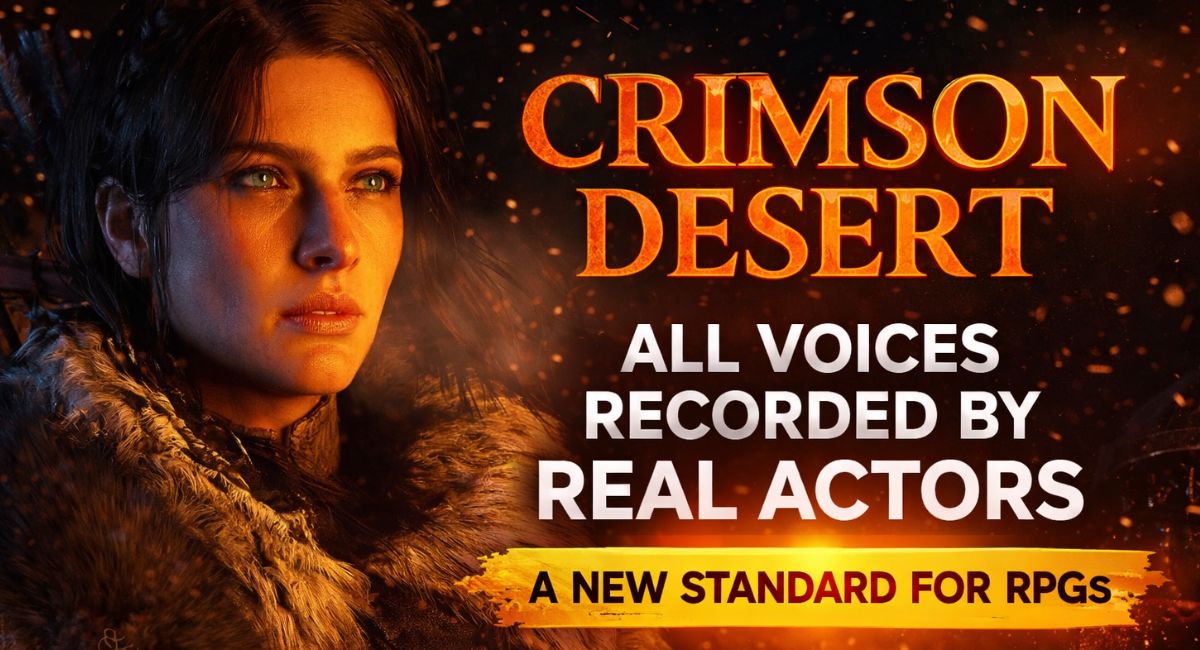
Few modern role-playing games have generated as much sustained anticipation as Crimson Desert. Developed as a large-scale open-world action RPG set in a brutal and politically charged medieval fantasy world, the game has consistently promised technical innovation and narrative ambition. But one recent revelation stands out above the rest: all Crimson Desert voices have been recorded by real actors.
In an era where artificial voice synthesis and digital shortcuts are becoming increasingly common, this decision speaks volumes about the developers’ commitment to quality and authenticity. It is not merely a production detail. It is a philosophy.
This article explores what that decision means for the future of storytelling in games, how it elevates Crimson Desert above its competitors, the technical specifications behind its production, and why this approach strengthens its credibility among both players and industry professionals.
What Is Crimson Desert?
Crimson Desert is a narrative-driven open-world action RPG set on the war-torn continent of Pywel. Players step into the role of Kliff, a hardened mercenary leader navigating political turmoil, shifting alliances, and personal redemption.
The game blends:
- Large-scale battlefield encounters
- Deep narrative arcs
- Real-time combat mechanics
- Expansive exploration
- Cinematic storytelling
Unlike traditional MMORPG structures, Crimson Desert focuses heavily on a single-player narrative experience, though it carries ambitious world-building DNA from its developers’ earlier projects.
At its core, the game aims to deliver an emotionally resonant story within a living, breathing world.
Why Real Actors Matter in Modern Gaming?
The announcement that every voice in Crimson Desert has been recorded by real actors signals a significant industry stance.
The Human Factor
Voice acting is more than reading dialogue. It requires:
- Emotional nuance
- Timing and pacing
- Character embodiment
- Subtle performance variations
Real actors bring lived experience and professional craft to their performances. They respond to context, tone shifts, and dramatic tension in ways that synthetic tools cannot replicate with the same authenticity.
In narrative-heavy RPGs, voice delivery often determines whether a scene feels cinematic or mechanical. Crimson Desert’s decision ensures its characters will sound human, not processed.
Building Emotional Credibility Through Performance
A world as intense as Pywel demands layered performances.
Mercenaries torn by loyalty. Nobles driven by ambition. Soldiers grappling with loss. These emotional beats require:
- Breath control
- Dynamic expression
- Controlled vulnerability
- Authentic intensity
By employing real actors across the entire cast, Crimson Desert ensures consistency in tone and emotional continuity. Players are more likely to feel immersed when dialogue feels natural rather than artificially polished.
In high-stakes storytelling, believability is everything.
Technical Production Specs of Crimson Desert
While the voice acting revelation has attracted attention, it exists within a larger framework of ambitious production standards.
Here are the confirmed and widely discussed technical elements of Crimson Desert:
Genre: Open-world action RPG
Setting: Medieval fantasy continent of Pywel
Perspective: Third-person
Engine: Proprietary next-generation engine
Primary Mode: Narrative-driven single-player
Combat Style: Real-time, physics-influenced action
World Design: Seamless open world
Voice Production: Entire cast recorded by professional real actors
Audio Design: Fully localized cinematic dialogue
The integration of professional voice actors complements the game’s advanced engine, which emphasizes realistic physics, environmental interaction, and detailed character animation.
High-fidelity visuals require equally high-fidelity sound design. Without authentic voice work, even the most beautiful world can feel hollow.
Immersion: The Competitive Edge
In today’s gaming landscape, immersion separates good games from unforgettable ones.
Crimson Desert is competing in a market shaped by titles that have raised expectations for:
- Performance capture
- Voice realism
- Cinematic dialogue pacing
- Emotional storytelling
By ensuring that every character — from major protagonists to minor NPCs — is voiced by real actors, the developers are signaling that no detail is too small.
Even incidental dialogue can shape player perception of a world’s authenticity.
The Risks of Synthetic Voices in Narrative RPGs
Some studios have begun experimenting with synthetic or AI-assisted voice production to reduce costs or streamline localization. While technology continues to evolve, it often lacks:
- Organic imperfection
- Emotional spontaneity
- Reactive nuance
- Subtle performance texture
In a story-driven title like Crimson Desert, any artificial-sounding dialogue could undermine narrative tension.
By investing in professional actors instead, the developers eliminate that risk.
Performance Capture and Character Animation Synergy
Modern RPG development increasingly integrates voice acting with performance capture. When actors physically embody their roles — even partially — animators can align facial expressions, posture, and vocal intensity more precisely.
Crimson Desert’s approach likely enhances:
- Lip-sync accuracy
- Emotional facial animation
- Character movement authenticity
- Cinematic cutscene realism
The result is a seamless blend of sound and motion that reinforces immersion.
Cultural and Global Localization Impact
Crimson Desert is positioned as a global release. Recording all voices with real actors also enhances localization quality.
Professional actors bring:
- Cultural sensitivity
- Language fluency
- Natural dialect control
- Contextual understanding
Rather than relying on automated voice adaptation, the use of actors ensures each regional version maintains narrative integrity.
For international audiences, this strengthens trust in the brand.
Why This Matters for the Industry?
Crimson Desert’s decision reflects a broader debate in entertainment: craftsmanship versus automation.
While technology can accelerate production, storytelling remains a human art form.
By prioritizing actors, the developers affirm:
- Commitment to creative authenticity
- Investment in artistic talent
- Respect for performance craft
- Long-term brand credibility
In a competitive market, these values resonate with players who care about storytelling depth.
Early Player Expectations and Community Response
Initial reactions to the voice acting announcement have been largely positive. Fans of cinematic RPGs understand how critical voice delivery can be.
Common sentiments include:
- Appreciation for authenticity
- Confidence in narrative depth
- Optimism about character development
- Increased anticipation for story scenes
Voice performance shapes first impressions. If Crimson Desert delivers on its promise, it may redefine expectations for mid-generation RPG releases.
Storytelling as a Core Design Pillar
Many action RPGs emphasize combat systems and open-world exploration. Crimson Desert, however, appears equally focused on character-driven storytelling.
Real actors reinforce this direction.
When dialogue feels genuine:
- Players form stronger emotional attachments
- Narrative twists hit harder
- Character arcs feel earned
- Moral decisions carry weight
Storytelling thrives on human expression.
The Economic Decision Behind Real Actors
Hiring professional voice actors is not a small expense. Recording sessions, direction, editing, and localization all require substantial investment.
This choice suggests:
- Confidence in the game’s commercial potential
- Long-term franchise planning
- Dedication to premium production values
It also positions Crimson Desert as a prestige title rather than a cost-optimized project.
Future-Proofing Narrative RPG Development
As technology advances, audiences grow more discerning. Players recognize emotional authenticity.
By grounding its voice work in human performance, Crimson Desert builds resilience against trends that may age poorly.
Synthetic voices may improve, but authentic acting rarely feels outdated.
This strategic foresight strengthens the game’s long-term reputation.
A Statement of Artistic Integrity
The revelation that every voice in Crimson Desert has been recorded by real actors is more than a production detail. It is a statement.
It reflects:
- Confidence in narrative ambition
- Respect for performance artistry
- Commitment to immersive storytelling
- Strategic long-term thinking
As the gaming industry navigates rapid technological transformation, Crimson Desert reminds us that at the heart of compelling stories are human voices.
If the game’s visuals, combat, and world-building match the authenticity of its voice performances, it may not only meet expectations — it may redefine them.
FAQs
Is Crimson Desert fully voiced by real actors?
Yes. All dialogue in Crimson Desert has been recorded by professional real actors, ensuring authentic vocal performances across the entire cast.
Who is the main character in Crimson Desert?
Players take on the role of Kliff, a mercenary navigating political chaos and personal conflict in the continent of Pywel.
Is Crimson Desert an MMORPG?
While the game’s developers have MMORPG experience, Crimson Desert is designed primarily as a narrative-driven open-world action RPG.
What engine does Crimson Desert use?
The game runs on a proprietary next-generation engine built to support large-scale environments, realistic physics, and cinematic storytelling.