
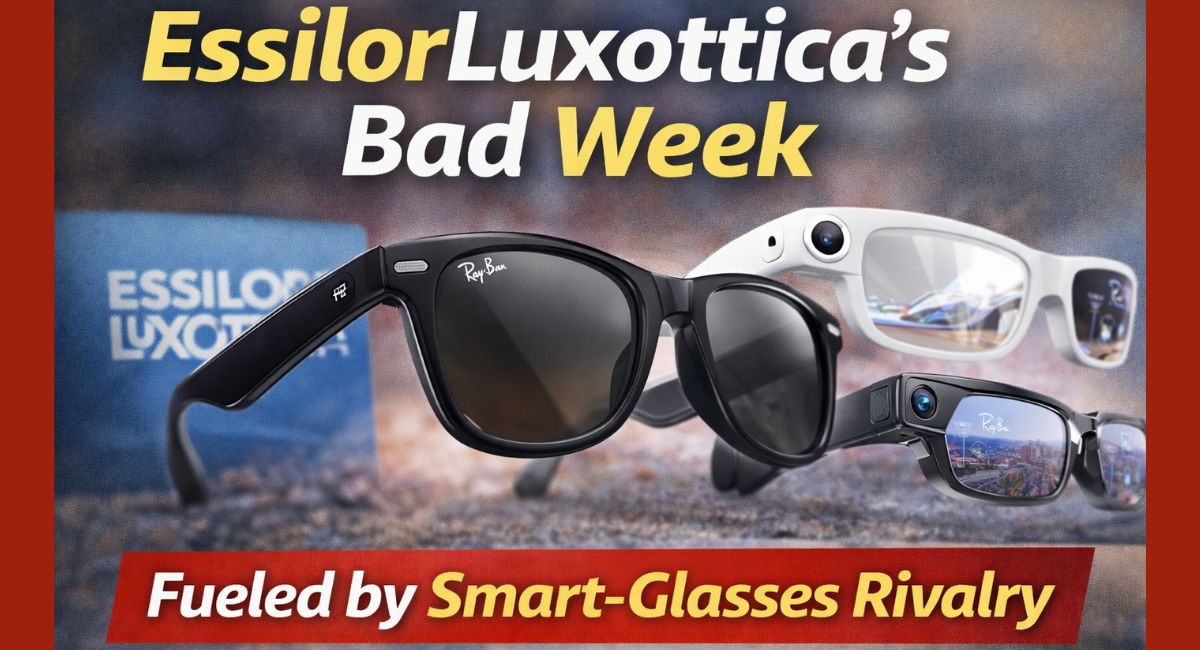
The eyewear industry has long been dominated by legacy brands known for craftsmanship, retail strength, and optical innovation. But in recent years, a new category has disrupted the traditional playbook: smart-glasses.
What was once seen as a niche tech experiment is now a serious battleground between eyewear giants and Silicon Valley powerhouses. And few companies sit more directly at this crossroads than EssilorLuxottica.
After a turbulent week shaped by competitive pressures and investor scrutiny, the company finds itself navigating one of the most transformative periods in its history. The challenge is no longer just about lenses and frames—it’s about integrating hardware, software, artificial intelligence, and consumer lifestyle into a single wearable device.
This article explores how smart-glasses rivalry is influencing EssilorLuxottica’s trajectory, why the competition is heating up, and what it means for the broader wearable technology ecosystem.
The Rise of Smart-Glasses: From Concept to Competitive Reality
For over a decade, smart-glasses have promised a future where digital information seamlessly integrates into daily life. Early attempts were ambitious but premature. Battery limitations, bulky designs, privacy concerns, and high costs kept adoption low.
However, technological improvements have reignited interest.
Today’s smart-glasses offer:
- Integrated speakers
- Built-in cameras
- Voice assistants
- Augmented reality (AR) overlays
- AI-powered contextual assistance
Unlike early experimental devices, modern smart-glasses prioritize wearability and fashion alongside functionality.
This shift has attracted both technology giants and established eyewear manufacturers—setting the stage for rivalry.
EssilorLuxottica’s Unique Position in the Smart-Glasses Ecosystem
EssilorLuxottica occupies a rare strategic position.
The company controls:
- Global eyewear brands
- Extensive manufacturing capabilities
- Retail distribution networks
- Optical lens expertise
In theory, this makes it well positioned to lead in smart-glasses development. It understands consumer fit, frame comfort, optical integration, and retail strategy better than most technology companies.
However, smart-glasses are not just about hardware aesthetics—they are deeply tied to software ecosystems and AI capabilities. This is where the competitive challenge intensifies.
Technology Companies Enter the Arena
Major technology players have re-entered the smart-glasses race with renewed focus.
These companies bring strengths in:
- AI integration
- Advanced chipsets
- Software ecosystems
- Cloud connectivity
- Developer platforms
The rivalry is no longer hypothetical. It is now strategic and aggressive.
While eyewear companies focus on design, tech firms focus on computational power and user data ecosystems. The winning formula likely requires both.
Why EssilorLuxottica Faced a Difficult Week?
Investor sentiment often shifts quickly in technology-adjacent industries. When competition intensifies or product announcements shift expectations, market reactions follow.
A challenging week for EssilorLuxottica reflects broader concerns:
- Can it compete with tech-first companies?
- Does it have enough in-house AI expertise?
- Will partnerships sustain long-term innovation?
- Can margins hold amid rising R&D costs?
In smart-glasses, success depends on rapid iteration cycles—a pace more common in technology firms than traditional eyewear brands.
The Smart-Glasses Technology Stack Explained
To understand the rivalry, it helps to break down what modern smart-glasses actually require.
Hardware Components
- Micro speakers or bone conduction drivers
- High-resolution micro cameras
- Embedded processors
- Sensors (gyroscope, accelerometer)
- Micro displays for AR
- Battery modules
Software Requirements
- AI-powered voice assistants
- Image recognition systems
- Real-time translation
- Augmented reality overlays
- Secure cloud connectivity
Balancing these components while maintaining lightweight comfort is an engineering challenge.
Fashion vs Function: A Critical Balance
Smart-glasses cannot succeed if they look like experimental gadgets. Consumers expect:
- Stylish frames
- Comfortable fit
- All-day wearability
- Prescription lens compatibility
EssilorLuxottica’s strength lies in aesthetic credibility. Technology brands often struggle with fashion authenticity.
The rivalry hinges on merging:
- Design sophistication
- Technological innovation
This is easier said than done.
Consumer Demand: Is the Market Ready?
The success of smart-glasses depends on consumer readiness.
Key questions include:
- Are users comfortable wearing cameras publicly?
- Do consumers see daily value in AR overlays?
- Will pricing remain accessible?
Unlike smartphones, smart-glasses must justify being worn continuously. They cannot feel intrusive.
Adoption will likely be gradual rather than explosive.
Competitive Landscape Overview
The smart-glasses market includes:
- Tech giants investing in AR
- Consumer electronics companies exploring audio-based glasses
- Eyewear brands integrating subtle smart features
Some models emphasize audio and calls without displays. Others pursue full AR immersion.
The spectrum ranges from lifestyle accessories to near-headset computing devices.
EssilorLuxottica must decide where on this spectrum it competes most effectively.
Financial Implications of Smart-Glasses Rivalry
Developing smart-glasses is capital-intensive.
Costs include:
- Semiconductor integration
- AI development
- Hardware miniaturization
- Regulatory compliance
- Global marketing
Margins can shrink in early product cycles due to R&D investments.
Investors often scrutinize companies transitioning into technology-heavy categories.
Short-term volatility may reflect long-term repositioning.
Strategic Partnerships: A Necessary Path?
Given the complexity of smart-glasses, partnerships between eyewear companies and technology firms are almost inevitable.
Such collaborations combine:
- Optical expertise
- AI and software capabilities
- Manufacturing scale
- Brand equity
However, partnerships can also introduce dependency risks.
Control over user data, ecosystem integration, and innovation timelines become critical negotiation points.
The Future of Smart-Glasses: Evolution or Revolution?
Smart-glasses could evolve in phases:
Phase 1:
Audio-first glasses with subtle connectivity features.
Phase 2:
Camera-enhanced glasses with AI assistance.
Phase 3:
Full AR displays with spatial computing capabilities.
Each phase introduces new challenges.
Battery efficiency, privacy regulations, and user comfort remain central concerns.
Why the Rivalry Is Intensifying Now
Several macro trends are accelerating competition:
- Advances in AI chips
- Miniaturization of displays
- Growing wearable adoption
- Demand for hands-free computing
- Consumer familiarity with voice assistants
Companies recognize that the next computing platform may shift from phones to wearables.
Smart-glasses sit at the center of that transition.
What This Means for Consumers?
For buyers, rivalry is positive.
Increased competition leads to:
- Better product refinement
- Faster innovation cycles
- Improved pricing strategies
- Broader feature availability
Consumers may benefit from improved battery life, smarter AI integration, and lighter designs.
Risks Facing the Smart-Glasses Market
Despite optimism, challenges remain:
- Privacy concerns around cameras
- Regulatory restrictions in public spaces
- Limited battery capacity
- High production costs
- Consumer skepticism
Companies must navigate these carefully to avoid early backlash.
EssilorLuxottica’s Strategic Crossroads
For EssilorLuxottica, the path forward involves:
- Balancing tradition with innovation
- Leveraging global brand power
- Expanding digital expertise
- Managing investor expectations
The company’s future in smart-glasses will depend on how effectively it blends eyewear craftsmanship with cutting-edge technology.
A Defining Moment for Wearable Tech
The recent difficult week for EssilorLuxottica highlights the reality of entering a tech-driven battleground.
Smart-glasses are no longer a futuristic experiment—they are becoming a competitive frontier.
Whether this category becomes the next smartphone-level revolution or remains a premium niche depends on execution.
One thing is clear: the rivalry has begun in earnest, and the stakes are high.
FAQs
What are smart-glasses?
Smart-glasses are wearable devices that integrate technology such as speakers, cameras, sensors, or augmented reality displays into traditional eyewear frames.
Why is smart-glasses competition increasing?
Advances in AI, wearable computing, and display miniaturization have made smart-glasses more practical and commercially viable.
Are smart-glasses replacing smartphones?
Not yet. They are currently complementary devices but may evolve into more independent platforms over time.
What challenges do smart-glasses face?
Battery limitations, privacy concerns, regulatory hurdles, and consumer acceptance remain key challenges.