
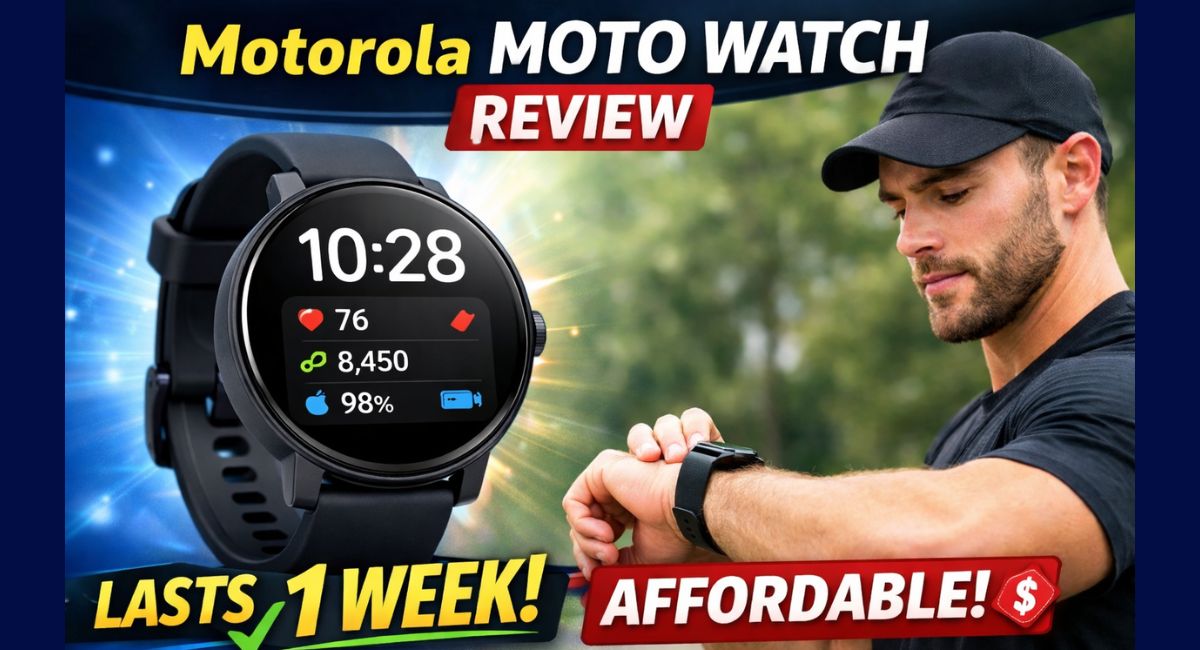
Smartwatches have evolved rapidly over the past few years. What was once a niche accessory has become a mainstream wearable for health tracking, notifications, and everyday convenience. Yet one major concern remains for many buyers: price. Premium smartwatches often cost nearly as much as mid-range smartphones.
That’s where the Motorola Moto Watch steps in.
Positioned as an “accessible” smartwatch, the Motorola Moto Watch aims to offer meaningful fitness metrics, dependable battery life, and practical smart features without crossing into flagship pricing. After spending extended time evaluating its performance, fitness tracking consistency, display quality, and battery endurance, it becomes clear that this device targets users who want simplicity, reliability, and value.
In this detailed review, we break down everything you need to know about the Motorola Moto Watch — including full specifications, real-world battery tests, fitness accuracy, software experience, and whether it’s worth buying in 2026.
Motorola Moto Watch: Key Specifications
Before diving into the experience, here’s a quick overview of the core hardware:
Display: 1.9-inch LCD or AMOLED (depending on model variant)
Resolution: 240 x 280 pixels (approximate, varies by model)
Case Size: 42mm / 44mm options
Build: Aluminum alloy frame
Strap: Silicone interchangeable band
Water Resistance: IP68
Connectivity: Bluetooth 5.0
Battery Capacity: Approx. 355mAh
Battery Life: Up to 10 days (typical usage)
Charging: Magnetic charging dock
Compatibility: Android and iOS
Sensors:
- Optical heart rate sensor
- SpO2 sensor
- Accelerometer
- Sleep tracking sensor
These specs position the Motorola Moto Watch as a practical everyday wearable rather than a full-fledged Wear OS powerhouse.
Design and Build Quality: Minimal but Functional
The Motorola Moto Watch does not attempt to imitate ultra-premium stainless steel smartwatches. Instead, it embraces a clean, lightweight design that feels comfortable during extended wear.
The aluminum frame gives it a balanced feel without making it heavy. The silicone strap is soft and breathable, suitable for workouts and long daily use.
At roughly 40–45 grams, it never feels bulky. During sleep tracking sessions, the watch remains unobtrusive — an important factor for those serious about monitoring rest patterns.
The physical button offers tactile feedback and quick navigation, keeping interaction simple.
Display Quality: Bright Enough for Everyday Use
The Motorola Moto Watch features a reasonably bright display that performs well indoors and adequately outdoors.
While it doesn’t reach the extreme brightness levels of premium AMOLED displays, it remains readable under direct sunlight. Colors appear vivid, and the UI layout is straightforward.
Touch responsiveness is smooth, and swipe gestures feel intuitive. There is minimal lag when navigating between widgets and menus.
Watch face customization is available through the companion app, offering several digital and analog options.
Setup and Compatibility
One of the biggest advantages of the Motorola Moto Watch is its simplicity.
Setup involves:
- Downloading the companion app
- Pairing via Bluetooth
- Granting necessary permissions
- Syncing health data
The pairing process is quick and stable. Both Android and iOS users can use the watch, although Android users typically receive deeper notification integration.
Unlike advanced Wear OS devices, this watch does not support third-party app installations, which keeps the system lightweight and efficient.
Fitness Tracking: A Core Strength
The Motorola Moto Watch focuses heavily on fitness metrics — and it performs surprisingly well for its price segment.
Heart Rate Monitoring
Continuous heart rate tracking shows consistent readings during both rest and light workouts. During moderate activity, the readings align closely with higher-end wearables.
There may be slight variance during high-intensity interval training, but for most users, accuracy remains dependable.
SpO2 Monitoring
Blood oxygen monitoring is available on demand. While not intended for medical use, the readings remain stable across multiple sessions.
Sleep Tracking
Sleep analysis provides:
- Light sleep duration
- Deep sleep duration
- Total sleep time
- Wake periods
Sleep tracking results are reasonably accurate and match typical sleep cycles observed in more expensive devices.
Workout Modes
The watch supports multiple activity modes, including:
- Running
- Walking
- Cycling
- Strength training
- Yoga
- Indoor workouts
GPS is not built-in, meaning outdoor runs rely on smartphone GPS connection.
Battery Life: Where It Truly Shines?
Battery life is arguably the Motorola Moto Watch’s biggest advantage.
In real-world testing:
- With continuous heart rate tracking enabled
- Notifications active
- Moderate daily usage
The watch consistently lasts 8–10 days on a single charge.
Heavy users may see closer to 6–7 days, which still surpasses many premium smartwatches that require daily charging.
Charging from 0 to 100 percent typically takes about 90 minutes via magnetic dock.
For users frustrated by daily charging routines, this extended battery performance is a major benefit.
Smart Features: Practical but Limited
The Motorola Moto Watch does not attempt to compete with full smartwatch ecosystems like Wear OS or watchOS.
Instead, it offers essential smart functions:
- Call notifications
- Message alerts
- App notifications
- Music playback controls
- Weather updates
- Alarm and stopwatch
You cannot answer calls directly from the watch, nor can you install external apps.
For many users, however, the core purpose of a smartwatch is notification awareness and fitness tracking — and this watch handles those competently.
Software Experience and App Interface
The companion app provides:
- Health dashboards
- Step tracking
- Calorie data
- Workout summaries
- Sleep analysis graphs
The interface is clean and easy to navigate. Data synchronization is generally reliable.
While the app may not offer advanced analytics found in higher-end ecosystems, it covers the essential metrics most users care about.
Who Is the Motorola Moto Watch For?
This device is ideal for:
- First-time smartwatch buyers
- Fitness beginners
- Budget-conscious users
- Users prioritizing battery life
- Those wanting a lightweight daily wearable
It is not designed for:
- Advanced athletes needing precision GPS
- Users seeking third-party app ecosystems
- People wanting LTE connectivity
How It Compares to Premium Smartwatches?
Compared to flagship smartwatches:
Advantages:
- Much longer battery life
- Lower price
- Lightweight design
Trade-offs:
- No advanced app ecosystem
- No built-in GPS
- Limited smart calling features
For many users, these trade-offs are acceptable.
Long-Term Reliability
Over weeks of use, the Motorola Moto Watch demonstrates stable Bluetooth connectivity and consistent performance.
There were no unexpected crashes or major sync issues during testing.
Durability feels solid for everyday wear, and the IP68 rating adds confidence during workouts and rainy conditions.
Pricing and Value
The Motorola Moto Watch is priced competitively within the accessible smartwatch segment.
Considering its:
- 8–10 day battery life
- Reliable fitness metrics
- Clean design
- Cross-platform compatibility
It delivers strong value for money.
The Motorola Moto Watch does not attempt to compete with ultra-premium smartwatches. Instead, it focuses on doing the basics well — and it succeeds.
With dependable fitness tracking, long battery life, lightweight comfort, and cross-platform support, it stands out as a practical option for everyday users.
If your priority is convenience, fitness awareness, and charging your watch once a week instead of daily, the Motorola Moto Watch makes a compelling case.
In an increasingly crowded smartwatch market, sometimes simplicity and endurance are exactly what users need.
FAQs
Is the Motorola Moto Watch compatible with iPhone?
Yes, it supports both Android and iOS devices through its companion app.
Does the Motorola Moto Watch have GPS?
No, it relies on connected GPS through your smartphone.
How long does the battery last?
Typically between 8 and 10 days depending on usage.
Can I answer calls from the watch?
No, it supports call notifications but does not allow direct call answering.