Motorola Edge 70 Fusion Leak: Is Snapdragon 7-Series Not Enough This Time?

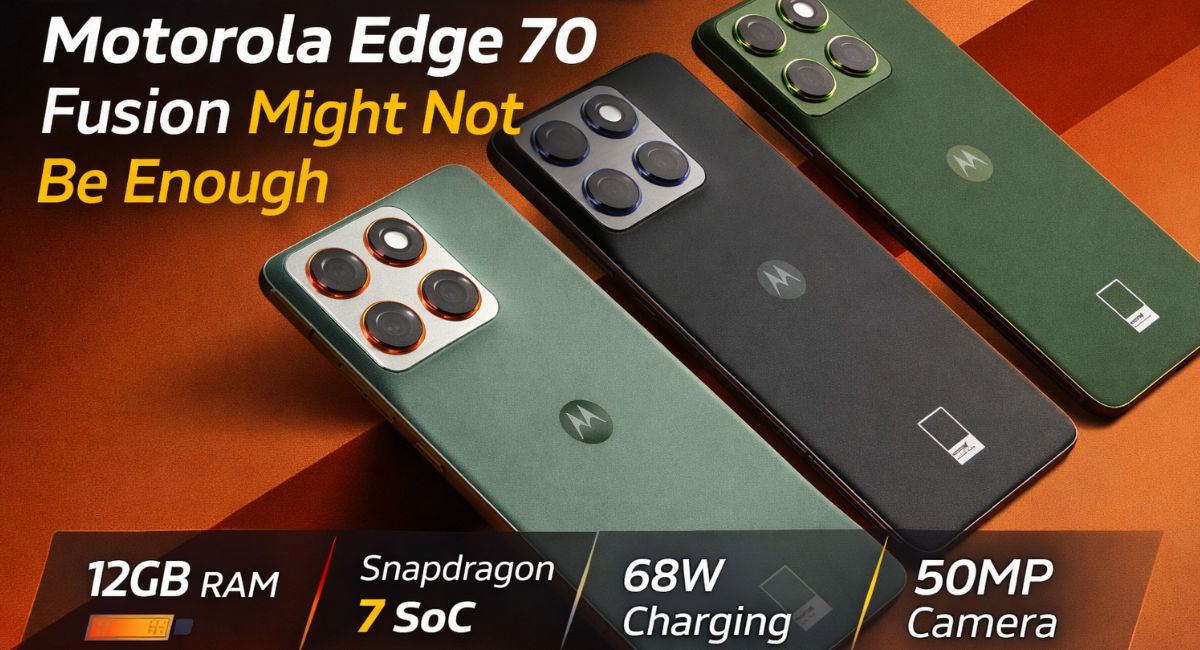
The mid-range smartphone market is more competitive than ever. Every year, brands try to blur the line between flagship luxury and affordable practicality. Now, a fresh leak has put the spotlight on the Motorola Edge 70 Fusion, suggesting it will arrive powered by a Snapdragon 7-series processor.

If accurate, this move positions the device as a performance-focused upper mid-range contender—one designed for users who demand speed, efficiency, and premium design without flagship pricing.

In this in-depth analysis, we break down what the leak reveals, examine expected specifications, discuss performance implications, and evaluate how the Motorola Edge 70 Fusion could reshape the segment.

Why the Snapdragon 7-Series Matters?

Motorola’s Fusion lineup has traditionally targeted users who want strong everyday performance with modern design and capable cameras. The introduction of a Snapdragon 7-series chip could elevate that promise significantly.

The Snapdragon 7-series platform is known for:

  • Balanced performance and power efficiency
  • Advanced AI capabilities
  • Strong gaming support
  • Improved camera processing
  • 5G connectivity
  • Enhanced thermal management

Unlike entry-level processors, Snapdragon 7-series chips typically bring near-flagship-level responsiveness in multitasking and gaming scenarios.

If the leak proves accurate, the Motorola Edge 70 Fusion may deliver a noticeable boost over its predecessor.

Expected Core Specifications

While official confirmation is pending, leaks and industry trends suggest the following potential configuration for the Motorola Edge 70 Fusion:

Processor & Performance

  • Chipset: Snapdragon 7-series (likely 7 Gen platform)
  • Architecture: 4nm or similar advanced node
  • GPU: Adreno GPU optimized for gaming
  • AI Engine: Integrated AI acceleration
  • Connectivity: 5G support, Wi-Fi 6 or above, Bluetooth 5.3

Memory & Storage

  • RAM Options: 8GB / 12GB
  • Storage Variants: 128GB / 256GB
  • Storage Type: UFS 2.2 or better

Display

  • Size: Around 6.6–6.7 inches
  • Panel Type: pOLED or AMOLED
  • Refresh Rate: 120Hz or 144Hz
  • Resolution: Full HD+
  • HDR Support: HDR10+

Cameras

  • Primary Camera: 50MP with OIS
  • Ultra-Wide Camera: 13MP or similar
  • Front Camera: 32MP selfie sensor
  • Video: 4K recording capability

Battery & Charging

  • Battery Capacity: 4,500–5,000mAh
  • Charging Speed: 68W fast charging (expected)
  • USB Type-C: Yes

Software

  • Operating System: Android 14 or newer
  • UI: Near-stock Motorola experience
  • Security Updates: Multi-year support expected

These specifications suggest a device that aims squarely at performance-focused mid-range buyers.

Performance Expectations: Real-World Impact

A Snapdragon 7-series processor typically bridges the gap between mid-range and flagship.

Multitasking

With 8GB or 12GB of RAM, users can expect smooth switching between apps, stable background processes, and minimal lag during heavy usage.

Gaming

The Adreno GPU integrated into Snapdragon 7-series chips is optimized for popular titles. Casual and even moderately demanding games should run comfortably at high settings with stable frame rates.

Thermal management improvements also mean reduced throttling during extended gaming sessions.

AI Enhancements

Modern Snapdragon 7-series processors integrate AI features that enhance:

  • Camera scene detection
  • Image processing
  • Battery optimization
  • Voice recognition

This means the Motorola Edge 70 Fusion could offer smarter photography and better battery longevity through AI-driven efficiency.

Read more:- The new Audi RS 5: High-Performance Hybrid That Redefines the Sports Sedan Era

Design Language: Premium Without the Premium Price

Motorola’s Edge series has built a reputation for sleek, curved designs and comfortable ergonomics.

Expect the Motorola Edge 70 Fusion to continue this design philosophy:

  • Slim profile
  • Lightweight body
  • Curved display edges
  • Minimal bezels
  • Vegan leather or matte glass finish

Motorola often experiments with unique color finishes, which could help the device stand out in a crowded market.

Build quality will likely feel more premium than the price suggests, a hallmark of the Fusion lineup.

Display: Smoothness and Visual Immersion

A high refresh rate display is almost mandatory in this category.

If Motorola includes a 120Hz or even 144Hz pOLED panel, the Edge 70 Fusion could offer:

  • Smooth scrolling
  • Enhanced gaming visuals
  • Crisp media playback
  • Strong brightness for outdoor use

Motorola typically tunes its displays for vivid colors without oversaturation, appealing to both casual users and content consumers.

Camera Capabilities: Balanced and Practical

Motorola phones often prioritize a reliable primary sensor rather than chasing excessive megapixels.

50MP Main Sensor With OIS

Optical Image Stabilization (OIS) is a significant feature. It helps reduce blur in low-light shots and improves video stability.

Combined with Snapdragon’s image processing engine, users can expect:

  • Better night photography
  • Faster HDR processing
  • More natural skin tones

Ultra-Wide & Selfie Camera

The ultra-wide sensor should handle landscape shots effectively, while a 32MP front camera would cater well to video calls and social media users.

While not positioned as a camera-centric flagship, the Motorola Edge 70 Fusion could deliver consistent, dependable results.

Battery Life and Charging Speed

Battery performance remains critical for mid-range buyers.

A 5,000mAh battery paired with a power-efficient Snapdragon 7-series chip should comfortably deliver:

  • Full-day heavy use
  • Up to two days of moderate use

Motorola’s 68W fast charging is a strong advantage. It can recharge the device quickly, minimizing downtime.

This combination of capacity and charging speed makes the device practical for everyday users.

Software Experience: Clean and Close to Stock

One of Motorola’s biggest strengths is its near-stock Android experience.

Users can expect:

  • Minimal bloatware
  • Clean UI
  • Smooth animations
  • Useful gestures (like chop for flashlight, twist for camera)

The Motorola Edge 70 Fusion is likely to ship with the latest Android version available at launch, along with promised security updates.

For users tired of heavy custom skins, this software approach adds significant value.

Competitive Positioning

The upper mid-range market includes strong competitors offering similar processors and features.

However, Motorola has an opportunity to stand out through:

  • Cleaner software
  • Fast charging advantage
  • Distinctive design
  • Competitive pricing

If priced strategically, the Motorola Edge 70 Fusion could challenge devices in the same performance bracket while offering a more refined user experience.

Who Should Consider the Motorola Edge 70 Fusion?

This device appears ideal for:

  • Students needing reliable performance
  • Mobile gamers seeking balance
  • Professionals wanting stylish design
  • Content consumers who value display quality
  • Users upgrading from older mid-range phones

It may not target hardcore flagship enthusiasts, but it could deliver 80–90% of flagship performance at a significantly lower cost.

Potential Market Impact

Leaks often shape consumer expectations. By hinting at a Snapdragon 7-series chip, the Motorola Edge 70 Fusion already positions itself as performance-forward.

If Motorola pairs this processor with competitive pricing and timely updates, the device could:

  • Strengthen its presence in global markets
  • Reinforce the Edge series brand
  • Expand appeal among younger buyers

Performance-driven mid-range devices are increasingly popular, and this model aligns perfectly with that trend.

Anticipated Final Specifications Summary

CategoryExpected Specification
ProcessorSnapdragon 7-Series
RAM8GB / 12GB
Storage128GB / 256GB
Display6.6–6.7” FHD+ pOLED, 120Hz+
Rear Camera50MP + Ultra-wide
Front Camera32MP
Battery4,500–5,000mAh
Charging68W Fast Charging
OSAndroid 14 or newer
Connectivity5G, Wi-Fi 6, Bluetooth 5.3

The Motorola Edge 70 Fusion appears poised to deliver a refined balance of performance, design, and practicality.

The rumored Snapdragon 7-series chip signals a serious upgrade in processing power, while Motorola’s focus on clean software and fast charging enhances the overall package.

In a market where mid-range devices often feel compromised, this leak suggests that Motorola may once again blur the boundaries between affordability and premium performance.

If these specifications hold true at launch, the Edge 70 Fusion could become one of the most compelling upper mid-range smartphones of the year.

FAQs

What processor will the Motorola Edge 70 Fusion use?

Leaks suggest it will feature a Snapdragon 7-series chipset, offering strong performance and efficiency for mid-range users.

Is the Motorola Edge 70 Fusion good for gaming?

If powered by a Snapdragon 7-series chip with an Adreno GPU, it should handle popular games smoothly at high settings.

Will the Motorola Edge 70 Fusion support 5G?

Yes, Snapdragon 7-series processors typically include integrated 5G connectivity.

Does the Motorola Edge 70 Fusion have fast charging?

Leaks indicate support for 68W fast charging, allowing quick power top-ups.
The new Audi RS 5: High-Performance Hybrid That Redefines the Sports Sedan Era

The performance car landscape is changing. Electrification is no longer a compromise—it’s becoming the foundation of next-generation speed. At the heart of this transformation stands the new Audi RS 5, a high-performance hybrid engineered to deliver explosive power without sacrificing everyday usability.

Audi’s RS division has always balanced raw speed with technical sophistication. Now, by introducing hybrid technology into the RS 5 platform, the brand is signaling a clear direction: electrification can enhance performance rather than dilute it.

In this comprehensive review, we explore everything that matters—powertrain architecture, specifications, performance data, design evolution, interior technology, driving impressions, and ownership considerations.

A New Chapter for RS Performance

For years, the RS 5 has been known for its muscular V6 character and quattro confidence. With the new hybrid setup, Audi hasn’t replaced performance—it has amplified it.

The electrified system enhances torque delivery, sharpens throttle response, and improves efficiency without compromising the RS DNA. This is not a mild update. It represents a structural evolution of what the RS 5 stands for.

The goal? Maintain thrilling acceleration while reducing emissions and preparing for the future of high-performance mobility.

Powertrain: Hybrid Engineering With RS Intent

At the core of the new Audi RS 5 lies a performance-focused hybrid system that combines a turbocharged combustion engine with an electric motor.

Key Powertrain Specifications

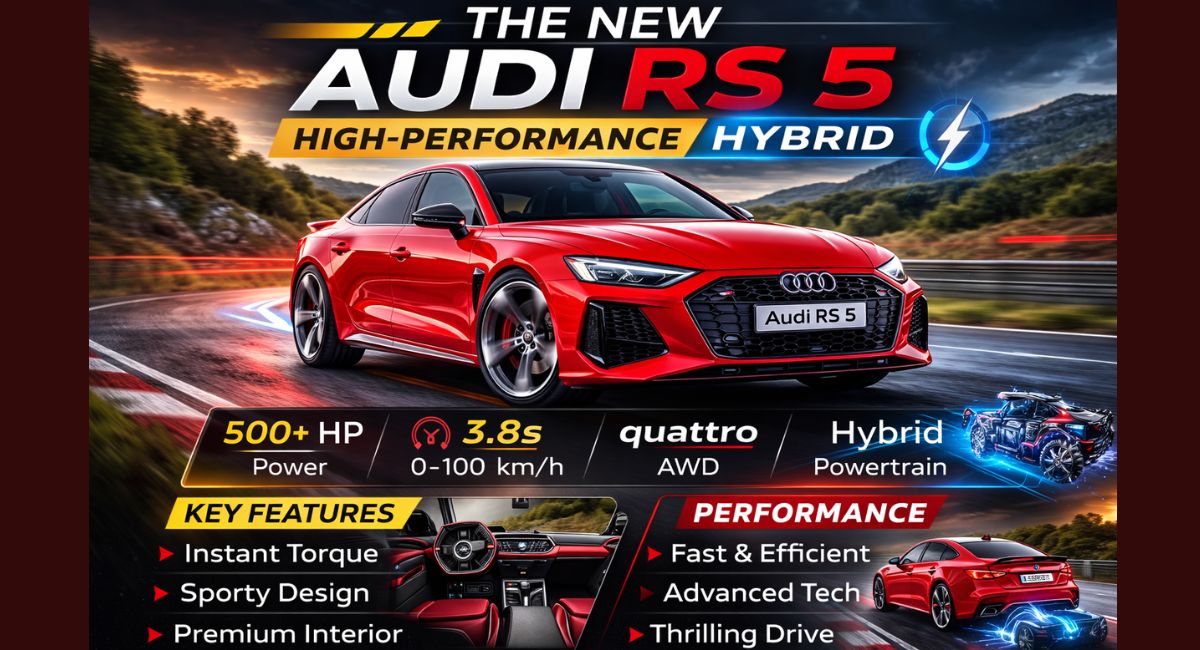
  • Engine: 2.9-liter twin-turbocharged V6
  • Hybrid System: Integrated electric motor with high-voltage battery
  • Combined Output: Approximately 500+ horsepower (varies by market specification)
  • Combined Torque: Over 600 Nm
  • Transmission: 8-speed Tiptronic automatic
  • Drivetrain: quattro all-wheel drive with sport differential
  • 0–100 km/h: Around 3.8 seconds
  • Top Speed: Electronically limited (approx. 250–280 km/h depending on package)
  • Battery Type: Lithium-ion high-voltage battery
  • Driving Modes: Multiple RS-specific drive configurations

The electric motor provides instant torque from standstill, filling in any turbo lag and creating seamless acceleration. The result is a surge of power that feels immediate and continuous.

Unlike traditional hybrids designed for economy, this system is tuned for responsiveness. The electric motor supports the combustion engine during acceleration and can assist with torque vectoring for improved cornering stability.

Electrification Without Compromise

Hybridization in performance cars often raises questions. Will it add weight? Will it dilute the character?

Audi has addressed these concerns through intelligent integration. The battery placement is optimized for weight distribution, maintaining the balanced chassis dynamics the RS 5 is known for.

Regenerative braking not only improves efficiency but enhances braking stability. Energy recovery occurs during deceleration, storing power for future bursts of acceleration.

The transition between electric assistance and combustion power is nearly imperceptible. This seamless integration defines the sophistication of the new RS 5.

Driving Experience: Sharper, Faster, More Responsive

From behind the wheel, the difference is noticeable.

Instant Torque Delivery

Electric assistance eliminates hesitation. Throttle inputs are met with immediate response, especially at low and mid-range speeds.

Enhanced Corner Exit Acceleration

The electric motor supports acceleration when exiting corners, giving drivers confidence and measurable performance advantages on winding roads.

Adaptive RS Suspension

The RS sport suspension dynamically adjusts damping rates. Drivers can choose between comfort-oriented and track-focused setups via Audi Drive Select.

Steering and Handling

The electromechanical steering is precise, weighted appropriately, and communicates road texture effectively. Combined with the quattro system and sport differential, the car remains composed even under aggressive driving.

Exterior Design: Evolution of an Icon

The new Audi RS 5 maintains its athletic proportions while introducing subtle visual cues that hint at electrification.

Notable Exterior Features

  • Wider RS-specific front grille
  • Enlarged air intakes
  • Matrix LED or optional laser headlights
  • Sculpted hood lines
  • Flared wheel arches
  • RS-specific rear diffuser
  • Dual oval exhaust outlets
  • Available carbon-fiber styling packages

The stance remains aggressive but refined. The hybrid identity does not dominate the design—it enhances it.

Wheel options range up to 20 inches, wrapped in high-performance tires developed for maximum grip.

Read more:- Simon India and IIT Bombay Join Forces to Accelerate Green Technology Innovation in India

Interior: Performance Meets Precision Craftsmanship

Inside, the cabin reflects Audi’s reputation for premium build quality and technical innovation.

Interior Highlights

  • RS sport seats with integrated headrests
  • Fine Nappa leather or Alcantara upholstery
  • RS-specific steering wheel with flat bottom
  • Audi Virtual Cockpit with hybrid performance displays
  • Carbon fiber, aluminum, or piano black trim
  • Ambient lighting customization
  • Advanced infotainment system with touchscreen interface

The Virtual Cockpit includes hybrid-specific data such as energy flow, battery status, and performance metrics.

Despite its aggressive character, the RS 5 remains comfortable enough for daily commuting.

Technology and Connectivity

The infotainment system integrates seamlessly with modern smartphone ecosystems. Drivers benefit from:

  • Wireless smartphone integration
  • Voice control
  • Real-time navigation
  • Over-the-air updates
  • Advanced driver assistance systems

Safety features include adaptive cruise control, lane assist, collision mitigation systems, and parking assistance.

Audi’s driver assistance technologies operate subtly in the background, preserving the performance-first identity of the RS badge.

Chassis and Performance Hardware

Performance is not just about power output. The chassis plays an equally critical role.

Performance Components

  • RS sport suspension plus with dynamic ride control
  • Optional carbon-ceramic brake system
  • Progressive steering
  • quattro sport differential
  • Reinforced chassis tuning for hybrid integration

The carbon-ceramic brakes significantly reduce unsprung mass and provide consistent stopping power during repeated high-speed braking scenarios.

Weight management is critical in hybrid performance vehicles. Audi engineers have optimized structural components to offset the added battery mass.

Efficiency Gains

Hybrid assistance improves fuel efficiency compared to previous purely combustion-powered versions.

While exact consumption figures vary by market and test cycle, improvements are measurable under everyday driving conditions.

Electric boost allows the engine to operate more efficiently at cruising speeds, while regenerative braking recaptures energy that would otherwise be lost.

For drivers who want RS performance without excessive fuel penalties, this balance is compelling.

How the new Audi RS 5 Stands Against Competitors?

The high-performance sports sedan segment includes formidable rivals. Yet the hybridized RS 5 occupies a unique position.

Many competitors still rely solely on combustion engines, while others are transitioning to full electrification. The RS 5 bridges these worlds.

It delivers:

  • Traditional engine sound and character
  • Immediate electric torque
  • Everyday usability
  • Premium craftsmanship

This dual personality makes it versatile. It can function as a daily driver, a highway cruiser, or a weekend track machine.

Ownership Experience

Audi’s RS models typically maintain strong resale value due to brand prestige and limited production numbers.

Hybrid technology may also contribute positively in markets where emissions regulations influence taxation or registration fees.

Maintenance complexity increases slightly with hybrid systems, but Audi’s engineering standards ensure reliability through rigorous testing.

Warranty coverage for hybrid components provides additional peace of mind.

Who Is the new Audi RS 5 For?

This vehicle is ideal for:

  • Enthusiasts seeking modernized performance
  • Drivers transitioning toward electrification without abandoning combustion
  • Professionals wanting a premium executive sports sedan
  • Buyers who value quattro traction and all-weather usability

It is not purely a track toy nor a soft hybrid commuter. It occupies the middle ground with precision.

Detailed Specifications Overview

Below is a consolidated overview for quick reference:

CategorySpecification
Engine2.9L Twin-Turbo V6
Hybrid SystemIntegrated Electric Motor
Combined Power500+ HP
Combined Torque600+ Nm
Transmission8-Speed Automatic
Drivetrainquattro AWD
0–100 km/h~3.8 seconds
Top Speed250–280 km/h (limited)
SuspensionRS Adaptive Sport Suspension
BrakesSteel standard / Optional Carbon-Ceramic
InfotainmentAudi Virtual Cockpit + Touchscreen

The Future of RS

The new Audi RS 5 represents a transitional milestone. It proves that performance heritage and electrification can coexist.

As regulatory pressures increase and electrification expands, hybrid performance models like this will define the bridge toward fully electric RS vehicles.

Yet this model retains the emotional core that RS fans expect—sound, grip, acceleration, and tactile engagement.

The new Audi RS 5 signals a confident evolution in high-performance engineering. It doesn’t abandon its roots—it strengthens them with electrification.

For enthusiasts who demand speed, refinement, and modern technology in one cohesive package, this hybrid RS model stands as a benchmark for the next generation of performance sedans.

FAQs

Is the new Audi RS 5 fully electric?

No. The new Audi RS 5 is a hybrid performance vehicle that combines a twin-turbocharged V6 engine with an electric motor for enhanced power and efficiency.

How fast is the new Audi RS 5?

It accelerates from 0–100 km/h in approximately 3.8 seconds, depending on configuration.

Does the hybrid system improve performance?

Yes. The electric motor delivers instant torque, improving throttle response and enhancing acceleration, especially at low speeds.

Is the new Audi RS 5 suitable for daily driving?

Absolutely. Despite its high performance, it offers comfortable suspension modes, premium interior features, and advanced driver assistance systems.

Does the hybrid battery reduce trunk space?

Audi has optimized battery placement to minimize space compromise, though slight reductions may vary by configuration.

Meta Builds AI Infrastructure With NVIDIA: Here’s Why It Matters?

Artificial intelligence is no longer a side project for technology giants. It is the foundation of their future. When the news broke that Meta Builds AI Infrastructure With NVIDIA, it wasn’t just another corporate partnership announcement. It marked a decisive moment in the race to build the most powerful AI computing ecosystem in the world.

Meta, the company behind Facebook, Instagram, and WhatsApp, is investing heavily in AI-driven products—from generative content tools to immersive virtual experiences. To support these ambitions, it has partnered with NVIDIA, the global leader in AI hardware acceleration, to construct a massive, next-generation AI infrastructure designed to train and deploy frontier-scale models.

This article takes a deep dive into what this infrastructure actually includes, why it matters, the technical specifications behind it, and how it positions Meta in the increasingly competitive AI landscape.

The Strategic Vision Behind the Partnership

When Meta Builds AI Infrastructure With NVIDIA, the goal isn’t incremental improvement. It’s exponential acceleration.

Meta’s leadership has made it clear: artificial intelligence is central to everything the company does going forward—content recommendation, advertising optimization, generative AI tools, metaverse development, safety systems, and even internal research.

To train advanced large language models (LLMs) and multimodal AI systems, enormous computational power is required. Traditional data centers simply cannot keep pace. That’s where NVIDIA’s advanced GPU platforms come in.

By combining Meta’s large-scale data capabilities with NVIDIA’s AI-optimized hardware and networking technologies, the companies are building one of the most powerful AI supercomputing environments ever assembled.

The Hardware Foundation: NVIDIA’s AI Accelerators

At the heart of the system powering the initiative are NVIDIA’s high-performance data center GPUs, specifically the latest generation built for AI training and inference at scale.

NVIDIA supplies advanced AI accelerators including:

NVIDIA H100 Tensor Core GPUs

The NVIDIA H100 is designed specifically for training and deploying massive AI models.

Key Specifications:

  • Architecture: Hopper
  • Process Node: 4N (custom TSMC process)
  • Memory: 80GB HBM3
  • Memory Bandwidth: Up to 3 TB/s
  • Transformer Engine: Optimized for large language models
  • FP8 and FP16 Precision Support
  • NVLink High-Speed GPU Interconnect
  • Designed for multi-node scaling

The H100 delivers significant improvements over previous-generation GPUs in:

  • AI training speed
  • Energy efficiency
  • Large-scale transformer workloads
  • Model parallelism

This allows Meta to train multi-trillion-parameter models with greater speed and reduced power consumption per computation.

AI Networking: The Invisible Power Multiplier

When Meta Builds AI Infrastructure With NVIDIA, it’s not just about GPUs. Networking is equally critical.

Large AI models are not trained on a single GPU. They are trained across thousands of GPUs simultaneously. That requires ultra-low latency, high-bandwidth networking.

NVIDIA provides:

NVIDIA Quantum InfiniBand Networking

Key Features:

  • 400Gb/s bandwidth per port
  • Remote Direct Memory Access (RDMA)
  • Low-latency, high-throughput data transfer
  • Scalable architecture across thousands of nodes

InfiniBand enables efficient distributed training by ensuring that GPUs communicate almost as if they were a single system.

NVLink and NVSwitch

Inside each server, NVIDIA’s NVLink interconnect allows GPUs to share memory at extremely high speeds.

This reduces bottlenecks and dramatically increases model training efficiency.

Software Stack: Beyond Hardware

AI infrastructure is incomplete without optimized software.

Meta leverages NVIDIA’s CUDA ecosystem and AI software frameworks to maximize performance.

CUDA Platform

CUDA enables developers to harness GPU acceleration for complex computations.

NVIDIA AI Enterprise Tools

  • Optimized deep learning libraries
  • AI workflow management tools
  • Performance profiling systems
  • Scalable container-based deployment

These tools ensure that the hardware is utilized efficiently for:

  • Model training
  • Model fine-tuning
  • Inference workloads
  • Real-time AI services

Data Center Scale: How Big Is This Infrastructure?

When Meta Builds AI Infrastructure With NVIDIA, the scale is staggering.

Meta has previously disclosed building large-scale AI research clusters with tens of thousands of GPUs. This new infrastructure expands that capacity significantly.

While exact numbers fluctuate with deployment phases, industry analysts estimate that:

  • Tens of thousands of H100 GPUs are involved
  • Exabytes of storage capacity support model training
  • Massive cooling systems are deployed to manage thermal loads
  • Power consumption measured in hundreds of megawatts across facilities

This positions Meta among the top AI supercomputing operators globally.

Read more:- Smarter Spending in 2026: Why the New 2026 Laptop Deals from Laptop Outlet Prioritize Price and Reliability?

Why This Infrastructure Matters for Generative AI?

Generative AI models like large language models and image generators require:

  • Massive training datasets
  • Enormous parameter counts
  • High-speed distributed training
  • Efficient inference capabilities

With this infrastructure, Meta can:

  • Train larger foundation models
  • Improve multimodal AI systems (text + image + video)
  • Enhance content moderation AI
  • Accelerate metaverse-related AI simulations
  • Improve personalized recommendation engines

The computational scale directly influences model quality and capability.

Impact on Meta’s AI Products

Meta has multiple AI initiatives that benefit from this infrastructure:

Large Language Models (LLMs)

Improved reasoning, contextual understanding, and multilingual capabilities.

Recommendation Algorithms

Better personalization across Facebook, Instagram, and WhatsApp.

AI Assistants

More advanced conversational agents embedded in social platforms.

Creator Tools

Generative AI features for image editing, text generation, and video enhancement.

Metaverse Development

AI-driven 3D world generation and immersive interaction models.

The infrastructure enables faster iteration cycles, allowing Meta to release improvements more rapidly.

Energy Efficiency and Sustainability

Large-scale AI infrastructure consumes enormous power. However, modern GPUs like the H100 are designed to maximize performance per watt.

Key sustainability strategies include:

  • Liquid cooling systems
  • Renewable energy integration
  • AI workload optimization to reduce redundancy
  • Advanced power management technologies

Efficiency is not just about cost reduction—it’s about environmental responsibility.

Competitive Landscape

When analyzing the phrase Meta Builds AI Infrastructure With NVIDIA, it’s impossible to ignore the broader AI arms race.

Major players investing heavily in AI supercomputing include:

  • Microsoft
  • Google
  • Amazon
  • OpenAI

The AI infrastructure race is about more than model size. It’s about:

  • Training speed
  • Deployment scalability
  • Energy efficiency
  • Research flexibility
  • Data integration capability

Meta’s partnership with NVIDIA strengthens its competitive standing significantly.

Detailed Technical Overview

Below is a consolidated specification overview of the AI infrastructure components:

Compute Hardware

  • NVIDIA H100 Tensor Core GPUs
  • Hopper architecture
  • 80GB HBM3 per GPU
  • Transformer Engine for optimized LLM training

Networking

  • 400Gb/s NVIDIA Quantum InfiniBand
  • NVLink GPU-to-GPU interconnect
  • NVSwitch for intra-node scalability

Storage

  • Exabyte-scale distributed storage
  • High-performance SSD arrays
  • Parallel file systems optimized for AI workloads

Cooling

  • Advanced liquid cooling systems
  • High-efficiency airflow management
  • AI-optimized thermal monitoring

Software Ecosystem

  • CUDA
  • Deep learning libraries
  • Containerized deployment
  • AI performance monitoring tools

Business Implications

When Meta Builds AI Infrastructure With NVIDIA, it sends a clear message to investors and developers alike:

AI is the company’s primary growth engine.

Implications include:

  • Faster innovation cycles
  • Reduced reliance on third-party cloud providers
  • Greater control over AI development pipelines
  • Improved monetization through AI-powered advertising
  • Expansion into enterprise AI offerings

This infrastructure investment is both technical and strategic.

Long-Term Vision

Meta’s long-term AI roadmap includes:

  • Artificial general intelligence research
  • Fully immersive AI-powered metaverse experiences
  • Advanced AI-driven safety and moderation systems
  • Seamless human-AI interaction

Infrastructure is the backbone that enables these ambitions.

Without this computational foundation, frontier AI development would be impossible at scale.

Risks and Challenges

Despite its advantages, building AI infrastructure at this level presents challenges:

  • High capital expenditure
  • Supply chain constraints
  • Power grid limitations
  • Regulatory scrutiny
  • Data governance complexities

However, partnering with NVIDIA mitigates many technical risks due to its established leadership in AI hardware.

Why This Development Matters for the Industry?

The announcement that Meta Builds AI Infrastructure With NVIDIA reflects a broader industry trend:

AI infrastructure is becoming as critical as traditional internet infrastructure.

Just as cloud computing reshaped the digital world, AI supercomputing will define the next decade.

Companies that control compute capacity will shape the future of AI innovation.

The decision that Meta Builds AI Infrastructure With NVIDIA represents more than a hardware upgrade. It is a foundational shift in how Meta approaches artificial intelligence at scale.

By integrating cutting-edge GPUs, high-speed networking, optimized software ecosystems, and massive data center capacity, Meta is building the computational backbone necessary for the next generation of AI innovation.

In the evolving world of artificial intelligence, compute is power. And with NVIDIA as its infrastructure partner, Meta has positioned itself as one of the most formidable players in the AI-driven future.

FAQs

What does “Meta Builds AI Infrastructure With NVIDIA” mean?

It refers to Meta partnering with NVIDIA to build a large-scale AI supercomputing system powered by NVIDIA’s advanced GPUs and networking technology to train and deploy next-generation AI models.

Which NVIDIA GPUs are used in Meta’s AI infrastructure?

Meta uses NVIDIA H100 Tensor Core GPUs built on the Hopper architecture, designed specifically for large language model training and high-performance AI workloads.

Why does Meta need such powerful AI infrastructure?

Training large language models and multimodal AI systems requires enormous computational power. The infrastructure enables faster training, better model quality, and scalable deployment.

How does this impact Meta’s AI products?

It improves recommendation systems, generative AI tools, AI assistants, safety systems, and metaverse-related technologies.

Smarter Spending in 2026: Why the New 2026 Laptop Deals from Laptop Outlet Prioritize Price and Reliability?

In a market flooded with high-end processors, flashy OLED displays, and ever-increasing price tags, there’s a refreshing shift happening in 2026. Buyers are asking a different question: instead of “What’s the most powerful laptop?” they’re asking, “What’s the most reliable laptop for the price?”

That shift is precisely what defines the New 2026 laptop deals from Laptop Outlet. Rather than chasing premium-tier extravagance, these offers focus on practical performance, long-term durability, and cost efficiency.

For businesses managing IT budgets, students balancing tuition and tech expenses, and professionals seeking dependable work machines, this approach feels timely and strategic.

In this in-depth analysis, we examine the technical specifications, performance benchmarks, reliability factors, and long-term value proposition behind the New 2026 laptop lineup.

The 2026 Laptop Buying Landscape

Laptop buyers in 2026 face a paradox:

  • Devices are more powerful than ever.
  • Prices are increasingly volatile.
  • Hardware cycles are accelerating.
  • Repairability is declining in premium models.

In response, a growing segment of consumers and businesses is prioritizing:

  • Stability over cutting-edge experimentation
  • Predictable performance over benchmark records
  • Warranty-backed reliability over trend-driven upgrades

This is where the New 2026 laptop deals stand out.

What Makes the New 2026 Laptop Lineup Different?

The defining characteristics of these deals include:

  • Competitive pricing across mid-range models
  • Proven processor platforms rather than experimental chipsets
  • Business-grade durability options
  • Balanced RAM and storage configurations
  • Strong after-sales support

Instead of focusing exclusively on ultra-premium devices, the lineup targets everyday productivity and enterprise stability.

Core Technical Specifications (Typical Configurations)

While configurations vary, most New 2026 laptop deals emphasize the following balanced hardware:

Processor Options:

  • Intel Core i5 (13th or 14th Gen)
  • AMD Ryzen 5 7000 Series

RAM:

  • 8GB DDR4 / DDR5 (expandable to 16GB or 32GB)

Storage:

  • 256GB or 512GB NVMe SSD
  • Upgradeable storage bays in select models

Display:

  • 14-inch or 15.6-inch Full HD (1920 x 1080)
  • Anti-glare panel
  • 250–300 nits brightness

Graphics:

  • Integrated Intel Iris Xe or AMD Radeon Graphics

Battery Life:

  • 6 to 10 hours typical usage

Operating System:

  • Windows 11 Pro or Home

These specifications prioritize reliability and business compatibility rather than extreme gaming performance.

Reliability as a Selling Point

Reliability in laptops is about more than hardware specs. It includes:

  • Thermal stability
  • Durable chassis materials
  • Keyboard longevity
  • Battery cycle endurance
  • BIOS and firmware stability

The New 2026 laptop lineup appears curated around models known for predictable performance under sustained workloads.

This matters in:

  • Office environments
  • Educational institutions
  • Remote work setups
  • Small-to-medium enterprises

Unplanned downtime costs more than premium aesthetics ever will.

Performance Benchmarks: Practical, Not Theoretical

A New 2026 laptop in this segment handles:

  • Office productivity suites
  • Web-based applications
  • Video conferencing
  • Light content creation
  • Multitasking workflows

With 8GB RAM and SSD storage, boot times are typically under 15 seconds. Application switching remains smooth for common productivity tasks.

These machines are not designed for:

  • Heavy 3D rendering
  • High-end gaming
  • Advanced video production

But for 80% of everyday users, they deliver sufficient power without unnecessary cost overhead.

Read more:- Crimson Desert Raises the Bar: Every Voice Performed by Real Actors in a Bold Commitment to Authentic Storytelling

Business and Enterprise Appeal

One of the most compelling aspects of the New 2026 laptop deals is their alignment with enterprise purchasing needs.

Businesses value:

  • Standardized configurations
  • Easy fleet management
  • Security features
  • Warranty coverage
  • Upgrade paths

Many models in this lineup include:

  • TPM 2.0 security chips
  • BIOS-level protection
  • Optional fingerprint readers
  • Business-grade Windows editions

This enhances long-term usability and IT oversight.

Cost Efficiency in 2026

Rising component prices have made high-end laptops significantly more expensive.

The New 2026 laptop deals focus on:

  • Mid-range hardware sweet spots
  • Discounted bulk purchasing
  • Refurbished or certified devices (where applicable)
  • Cost-to-performance optimization

This approach supports educational institutions and SMEs with limited budgets.

Battery and Energy Efficiency

Energy efficiency is often overlooked but crucial for reliability.

Most New 2026 laptops in this category prioritize:

  • Efficient processor architectures
  • Integrated graphics for lower power draw
  • Optimized thermal designs

Battery longevity impacts long-term ownership cost.

A stable 8-hour workday battery cycle is often more valuable than high-performance peaks.

Build Quality and Design Philosophy

Unlike fragile ultrabooks that sacrifice durability for slimness, many models in this segment feature:

  • Reinforced hinges
  • Spill-resistant keyboards
  • Matte finishes for reduced fingerprint visibility
  • Standard port selections

Ports typically include:

  • USB-A
  • USB-C
  • HDMI
  • Ethernet (in business models)
  • 3.5mm audio jack

This practical design improves longevity.

Security and Software Stability

Security matters in 2026 more than ever.

The New 2026 laptop lineup emphasizes:

  • Windows 11 security integration
  • Regular firmware updates
  • Business-ready antivirus compatibility
  • Data encryption options

These features enhance trustworthiness for enterprise buyers.

Who Should Buy the New 2026 Laptop?

This lineup is ideal for:

  • Students
  • Office professionals
  • Remote workers
  • Small business owners
  • Facilities management teams
  • Public sector buyers

It is less suited for:

  • Professional gamers
  • High-end graphic designers
  • AI model developers

Understanding your usage profile ensures the best value.

Longevity and Upgrade Potential

A key advantage in this segment is serviceability.

Many New 2026 laptop models allow:

  • RAM upgrades
  • SSD replacements
  • Battery servicing

This extends lifecycle value beyond three years—crucial for business IT budgeting.

Warranty and After-Sales Support

Reliable devices require reliable support.

The New 2026 laptop deals often include:

  • Manufacturer warranty coverage
  • Optional extended protection plans
  • On-site service options
  • Replacement policies

Strong warranty support enhances buyer confidence.

Comparing Value Against Premium Alternatives

Premium laptops may offer:

  • 4K OLED displays
  • Discrete GPUs
  • Ultra-thin aluminum builds

However, they often come at:

  • Higher cost
  • Reduced repairability
  • Shorter battery cycles under heavy load

The New 2026 laptop strategy is about balance—not excess.

Practical Power in a Price-Conscious Era

The New 2026 laptop deals from Laptop Outlet represent a pragmatic shift in consumer technology purchasing.

Instead of chasing performance headlines, they prioritize:

  • Reliability
  • Security
  • Upgrade flexibility
  • Cost efficiency
  • Long-term ownership value

In a technology landscape often driven by rapid upgrades and marketing hype, this approach feels grounded and strategic.

For buyers who value consistency over spectacle, the New 2026 laptop lineup may be exactly what 2026 demands.

FAQs

What is included in the New 2026 laptop deals?

Typically, mid-range laptops with reliable processors, SSD storage, business-ready operating systems, and competitive pricing.

Are these laptops good for office work?

Yes. They are optimized for productivity tasks such as document editing, video calls, spreadsheets, and web applications.

Can I upgrade RAM and storage?

Many models allow RAM and SSD upgrades, extending device lifespan.

Are these laptops suitable for students?

Absolutely. They provide reliable performance for research, assignments, and online classes at affordable price points.

Simon India and IIT Bombay Join Forces to Accelerate Green Technology Innovation in India

This alliance is not merely symbolic. It is structured around actionable innovation, technical development, and scalable solutions designed to support India’s energy transition. With IIT Bombay’s research expertise and Simon India’s industrial capabilities, the partnership aims to create measurable progress in sustainable engineering and climate-conscious design.

In this comprehensive analysis, we examine what this collaboration means for Green Technology in India, the technical scope of the partnership, its long-term strategic implications, and how it could influence industry-wide transformIndia’s sustainability journey is entering a decisive phase. As climate challenges intensify and industries face mounting pressure to decarbonize, partnerships between academia and industry are becoming critical. In this context, the collaboration between Simon India and IIT Bombay represents a significant step forward in advancing Green Technology across research, development, and real-world application.

This alliance is not merely symbolic. It is structured around actionable innovation, technical development, and scalable solutions designed to support India’s energy transition. With IIT Bombay’s research expertise and Simon India’s industrial capabilities, the partnership aims to create measurable progress in sustainable engineering and climate-conscious design.

In this comprehensive analysis, we examine what this collaboration means for Green Technology in India, the technical scope of the partnership, its long-term strategic implications, and how it could influence industry-wide transformation.ation.

The Strategic Importance of Green Technology in India

India stands at a crossroads. Rapid urbanization, expanding infrastructure, and growing energy demands are driving economic growth—but also environmental pressure.

Green Technology has become essential in areas such as:

  • Renewable energy systems
  • Energy-efficient infrastructure
  • Smart grid development
  • Sustainable industrial processes
  • Waste management solutions
  • Low-carbon manufacturing

The transition toward sustainable systems is not optional. It is central to economic resilience, energy security, and environmental responsibility.

This is where structured collaborations like Simon India and IIT Bombay become crucial.

Understanding the Partners

Simon India: Industrial Capability Meets Sustainability

Simon India operates within the industrial engineering and infrastructure development space, with expertise spanning:

  • Electrical systems
  • Industrial automation
  • Smart infrastructure integration
  • Energy management solutions

Its experience in delivering scalable industrial projects makes it well-positioned to implement Green Technology innovations at practical levels.

IIT Bombay: Research Leadership and Technical Depth

Indian Institute of Technology Bombay is one of India’s premier engineering institutions, globally recognized for research excellence.

Its strengths include:

  • Advanced materials research
  • Renewable energy systems
  • Environmental engineering
  • Energy storage innovation
  • Sustainable design frameworks

By partnering with Simon India, IIT Bombay can extend its laboratory innovations into industry-scale applications.

Read more:- Lewis Hamilton Says the 2026 Ferrari Car Has His ‘DNA’: A New Era Begins in Maranello

Objectives of the Green Technology Partnership

The collaboration is structured around three core pillars:

1. Research and Development

The partnership aims to accelerate R&D in:

  • Energy-efficient industrial systems
  • Carbon footprint reduction technologies
  • Smart electrical infrastructure
  • Sustainable manufacturing frameworks

Joint research initiatives are expected to produce prototype systems and pilot models ready for industrial deployment.

2. Technology Transfer and Commercialization

Academic research often faces a commercialization gap. This collaboration bridges that divide by:

  • Translating lab discoveries into market-ready products
  • Testing scalable prototypes
  • Creating industry-ready engineering solutions

Simon India’s industrial ecosystem provides a pathway from concept to execution.

3. Skill Development and Talent Pipeline

Green Technology requires trained engineers and technologists.

The partnership will likely support:

  • Internship programs
  • Industry-relevant curriculum enhancement
  • Applied research training
  • Collaborative workshops

This strengthens India’s sustainability talent ecosystem.

Technical Scope: Areas of Focus

While specific project details may evolve, expected areas of focus include:

Renewable Energy Integration

  • Solar photovoltaic optimization
  • Hybrid renewable energy systems
  • Smart grid compatibility
  • Energy storage integration

Energy Efficiency Systems

  • Industrial automation for energy savings
  • Power factor correction technologies
  • Intelligent load management
  • AI-driven energy monitoring systems

Sustainable Infrastructure

  • Green building electrical systems
  • Low-loss transmission components
  • Smart distribution networks

Environmental Impact Reduction

  • Carbon accounting tools
  • Waste-to-energy models
  • Circular economy design frameworks

Expected Technical Specifications and Framework

Although project-specific specs are under development, the Green Technology initiatives under this partnership are expected to adhere to:

Energy Efficiency Standards:

  • High-efficiency motor systems
  • Low transmission losses
  • Advanced insulation and power electronics

Carbon Reduction Targets:

  • Measurable reduction benchmarks
  • Life-cycle emissions analysis
  • Data-driven sustainability metrics

Automation and Digital Integration:

  • IoT-based monitoring systems
  • Predictive maintenance algorithms
  • Smart energy dashboards

Compliance and Certification:

  • Alignment with Indian renewable energy policies
  • Sustainable development frameworks
  • Industry-standard testing protocols

This structured approach enhances credibility and ensures scalability.

Why Industry-Academia Partnerships Matter?

Green Technology evolves rapidly. Industry alone may lack long-term research focus. Academia may lack implementation scale.

When combined, they deliver:

  • Practical innovation
  • Faster deployment cycles
  • Reduced commercialization barriers
  • Sustainable business models

India’s climate goals require coordinated effort.

This partnership exemplifies how private enterprise and academic excellence can converge.

Economic and Environmental Impact

Economic Benefits

  • Job creation in sustainable engineering
  • Growth of green startups
  • Industrial cost optimization through efficiency
  • Competitive advantage in global sustainability markets

Environmental Gains

  • Lower industrial emissions
  • Improved energy utilization
  • Reduction in fossil fuel dependence
  • Stronger renewable adoption frameworks

The ripple effect of Green Technology extends beyond single projects.

India’s Broader Sustainability Context

India has committed to:

  • Expanding renewable energy capacity
  • Achieving net-zero targets
  • Reducing carbon intensity
  • Promoting sustainable urban development

Collaborations like Simon India and IIT Bombay directly support these objectives.

They provide a model for structured, measurable sustainability action rather than isolated innovation.

Challenges and Risk Factors

No major initiative is without obstacles.

Potential challenges include:

  • Technology adoption resistance
  • Cost constraints for SMEs
  • Integration complexity in legacy systems
  • Policy uncertainty

However, structured research-backed solutions can mitigate these risks.

Pilot programs and phased implementation strategies often reduce barriers.

Long-Term Vision

The collaboration signals a long-term ambition.

Future possibilities include:

  • Dedicated Green Technology research centers
  • Joint patent filings
  • International sustainability partnerships
  • Advanced materials research for renewable systems

If sustained, this partnership could redefine how industrial Green Technology is developed in India.

Industry Perspective: Why This Collaboration Stands Out?

What differentiates this initiative is its alignment:

  • Academic credibility
  • Industrial execution capability
  • Policy relevance
  • Scalable technical roadmap

Rather than focusing solely on theoretical sustainability, the collaboration emphasizes practical engineering solutions.

That makes it both credible and impactful.

The partnership between Simon India and IIT Bombay marks more than an institutional agreement. It represents a strategic alignment of knowledge and execution power to accelerate Green Technology innovation in India.

As climate responsibility becomes central to economic growth, such collaborations are not just beneficial—they are essential.

By combining academic rigor with industrial scalability, this initiative has the potential to produce measurable environmental impact while strengthening India’s position as a leader in sustainable engineering.

Green Technology is no longer a niche concept. It is a national imperative.

And partnerships like this may well define how that imperative is fulfilled in the years ahead.

FAQs

What is Green Technology?

Green Technology refers to environmentally sustainable innovations designed to reduce carbon emissions, improve energy efficiency, and minimize ecological impact.

Why is IIT Bombay involved in Green Technology initiatives?

IIT Bombay has extensive research expertise in renewable energy, environmental engineering, and sustainable systems, making it a strong academic partner.

What does Simon India contribute to the partnership?

Simon India brings industrial implementation capability, infrastructure expertise, and commercialization pathways for Green Technology solutions.

How will this partnership impact India’s sustainability goals?

It supports renewable energy integration, industrial energy efficiency, and carbon reduction initiatives aligned with national sustainability commitments.

Lewis Hamilton Says the 2026 Ferrari Car Has His ‘DNA’: A New Era Begins in Maranello

When Lewis Hamilton declared that the 2026 Ferrari car has his ‘DNA,’ it was more than a confident soundbite. It was a statement layered with intent, symbolism, and technical implication. In Formula 1, drivers influence machinery in countless subtle ways. But for a seven-time world champion to suggest that Ferrari’s next-generation car carries his imprint signals something far more strategic.

The 2026 season represents a seismic shift in Formula 1 regulations. New power unit rules, revised aerodynamics, and evolving sustainability requirements will reset the competitive order. Against that backdrop, Hamilton’s assertion positions him not merely as a driver switching teams—but as a co-architect of Ferrari’s future.

In this in-depth analysis, we explore what it truly means when Hamilton says the Ferrari car has his ‘DNA,’ how driver feedback shapes F1 engineering, what the 2026 technical regulations demand, and why this partnership could redefine the competitive landscape.

The Significance of 2026 in Formula 1

 The 2026 regulations are not incremental tweaks—they are structural changes. The sport is introducing:

  • Revised aerodynamic philosophies
  • Lighter chassis targets
  • Greater electrical power contribution
  • Fully sustainable fuel integration
  • Simplified hybrid systems

Power units will shift toward a 50/50 split between internal combustion and electric output. Energy recovery systems will become more influential. Aerodynamic drag reduction systems will evolve.

For teams like Ferrari, this represents a rare opportunity: a reset button.

When Hamilton says the Ferrari car has his ‘DNA,’ it suggests his feedback has influenced how Ferrari interprets these sweeping changes.

What Does “DNA” Mean in Formula 1 Terms?

In motorsport language, DNA is not about branding—it is about driving characteristics.

A car that carries a driver’s “DNA” typically reflects:

  • Preferred steering feel
  • Brake balance characteristics
  • Rear-end stability under acceleration
  • Front-end responsiveness on turn-in
  • Suspension setup philosophy
  • Energy deployment preferences

Lewis Hamilton is known for:

  • Exceptional sensitivity to brake modulation
  • Preference for a stable rear platform
  • Smooth corner entry technique
  • Ability to adapt but strong preference for predictable balance

If the 2026 Ferrari car has his ‘DNA,’ engineers likely tailored development priorities around those traits.

Hamilton’s Development Legacy

Throughout his career, Hamilton has shaped championship-winning machines.

His strengths include:

  • Detailed simulator feedback
  • Tire management insight
  • Sensitivity to aerodynamic balance shifts
  • Deep understanding of hybrid energy deployment

Championship cars are rarely built in isolation. Drivers contribute to:

  • Setup direction
  • Mid-season upgrades
  • Long-term architecture decisions

At Ferrari, his involvement reportedly extends into early-stage development cycles—a crucial factor given the magnitude of the 2026 regulation overhaul.

Ferrari’s Strategic Rebuild

Ferrari’s ambitions in the hybrid era have fluctuated. Moments of promise have been offset by inconsistency.

The 2026 project is understood to involve:

  • A fully redesigned power unit
  • Reworked chassis concept
  • Revised aerodynamic package
  • Integration of sustainable fuels
  • Enhanced energy deployment systems

Hamilton’s arrival aligns perfectly with this rebuild.

When he says the Ferrari car has his ‘DNA,’ it suggests he has influenced not only setup preferences but potentially broader design philosophy decisions.

Read more:- 2026 Nissan Gravite Vs Renault Triber: Same Roots, Different Personalities? A Deep Dive Comparison

Technical Specifications: What We Know About the 2026 Ferrari Concept?

While official specifications remain confidential, based on regulatory frameworks and industry insight, the 2026 Ferrari car is expected to feature:

Power Unit Architecture:

  • 1.6L turbocharged V6 internal combustion engine
  • Increased electric motor contribution
  • Removal of the MGU-H
  • Expanded MGU-K power output

Fuel System:

  • 100% sustainable fuel

Chassis Changes:

  • Lighter overall car weight target
  • Revised floor aerodynamics
  • Reduced drag philosophy
  • Active aero components under consideration

Energy Deployment Strategy:

  • Enhanced battery storage
  • Aggressive energy harvesting
  • Optimized power distribution mapping

Driver input influences how these components interact dynamically.

Why Driver Feedback Matters More in 2026?

With greater electrical reliance, throttle response characteristics will change. Energy harvesting and deployment patterns become more complex.

A driver like Hamilton—who excels at managing hybrid systems—can shape:

  • Deployment mapping during corner exits
  • Brake-by-wire calibration
  • Energy regeneration balance
  • Power delivery smoothness

If Ferrari’s engineers built systems around his strengths, that’s the “DNA” he refers to.

Psychological Impact of the Statement

Beyond technical meaning, the statement carries psychological weight.

In Formula 1:

  • Confidence influences performance
  • Team belief impacts morale
  • Leadership shapes culture

By asserting ownership of the project, Hamilton signals commitment. That can galvanize engineers, mechanics, and management.

Ferrari thrives on belief. The narrative of a champion embedding himself into the team’s future strengthens internal unity.

Adapting Ferrari to Hamilton’s Driving Style

Ferrari cars historically exhibit:

  • Aggressive front-end turn-in
  • Sensitive rear balance
  • Strong mid-corner rotation

Hamilton typically favors:

  • Predictable rear grip
  • Stable braking platform
  • Smooth torque delivery

If the Ferrari car has his ‘DNA,’ it likely balances Ferrari’s natural sharpness with increased rear stability and braking confidence.

This blend could produce a uniquely competitive package.

The Maranello Factor

Ferrari’s facilities in Maranello represent decades of racing heritage. However, modern Formula 1 success requires more than tradition.

The 2026 project reportedly involves:

  • Wind tunnel refinements
  • Simulator upgrades
  • Data modeling expansion
  • Hybrid system innovation

Hamilton’s experience with cutting-edge development processes adds external insight.

When he says the Ferrari car has his ‘DNA,’ it may reflect collaborative alignment between driver and technical department.

Championship Implications

A regulation reset often disrupts dominance hierarchies.

In 2009, 2014, and 2022, new rules reshaped the grid.

2026 could do the same.

If Ferrari successfully integrates:

  • Competitive power output
  • Efficient energy recovery
  • Stable aerodynamic balance
  • Driver-optimized setup characteristics

They may position themselves as immediate title contenders.

Hamilton’s involvement increases that possibility.

Risk Factors

No matter how promising development appears, risks remain:

  • Power unit reliability challenges
  • Cooling integration difficulties
  • Battery management complexity
  • Weight distribution constraints

Even a car with a driver’s ‘DNA’ must overcome engineering realities.

Formula 1 margins are razor-thin.

Commercial and Brand Value

Hamilton joining Ferrari was already commercially seismic. His statement enhances that narrative.

Brand advantages include:

  • Global media amplification
  • Increased sponsor engagement
  • Cultural crossover appeal
  • Youth audience expansion

But ultimately, results determine legacy.

The phrase Ferrari car has his ‘DNA’ raises expectations accordingly.

Can Driver DNA Guarantee Success?

No driver influence guarantees championships.

However, successful F1 projects require:

  • Alignment between driver and engineering
  • Early development clarity
  • Unified technical direction
  • Confidence in car philosophy

If Ferrari truly built the 2026 car around Hamilton’s preferences, it reduces adaptation time.

And in a new regulation era, time matters.

Long-Term Legacy Considerations

For Hamilton, this chapter carries historical weight.

Success at Ferrari would:

  • Cement multi-team championship legacy
  • Enhance historical comparisons
  • Reinforce adaptability credentials

For Ferrari, pairing its iconic heritage with Hamilton’s global stature could redefine modern identity.

When Lewis Hamilton says the Ferrari car has his ‘DNA,’ he signals involvement, belief, and ownership.

In Formula 1, championships are rarely accidental. They are engineered through alignment—between driver, engineers, management, and regulation interpretation.

The 2026 season will test that alignment.

If Ferrari’s technical direction truly reflects Hamilton’s strengths, the partnership could usher in a transformative era. If not, expectations may turn into pressure.

Either way, one thing is clear: the project is personal.

And in Formula 1, personal investment often fuels extraordinary performance.

FAQs

What does Lewis Hamilton mean when he says the Ferrari car has his ‘DNA’?

It means the car’s development reflects his driving preferences, feedback, and technical input, influencing balance, energy deployment, and handling characteristics.

What changes are coming to Formula 1 in 2026?

The 2026 regulations introduce revised aerodynamics, increased electric power contribution, sustainable fuels, and simplified hybrid systems.

Will the 2026 Ferrari be competitive?

While performance remains unproven, regulation resets create opportunities for teams that interpret rules effectively.

How much influence does a driver have on car design?

Top drivers contribute significant feedback during simulator sessions, testing phases, and development meetings, shaping setup philosophy and refinement.

2026 Nissan Gravite Vs Renault Triber: Same Roots, Different Personalities? A Deep Dive Comparison

The compact 7-seater segment in India has always been about value, flexibility, and smart packaging. Now, with the arrival of the 2026 Nissan Gravite, buyers are naturally comparing it with one of the segment’s most practical offerings — the Renault Triber.

At first glance, the two vehicles appear closely related. And that’s not surprising. They share architectural similarities and target the same customer base: families seeking an affordable yet versatile three-row vehicle.

However, when you look beyond the surface, the 2026 Nissan Gravite Vs Renault Triber comparison reveals meaningful differences in design language, positioning, features, and brand philosophy.

In this detailed, expert-level breakdown, we examine everything from specifications and dimensions to interior layout, safety tech, pricing expectations, and ownership considerations.

Platform and Engineering: Shared DNA, Different Execution

Both models are built on a compact modular platform optimized for:

  • Space efficiency
  • Lightweight construction
  • Urban drivability
  • Cost-effective manufacturing

While the engineering roots are similar, Nissan has reworked the Gravite to reflect its evolving design identity and brand positioning.

Core Similarities

  • Front-wheel drive layout
  • Compact footprint under 4 meters
  • Three-row seating layout
  • 7-seater flexibility
  • Naturally aspirated petrol engine

This shared mechanical base keeps pricing competitive while allowing room for differentiation in styling and equipment.

Exterior Design: Urban Boldness vs Practical Simplicity

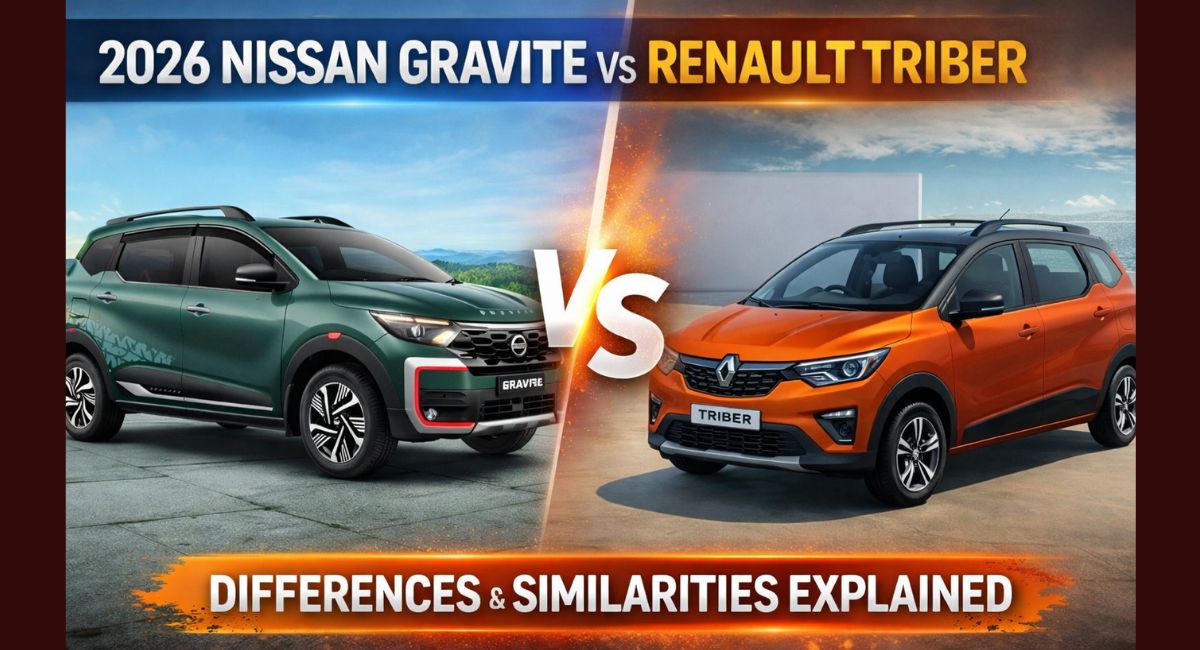
2026 Nissan Gravite: Sportier and More SUV-Inspired

The Nissan Gravite leans toward a crossover-inspired aesthetic. It features:

  • A bold V-motion grille
  • Sharper headlamp design
  • Sculpted bonnet lines
  • Chunkier bumper styling
  • Dual-tone alloy wheel options

Its stance appears slightly more muscular, targeting younger buyers who prefer SUV-like road presence.

Renault Triber: Functional and Balanced

The Renault Triber focuses on practicality:

  • Simpler grille treatment
  • Upright silhouette
  • Clean body lines
  • Practical roof rails
  • Neutral styling approach

It is less aggressive but arguably more timeless.

Verdict on Design

In the 2026 Nissan Gravite Vs Renault Triber design battle, Gravite wins on visual drama, while Triber appeals to conservative family buyers.

Dimensions and Space Utilization

One of the biggest selling points in this segment is interior flexibility.

Dimension Comparison (Expected / Known Figures)

Length: Under 4 meters (both)
Width: Similar compact width
Height: Comparable tall-boy design
Wheelbase: Shared platform architecture

Despite similar footprints, the interior layout can feel slightly different due to design tweaks and material choices.

Interior Layout and Cabin Experience

2026 Nissan Gravite Cabin

Nissan has reportedly upgraded:

  • Dashboard textures
  • Contrast stitching elements
  • Premium finish accents
  • Revised infotainment interface

The cabin feels slightly more modern and driver-focused.

Renault Triber Cabin

The Triber emphasizes modularity:

  • Removable third row
  • Multiple seat configurations
  • Flat floor layout
  • Functional dashboard design

It remains one of the most practical cabins in its category.

Seating and Boot Space Flexibility

The Triber has long been praised for its modularity.

Renault Triber Highlights:

  • Fully removable third-row seats
  • Flexible second-row sliding function
  • Class-leading adaptability

2026 Nissan Gravite Improvements:

  • Enhanced cushioning
  • Revised seat fabric
  • Improved rear AC vents
  • More refined finish

For families who frequently switch between passenger and luggage duties, both vehicles deliver strong versatility.

Read more:- The 5 Powerful Hero Karizma XMR Alternatives That Might Be Better for Entry-Level Sports Bike Buyers

Engine and Performance Specifications

The mechanical heart of this comparison remains crucial.

Expected Engine Specs (Shared Platform)

Engine Type: 1.0L naturally aspirated petrol
Displacement: Approx. 999cc
Power Output: Around 72 PS
Torque: Approx. 96 Nm
Transmission Options:

  • 5-speed manual
  • AMT (Automated Manual Transmission)

Driving Experience

Both vehicles prioritize:

  • Smooth urban commuting
  • Light steering feel
  • Fuel efficiency
  • Ease of maneuverability

Performance is adequate rather than thrilling. These vehicles are designed for city use and moderate highway cruising, not aggressive driving.

Fuel Efficiency

Fuel economy is a strong consideration for buyers in this segment.

Estimated Mileage Range:

  • Manual variant: Approximately 18–20 km/l
  • AMT variant: Slightly lower due to transmission losses

Efficiency figures remain competitive for 7-seater compact MPVs.

Features and Technology

2026 Nissan Gravite Feature Highlights

  • Touchscreen infotainment system
  • Wireless smartphone connectivity (expected in higher trims)
  • Steering-mounted controls
  • Digital instrument cluster elements
  • Rear parking camera
  • Automatic climate control (top variants)

Renault Triber Feature Highlights

  • 8-inch touchscreen
  • Apple CarPlay and Android Auto
  • Push-button start
  • Rear AC vents
  • Height-adjustable driver seat
  • Cruise control (select trims)

The Gravite may position itself slightly higher in perceived premium value, while Triber remains feature-rich for its price.

Safety Features

Safety is increasingly important in family-focused vehicles.

Common Safety Equipment

  • Dual front airbags
  • ABS with EBD
  • Rear parking sensors
  • Seatbelt reminders

Advanced Features (Variant Dependent)

  • Rear camera
  • Electronic Stability Control (in select variants)
  • Hill start assist

Safety ratings and structural improvements will ultimately influence buyer decisions once official crash test results are released.

Pricing Strategy

Pricing will be a defining factor in the 2026 Nissan Gravite Vs Renault Triber rivalry.

Renault Triber: Known for aggressive pricing and value-driven positioning.

Nissan Gravite: Expected to be priced competitively but possibly slightly higher due to added features and styling differentiation.

Buyers must weigh perceived brand appeal against overall value proposition.

Ownership and Brand Perception

Renault has established:

  • Strong presence in the affordable MPV segment
  • Widespread service network
  • Proven reliability record with Triber

Nissan is rebuilding its presence and may offer:

  • Competitive warranty packages
  • Attractive service plans
  • Brand refresh strategy

Long-term ownership costs will play a crucial role.

Who Should Buy Which?

Choose 2026 Nissan Gravite If:

  • You prefer sportier styling
  • You want a slightly more premium interior feel
  • You value modern design language

Choose Renault Triber If:

  • You prioritize maximum flexibility
  • Budget is your top concern
  • You want a proven track record

2026 Nissan Gravite Vs Renault Triber: Final Analysis

While they share structural DNA, these vehicles cater to slightly different emotional triggers.

The Triber is the rational, practical choice.

The Gravite adds personality and updated styling to the same foundational strengths.

For Indian families looking for a compact, affordable 7-seater, both remain strong contenders.

The 2026 Nissan Gravite Vs Renault Triber comparison highlights how two vehicles can share engineering roots yet express different identities.

The Triber remains the benchmark for affordability and modular flexibility.

The Gravite brings fresh styling, enhanced interior touches, and renewed brand appeal.

Ultimately, your choice depends on whether you value proven practicality or refreshed personality. Either way, this segment continues to offer one of the most intelligent family mobility solutions in the Indian automotive market.

FAQs

What is the engine of the 2026 Nissan Gravite?

The 2026 Nissan Gravite is expected to feature a 1.0-liter naturally aspirated petrol engine producing around 72 PS of power.

Is the Nissan Gravite bigger than the Renault Triber?

Both vehicles share similar dimensions under 4 meters in length, making them nearly identical in overall size.

Which car is more affordable, Nissan Gravite or Renault Triber?

The Renault Triber has traditionally been priced aggressively. The Gravite may carry a slightly premium positioning depending on variant.

Does the Nissan Gravite offer 7 seats?

Yes, like the Renault Triber, the Gravite offers a three-row 7-seater configuration.

Call of Duty Is Leaving Android and iOS: But Here’s the Catch That Changes Everything

Few gaming franchises command global attention like Call of Duty. For over two decades, the series has defined competitive shooters across consoles and PC. When it expanded to mobile devices, it reshaped expectations for what smartphone gaming could achieve.

Now, reports that Call of Duty is leaving Android and iOS have triggered confusion, concern, and intense speculation. But the reality is more nuanced. This is not a sudden disappearance. It is a strategic transition — and there is indeed a catch.

In this in-depth analysis, we break down what’s happening, why it’s happening, how it affects players, and what it reveals about the future of mobile gaming within the Call of Duty ecosystem.

Understanding the Headlines: Is Call of Duty Really Leaving Mobile?

The statement that Call of Duty is “leaving” Android and iOS requires context.

The franchise itself is not disappearing from mobile entirely. Instead, the change centers around restructuring, platform realignment, and long-term strategic direction.

For years, Call of Duty: Mobile delivered console-quality gameplay on smartphones. It offered multiplayer modes, battle royale, ranked seasons, weapon progression, and cosmetic customization — all optimized for touchscreen controls.

However, the mobile gaming landscape has evolved rapidly:

  • Hardware capabilities have increased
  • Cross-platform ecosystems have expanded
  • Cloud gaming infrastructure has matured
  • Player expectations for parity with console versions have grown

The reported departure reflects a pivot rather than a shutdown.

The Rise of Call of Duty on Mobile

When Call of Duty: Mobile launched, it achieved something rare. It successfully translated the franchise’s fast-paced gunplay into a mobile format without sacrificing competitive depth.

The game featured:

  • Iconic maps like Nuketown and Crash
  • Ranked multiplayer modes
  • 100-player battle royale
  • Seasonal battle passes
  • Controller support
  • Regular content updates

It quickly amassed millions of downloads and became one of the most successful shooter titles on mobile platforms.

So why step away from Android and iOS?

The Catch: It’s About Consolidation, Not Abandonment

The critical nuance is this: Call of Duty is not exiting the mobile market entirely. Instead, the franchise appears to be consolidating its ecosystem around newer infrastructure and possibly more unified platforms.

There are three likely factors behind the move:

1. Strategic Ecosystem Alignment

The Call of Duty franchise now operates across:

  • Console
  • PC
  • Cloud services
  • Subscription ecosystems

Maintaining separate development pipelines for standalone mobile builds may no longer align with long-term goals.

2. Focus on New Mobile Initiatives

With next-generation mobile hardware, developers may be shifting toward a more integrated or cloud-powered version of Call of Duty that connects directly with console ecosystems.

Rather than maintaining a legacy mobile framework, resources could be redirected to a more scalable future solution.

3. Infrastructure Evolution

Mobile gaming increasingly overlaps with:

  • Cloud gaming platforms
  • Cross-progression systems
  • Unified accounts
  • Shared seasonal content

Leaving Android and iOS in their traditional standalone form could signal a move toward deeper integration with broader franchise architecture.

Read more:- DJI Neo Review: Is This the Beginner Drone That Finally Gets Everything Right?

What Happens to Existing Players?

Naturally, the biggest concern for players is progression and purchased content.

If a mobile version transitions or sunsets, players typically want clarity on:

  • Account preservation
  • Purchased skins and battle passes
  • Rank progression
  • In-game currency balances

Historically, major franchises offer migration options, especially when transitioning platforms.

It is reasonable to expect that Call of Duty’s developers will prioritize user trust by:

  • Communicating transition timelines clearly
  • Offering account migration tools
  • Preserving cross-progression where possible

Player retention depends heavily on continuity.

Technical Specifications: What Mobile Call of Duty Required?

To understand the shift, it helps to revisit what the mobile version required from devices.

Call of Duty: Mobile Technical Specs (Typical Requirements)

Operating System:
Android 5.1+ / iOS 9.0+

RAM:
Minimum 2GB (recommended 3GB or higher)

Storage Space:
Approximately 2GB to 3GB, depending on updates

Graphics:
Mid-range to high-end mobile GPU for optimal performance

Internet Connection:
Stable broadband or 4G/5G connection

Over time, as graphical fidelity improved, the performance demands increased. Maintaining optimization across thousands of device models can become increasingly complex and costly.

A platform consolidation strategy may reduce fragmentation.

The Bigger Picture: Mobile Gaming Is Changing

Mobile gaming today is not what it was five years ago.

The lines between platforms are blurring.

Players expect:

  • Shared progression across devices
  • Unified seasonal events
  • Cross-play compatibility
  • Graphical parity with consoles

If Call of Duty is repositioning itself within this environment, the move may actually strengthen its long-term mobile presence — even if it temporarily disrupts the current model.

Cloud Gaming as the Future Gateway?

One potential direction is deeper reliance on cloud streaming.

With faster internet speeds and improved compression technology, high-end console experiences can now be streamed to mobile devices.

Advantages include:

  • No heavy local storage requirements
  • Reduced hardware fragmentation
  • Easier content updates
  • Visual consistency across devices

Instead of optimizing for thousands of smartphone configurations, developers can deliver a standardized experience via cloud infrastructure.

This could be the strategic “catch” behind the headline.

Competitive Landscape Pressures

The mobile shooter market is intensely competitive.

Rivals constantly innovate in:

  • Graphics engines
  • Live-service models
  • Monetization strategies
  • Social integration

Sustaining dominance requires continuous reinvestment.

If Call of Duty is reallocating resources toward larger ecosystem integration, it may be aiming to protect long-term brand strength rather than maintain short-term mobile independence.

Player Trust and Brand Longevity

Call of Duty is not a short-term brand. It is a multi-generational franchise.

Decisions affecting Android and iOS users must be handled carefully to avoid:

  • Community backlash
  • Reputation damage
  • Revenue decline

Transparent communication will be key.

Historically, the franchise has demonstrated adaptability — evolving from traditional single-player campaigns to online multiplayer dominance, then to battle royale integration.

This may simply be the next evolution.

Economic Considerations Behind the Move

Maintaining a live-service mobile game involves:

  • Ongoing server costs
  • Device compatibility testing
  • Security updates
  • Anti-cheat systems
  • Content development

As development priorities shift, companies often consolidate to improve efficiency.

If a new integrated model promises:

  • Broader monetization potential
  • Cross-platform synergy
  • Lower operational fragmentation

Then restructuring makes financial sense.

Is This the End of Mobile Call of Duty?

It is highly unlikely that Call of Duty will permanently abandon mobile audiences.

The mobile market represents:

  • Billions of potential players
  • Massive in-app revenue streams
  • Rapid global expansion opportunities

More realistically, this is a pivot toward a new mobile strategy rather than a withdrawal.

What Players Should Watch For Next?

Players should monitor announcements related to:

  • Account migration tools
  • Cloud gaming support
  • Cross-platform unification
  • New mobile entry points
  • Release timelines for updated experiences

Transitions often come with beta testing phases and phased rollouts.

Industry Implications

This development highlights a broader industry truth:

Gaming ecosystems are consolidating.

Instead of isolated platform versions, companies are increasingly building unified ecosystems that span:

  • Console
  • PC
  • Mobile
  • Cloud
  • Subscription services

Call of Duty may be aligning with this trend.

A Strategic Pivot, Not a Goodbye

The headline that Call of Duty is leaving Android and iOS sounds dramatic. But the deeper story reveals a calculated move toward ecosystem integration and long-term scalability.

For players, the key takeaway is this:

The franchise is evolving, not disappearing.

As gaming infrastructure modernizes and platform boundaries fade, Call of Duty appears determined to stay ahead of the curve — even if that means reshaping how and where it’s played on mobile devices.

Transitions can be disruptive. But if handled transparently, this move could ultimately deliver a stronger, more unified Call of Duty experience across every screen.

FAQs

Is Call of Duty shutting down on Android and iOS?

Reports suggest a strategic transition rather than an immediate shutdown. The franchise is expected to shift toward a new mobile strategy rather than disappear entirely.

What happens to my Call of Duty: Mobile account?

While official migration details may vary, major franchises typically offer account preservation or transition options to maintain player trust.

Will there be a new mobile version of Call of Duty?

It is highly likely that a new or integrated mobile experience will replace the current structure, potentially with cloud-based or cross-platform capabilities.

Why would Call of Duty leave Android and iOS?

The shift may be driven by ecosystem consolidation, infrastructure upgrades, and long-term platform integration strategies.

Crimson Desert Raises the Bar: Every Voice Performed by Real Actors in a Bold Commitment to Authentic Storytelling

Few modern role-playing games have generated as much sustained anticipation as Crimson Desert. Developed as a large-scale open-world action RPG set in a brutal and politically charged medieval fantasy world, the game has consistently promised technical innovation and narrative ambition. But one recent revelation stands out above the rest: all Crimson Desert voices have been recorded by real actors.

In an era where artificial voice synthesis and digital shortcuts are becoming increasingly common, this decision speaks volumes about the developers’ commitment to quality and authenticity. It is not merely a production detail. It is a philosophy.

This article explores what that decision means for the future of storytelling in games, how it elevates Crimson Desert above its competitors, the technical specifications behind its production, and why this approach strengthens its credibility among both players and industry professionals.

What Is Crimson Desert?

Crimson Desert is a narrative-driven open-world action RPG set on the war-torn continent of Pywel. Players step into the role of Kliff, a hardened mercenary leader navigating political turmoil, shifting alliances, and personal redemption.

The game blends:

  • Large-scale battlefield encounters
  • Deep narrative arcs
  • Real-time combat mechanics
  • Expansive exploration
  • Cinematic storytelling

Unlike traditional MMORPG structures, Crimson Desert focuses heavily on a single-player narrative experience, though it carries ambitious world-building DNA from its developers’ earlier projects.

At its core, the game aims to deliver an emotionally resonant story within a living, breathing world.

Why Real Actors Matter in Modern Gaming?

The announcement that every voice in Crimson Desert has been recorded by real actors signals a significant industry stance.

The Human Factor

Voice acting is more than reading dialogue. It requires:

  • Emotional nuance
  • Timing and pacing
  • Character embodiment
  • Subtle performance variations

Real actors bring lived experience and professional craft to their performances. They respond to context, tone shifts, and dramatic tension in ways that synthetic tools cannot replicate with the same authenticity.

In narrative-heavy RPGs, voice delivery often determines whether a scene feels cinematic or mechanical. Crimson Desert’s decision ensures its characters will sound human, not processed.

Read more:- Sonic the Hedgehog 4 Film Casts Kristen Bell as Amy Rose: What This Game-Changing Casting Means for the Franchise?

Building Emotional Credibility Through Performance

A world as intense as Pywel demands layered performances.

Mercenaries torn by loyalty. Nobles driven by ambition. Soldiers grappling with loss. These emotional beats require:

  • Breath control
  • Dynamic expression
  • Controlled vulnerability
  • Authentic intensity

By employing real actors across the entire cast, Crimson Desert ensures consistency in tone and emotional continuity. Players are more likely to feel immersed when dialogue feels natural rather than artificially polished.

In high-stakes storytelling, believability is everything.

Technical Production Specs of Crimson Desert

While the voice acting revelation has attracted attention, it exists within a larger framework of ambitious production standards.

Here are the confirmed and widely discussed technical elements of Crimson Desert:

Genre: Open-world action RPG
Setting: Medieval fantasy continent of Pywel
Perspective: Third-person
Engine: Proprietary next-generation engine
Primary Mode: Narrative-driven single-player
Combat Style: Real-time, physics-influenced action
World Design: Seamless open world
Voice Production: Entire cast recorded by professional real actors
Audio Design: Fully localized cinematic dialogue

The integration of professional voice actors complements the game’s advanced engine, which emphasizes realistic physics, environmental interaction, and detailed character animation.

High-fidelity visuals require equally high-fidelity sound design. Without authentic voice work, even the most beautiful world can feel hollow.

Immersion: The Competitive Edge

In today’s gaming landscape, immersion separates good games from unforgettable ones.

Crimson Desert is competing in a market shaped by titles that have raised expectations for:

  • Performance capture
  • Voice realism
  • Cinematic dialogue pacing
  • Emotional storytelling

By ensuring that every character — from major protagonists to minor NPCs — is voiced by real actors, the developers are signaling that no detail is too small.

Even incidental dialogue can shape player perception of a world’s authenticity.

The Risks of Synthetic Voices in Narrative RPGs

Some studios have begun experimenting with synthetic or AI-assisted voice production to reduce costs or streamline localization. While technology continues to evolve, it often lacks:

  • Organic imperfection
  • Emotional spontaneity
  • Reactive nuance
  • Subtle performance texture

In a story-driven title like Crimson Desert, any artificial-sounding dialogue could undermine narrative tension.

By investing in professional actors instead, the developers eliminate that risk.

Performance Capture and Character Animation Synergy

Modern RPG development increasingly integrates voice acting with performance capture. When actors physically embody their roles — even partially — animators can align facial expressions, posture, and vocal intensity more precisely.

Crimson Desert’s approach likely enhances:

  • Lip-sync accuracy
  • Emotional facial animation
  • Character movement authenticity
  • Cinematic cutscene realism

The result is a seamless blend of sound and motion that reinforces immersion.

Cultural and Global Localization Impact

Crimson Desert is positioned as a global release. Recording all voices with real actors also enhances localization quality.

Professional actors bring:

  • Cultural sensitivity
  • Language fluency
  • Natural dialect control
  • Contextual understanding

Rather than relying on automated voice adaptation, the use of actors ensures each regional version maintains narrative integrity.

For international audiences, this strengthens trust in the brand.

Why This Matters for the Industry?

Crimson Desert’s decision reflects a broader debate in entertainment: craftsmanship versus automation.

While technology can accelerate production, storytelling remains a human art form.

By prioritizing actors, the developers affirm:

  • Commitment to creative authenticity
  • Investment in artistic talent
  • Respect for performance craft
  • Long-term brand credibility

In a competitive market, these values resonate with players who care about storytelling depth.

Early Player Expectations and Community Response

Initial reactions to the voice acting announcement have been largely positive. Fans of cinematic RPGs understand how critical voice delivery can be.

Common sentiments include:

  • Appreciation for authenticity
  • Confidence in narrative depth
  • Optimism about character development
  • Increased anticipation for story scenes

Voice performance shapes first impressions. If Crimson Desert delivers on its promise, it may redefine expectations for mid-generation RPG releases.

Storytelling as a Core Design Pillar

Many action RPGs emphasize combat systems and open-world exploration. Crimson Desert, however, appears equally focused on character-driven storytelling.

Real actors reinforce this direction.

When dialogue feels genuine:

  • Players form stronger emotional attachments
  • Narrative twists hit harder
  • Character arcs feel earned
  • Moral decisions carry weight

Storytelling thrives on human expression.

The Economic Decision Behind Real Actors

Hiring professional voice actors is not a small expense. Recording sessions, direction, editing, and localization all require substantial investment.

This choice suggests:

  • Confidence in the game’s commercial potential
  • Long-term franchise planning
  • Dedication to premium production values

It also positions Crimson Desert as a prestige title rather than a cost-optimized project.

Future-Proofing Narrative RPG Development

As technology advances, audiences grow more discerning. Players recognize emotional authenticity.

By grounding its voice work in human performance, Crimson Desert builds resilience against trends that may age poorly.

Synthetic voices may improve, but authentic acting rarely feels outdated.

This strategic foresight strengthens the game’s long-term reputation.

 A Statement of Artistic Integrity

The revelation that every voice in Crimson Desert has been recorded by real actors is more than a production detail. It is a statement.

It reflects:

  • Confidence in narrative ambition
  • Respect for performance artistry
  • Commitment to immersive storytelling
  • Strategic long-term thinking

As the gaming industry navigates rapid technological transformation, Crimson Desert reminds us that at the heart of compelling stories are human voices.

If the game’s visuals, combat, and world-building match the authenticity of its voice performances, it may not only meet expectations — it may redefine them.

FAQs

Is Crimson Desert fully voiced by real actors?

Yes. All dialogue in Crimson Desert has been recorded by professional real actors, ensuring authentic vocal performances across the entire cast.

Who is the main character in Crimson Desert?

Players take on the role of Kliff, a mercenary navigating political chaos and personal conflict in the continent of Pywel.

Is Crimson Desert an MMORPG?

While the game’s developers have MMORPG experience, Crimson Desert is designed primarily as a narrative-driven open-world action RPG.

What engine does Crimson Desert use?

The game runs on a proprietary next-generation engine built to support large-scale environments, realistic physics, and cinematic storytelling.

Sonic the Hedgehog 4 Film Casts Kristen Bell as Amy Rose: What This Game-Changing Casting Means for the Franchise?

The announcement that the Hedgehog 4 Film Casts Kristen Bell as Amy Rose has electrified both longtime Sonic fans and mainstream moviegoers. In a franchise that has steadily grown from a nostalgic video game adaptation into a global box office powerhouse, this casting choice signals something bigger than just another sequel.

It signals evolution.

With the fourth installment in the Sonic cinematic universe officially bringing Amy Rose into the spotlight—voiced by Kristen Bell—the franchise is stepping into a new era of emotional depth, character chemistry, and expanded storytelling potential.

In this comprehensive breakdown, we explore what this casting means for the Sonic universe, how Kristen Bell fits the role, what we know about the production so far, and why this development is more significant than it might initially appear.

The Sonic Movie Universe So Far

When the first live-action adaptation, Sonic the Hedgehog, hit theaters in 2020, expectations were cautious. Video game adaptations historically struggled to earn both critical respect and fan approval.

But Sonic broke that trend.

The success of Sonic the Hedgehog 2 further solidified the franchise’s momentum, introducing beloved characters like Tails and Knuckles. By the time Sonic the Hedgehog 3 arrived, the cinematic universe had matured into a franchise capable of blending action, humor, and emotional storytelling.

Now, with Sonic the Hedgehog 4 officially moving forward, the addition of Amy Rose marks a pivotal expansion of the core character lineup.

Who Is Amy Rose? A Character Worth the Spotlight

Amy Rose has been a central figure in the Sonic franchise since her debut in the early 1990s. Introduced in classic Sonic games, she quickly became more than just a supporting character.

Amy is:

  • Energetic and optimistic
  • Fiercely loyal
  • Surprisingly strong and capable
  • Known for wielding her iconic Piko Piko Hammer

Over time, Amy evolved from a love-struck admirer of Sonic into a capable hero in her own right. In modern game adaptations and animated series, she’s portrayed as determined, emotionally intelligent, and unafraid to take initiative.

Bringing her into the live-action universe opens the door for deeper emotional arcs and more layered storytelling.

Read more:- The 5 Powerful Hero Karizma XMR Alternatives That Might Be Better for Entry-Level Sports Bike Buyers

Why Kristen Bell Is a Strategic Casting Choice?

The headline — the Hedgehog 4 Film Casts Kristen Bell as Amy Rose — is more than just celebrity news. It’s a strategic decision that aligns perfectly with the franchise’s direction.

1. Proven Voice Acting Talent

Kristen Bell is no stranger to animated roles. She has demonstrated remarkable versatility, emotional range, and comedic timing in voice performances across major projects.

Her voice carries warmth and determination — qualities that align seamlessly with Amy’s personality.

2. Balancing Humor and Heart

Amy Rose requires more than enthusiasm. She needs emotional authenticity. Bell’s ability to balance lighthearted energy with vulnerability makes her particularly suited for a character who could play a larger emotional anchor in the fourth film.

3. Expanding Mainstream Appeal

Casting a well-recognized Hollywood talent strengthens the franchise’s crossover appeal. It signals that Sonic is no longer just a nostalgic adaptation — it’s a major cinematic property attracting top-tier performers.

What We Know About Sonic the Hedgehog 4?

While full plot details remain under wraps, early production insights suggest:

  • A larger ensemble cast
  • Increased focus on character dynamics
  • Expanded universe storytelling
  • Higher emotional stakes

The addition of Amy Rose suggests a potential shift from purely action-driven narratives toward more character-centered arcs.

Given Amy’s history in the games, she could serve several possible narrative functions:

  • A new ally with her own independent mission
  • A catalyst for Sonic’s emotional growth
  • A bridge between existing characters
  • A central figure in a larger team dynamic

The franchise has steadily matured in tone. Sonic 4 appears poised to build on that growth.

The Evolution of Female Representation in the Sonic Franchise

One of the most meaningful aspects of this casting news is its broader cultural relevance.

Amy Rose has long represented a key female presence in a franchise historically centered around male characters. Modern portrayals have elevated her beyond a stereotypical role, showcasing her:

  • Independence
  • Physical capability
  • Emotional intelligence
  • Leadership potential

Casting Kristen Bell reinforces that Amy will likely be treated as a fully realized character — not a side note.

In an industry increasingly focused on strong, multidimensional female characters, this development feels timely and purposeful.

Technical and Production Specs (What We Can Confirm?)

Although complete production specifications have not yet been fully disclosed, here are the confirmed and expected details:

Title: Sonic the Hedgehog 4
Franchise: Sonic Cinematic Universe
Character Introduction: Amy Rose
Voice Actor for Amy Rose: Kristen Bell
Format: Live-action/CGI hybrid
Studio: Major Hollywood production studio behind previous Sonic films
Target Audience: Family, action-comedy, game adaptation fans
Expected Release Window: In development phase

From a production standpoint, the Sonic films have consistently delivered:

  • High-quality CGI character rendering
  • Fast-paced action sequences
  • Balanced comedic scripting
  • Strong voice casting synergy

With each installment, the visual effects have improved — suggesting Sonic 4 will likely push technical polish even further.

Fan Reactions and Industry Buzz

The reaction to the news that the Hedgehog 4 Film Casts Kristen Bell as Amy Rose has been largely positive.

Fans have highlighted:

  • Bell’s vocal tone matching Amy’s energetic personality
  • The opportunity for deeper character arcs
  • The potential expansion of Sonic’s team dynamic

Industry analysts also see this as a sign that the franchise is investing in longevity. Introducing Amy at this stage prevents character fatigue and refreshes narrative possibilities.

It’s a move that balances nostalgia with forward momentum.

How Amy Rose Could Redefine Sonic’s Character Arc?

In previous films, Sonic’s journey focused on:

  • Finding belonging
  • Understanding friendship
  • Accepting responsibility

Amy’s presence could introduce new emotional layers:

  • Romantic tension handled with maturity
  • Team leadership conflicts
  • Moral decision-making under pressure

Rather than positioning Amy solely as a romantic figure, modern storytelling trends suggest she may serve as an equal — possibly even challenging Sonic’s impulsiveness.

This dynamic would elevate the franchise’s storytelling complexity.

Why This Casting Signals Confidence in the Franchise?

Franchises typically introduce major legacy characters when they are confident in their direction. Bringing Amy into Sonic 4 implies:

  • The filmmakers are planning long-term arcs
  • The universe will likely expand beyond four films
  • Character development will remain central

In franchise building, timing is everything. Amy’s introduction now feels deliberate — not rushed.

The Broader Impact on Video Game Adaptations

The Sonic films have already shifted Hollywood’s perception of video game adaptations.

Where earlier projects struggled with tone and identity, Sonic has:

  • Maintained loyalty to source material
  • Balanced accessibility for newcomers
  • Invested in character-driven storytelling

The decision that the Hedgehog 4 Film Casts Kristen Bell as Amy Rose continues that upward trajectory.

It demonstrates that studios are treating video game IP with seriousness, care, and strategic casting decisions.

What to Expect Moving Forward?

As production progresses, audiences can likely expect:

  • Teaser reveals of Amy’s design
  • Trailer hints at her role in the story
  • Expanded ensemble marketing
  • Cross-promotional tie-ins with Sonic game releases

Given how carefully previous Sonic films handled character reveals, Amy’s cinematic debut will likely be crafted to generate excitement without revealing too much too soon.

The announcement that the Hedgehog 4 Film Casts Kristen Bell as Amy Rose is more than a casting update. It’s a statement about the franchise’s direction.

It signals growth.
It signals ambition.
And it signals that Sonic’s cinematic universe is far from slowing down.

If the previous films are any indication, Sonic the Hedgehog 4 won’t simply add another character — it will deepen the emotional and narrative foundation of the franchise.

For longtime fans and newcomers alike, this is shaping up to be one of the most exciting chapters yet.

FAQs

Who is voicing Amy Rose in Sonic the Hedgehog 4?

Kristen Bell has been cast as the voice of Amy Rose in Sonic the Hedgehog 4.

Is Amy Rose confirmed to appear in Sonic the Hedgehog 4?

Yes, Amy Rose is officially confirmed to appear in the fourth Sonic film installment.

When will Sonic the Hedgehog 4 be released?

While an exact release date has not been publicly finalized, the project is currently in development.

Is Kristen Bell known for voice acting?

Yes. Kristen Bell has extensive experience in voice roles and animated productions, making her well-suited for the character of Amy Rose.

Exit mobile version